
Biodiversity Hotspots in India

Biodiversity Hotspots – 2 Principal Qualifying Criteria
According to Conservation International website, a region must meet the two qualifying criteria to be classified as a hotspot:
1. The region must have at least 1500 species of vascular plants, i.e. a high degree of endemism.
2. It must contain 30 % (or less) of its original habitat, i.e. it must be threatened.
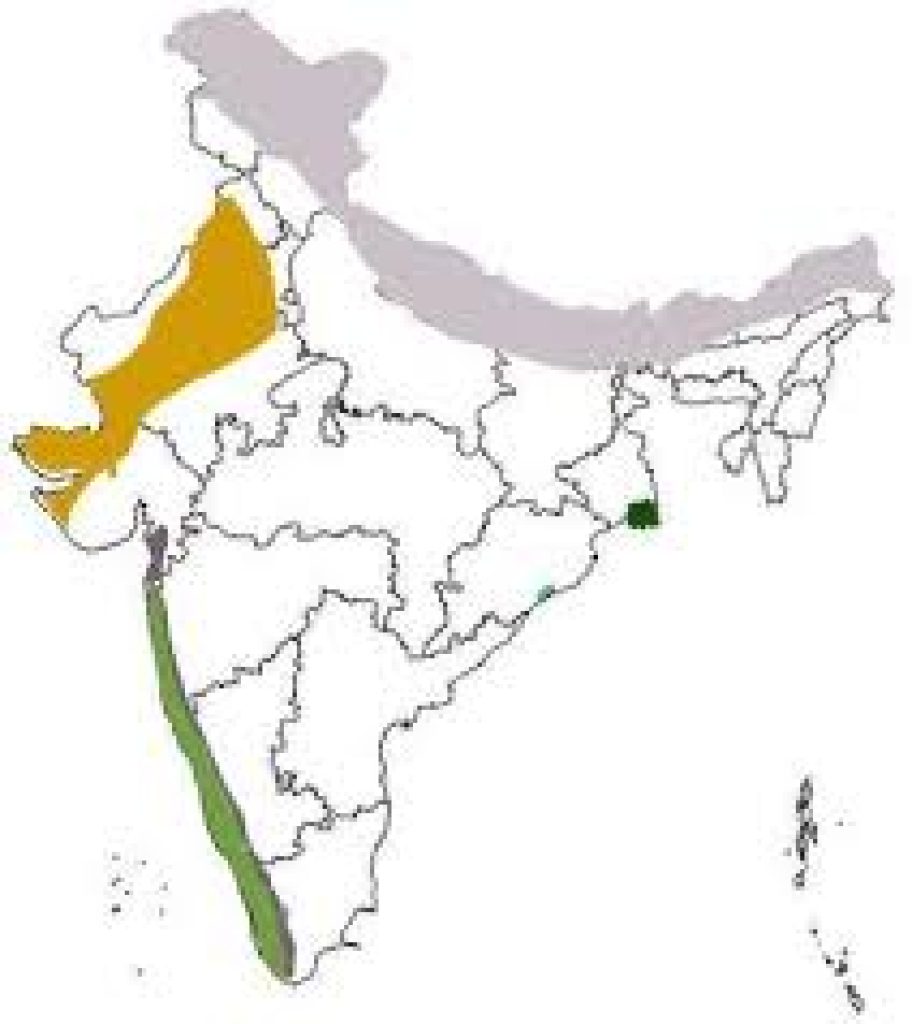
In following the criteria of an area being declared as Biodiversity Hotspot, there are four major biodiversity hotspots that are found in India:
1. The Himalayas
2. Indo-Burma Region
3. The Western Ghats
4. Sundaland
The Himalayas
The Himalayas (overall) is the highest in the world, comprising North-East India, Bhutan, Central and Eastern parts of Nepal. This area (NE Himalayas) has a record of hosting 163 endangered species including the Wild Asian Water Buffalo, One-horned Rhino; and a staggering number of 10,000 plant species with 3160 endemic. The mountain range covers nearly 750000 km2.
Indo – Burma
The Indo-Burma Region covers an area of 2,373,000 km². In the last 12 years, six large mammal species have been documented in this region; the Large-antlered Muntjac, the Annamite Muntjac, the Grey-shanked Douc, the Annamite Striped Rabbit, the Leaf Deer and the Saola.
Not only is this hotspot of important mammal species, it is also known to have endemic freshwater turtle species, with some being threatened with extinctions mostly because of over-harvesting and habitat loss. Meanwhile, there are 1300 additional bird species including the threatened White-eared Night-heron, the Grey-crowned Crocias, and the Orange-necked Partridge.
The Western Ghats
The Western Ghats are located on the western side of peninsular India and make up most of the deciduous forests and rain forests. According to UNESCO, the Western Ghats is home to a minimum of 325 globally threatened species, which include flora, fauna, birds, amphibians, reptiles and fish. Essentially all of this region used to have a total area of 190,000 km2 of vegetation but has now been reduced to 43,000 km2. Also, 229 plant species, 31 mammal species, 15 bird species, 43 amphibian species, 5 reptile species, and 1 fish species represent globally threatened flora and fauna in the region or the Western Ghats. As noted by UNESCO, “Of the total of 325 globally threatened species in the Western Ghats, 129 were classified as Vulnerable, 145 as Endangered, and 51 as Critically Endangered.”
Sundaland
The Sundaland hotspot is located in Southeast Asia which includes Singapore, Thailand, Indonesia, Brunei, and Malaysia. In 2013, the Sundaland was designated as a World Biosphere Reserve by the United Nations. Sundaland has a variety of exuberant terrestrial and marine ecosystems. Sundaland represents one of the most biologically rich hotspots in the world containing a total of 25,000 vascular plant species, and roughly 15,000 of these species are endemic to the region.