
Dyarchy System

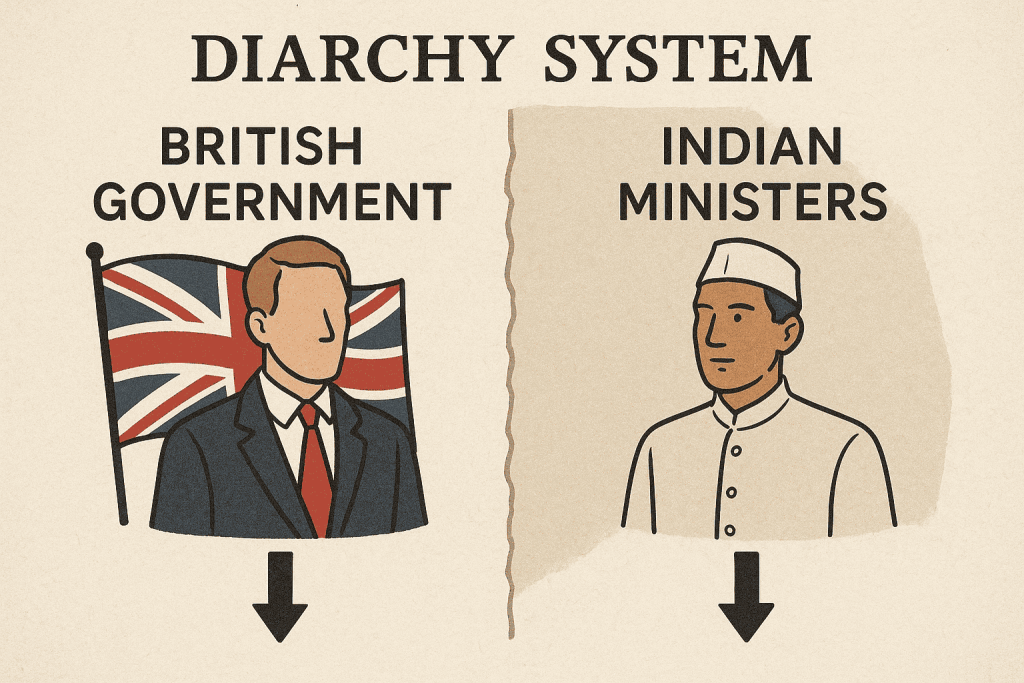
Dyarchy, introduced by the Government of India Act of 1919, was a system of dual government in British India’s provinces dividing executive responsibilities between British appointed officials (reserved subjects) and elected Indian ministers (transferred subjects).
To put it more clearly:
- Background:
The Government of India Act of 1919 (the Montagu-Chelmsford Reform), arose from the need to increase Indian involvement in governing. It formalised a dual arrangement (dyarchy) at the provincial level, and provided more independence for the provinces. - Dual Government:
Dyarchy created a dual arrangement of government within the provinces, split into: - Reserved Subjects: The Reserved subjects e.g. law and order, finance and land revenue were all under the control of the Governor appointed by the British and his executive council.
- Transferred Subjects: The Transferred subjects e.g. education, public health and local self-government which were done by elected Indian ministers, who were responsible to the provincial legislature.
Key Features:
- The provincial executive body was split into two distinct parts. Part accountable to legislature (Transferred subjects) and the other part not accountable (Reserved subjects).
- The Governor also had significant executive power, including veto powers and the authority to issue ordinances.
- The Secretary of State for India and the Governor-General could exert influence and control in respect of reserved subjects but not of transferred subjects.
- Significance:
- Dyarchy represents the first introduction of democratic principles to the executive branch of the British administration of India.
- Dyarchy was also an important part of a stepping stone towards a degree of Indian self-determination and eventual independence, to the dissatisfaction of Indian nationalists and British conservatives.
Abolition:
The system of dyarchy in the provinces was abolished with the introduction of provincial autonomy in 1935 by the Government of India Act of 1935.