
First Round Table Conference 1930

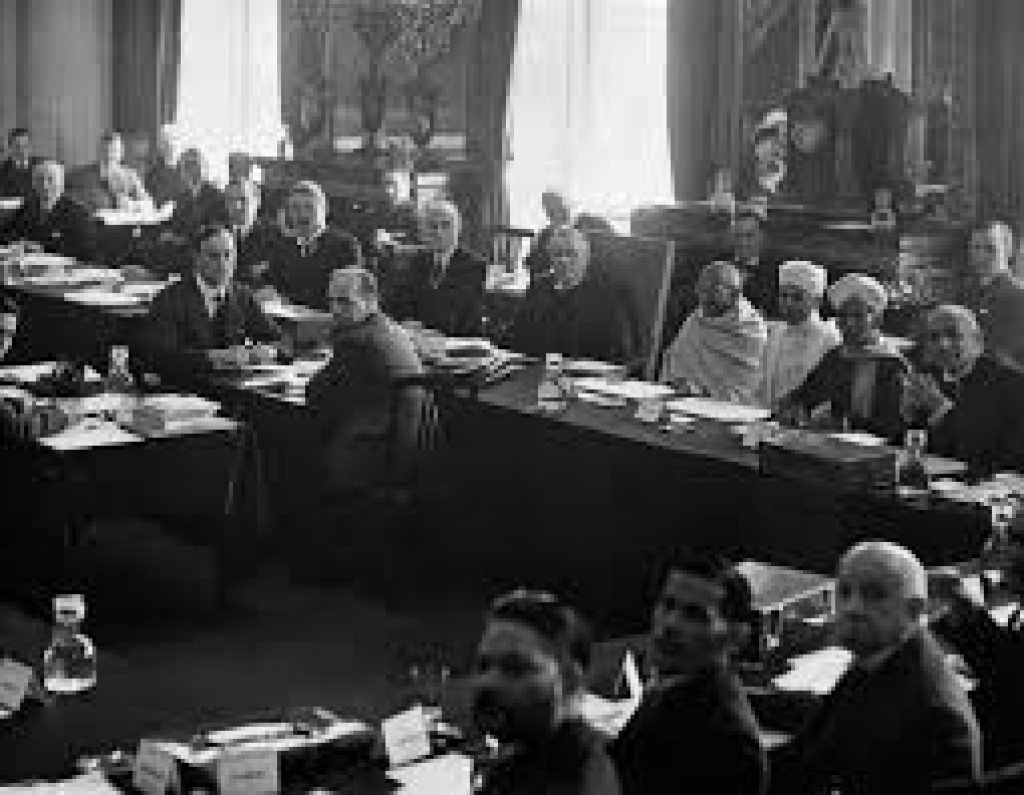
The first Round Table Conference was presided over by Ramsay MacDonald, the British Prime Minister. His Majesty George V inaugurated the event on November 12, 1930, at the Royal Gallery in the House of Lords, London. There were sixteen delegates from the three British political parties, along with 58 political figures from British India and 16 delegations from princely kingdoms in attendance.
Notes:
Chandradhar Barua represented Assam at the first Round Table Conference in London in 1930, which was held to discuss India’s future government.
At the Conference, there were 74 Indian delegates in attendance. Unfortunately, the Indian National Congress and several Indian business executives chose not to participate, as many were imprisoned for their involvement in the Civil Disobedience Movement. Tej Bahadur Sapru championed the concept of an All-India Federation, making it a key topic of discussion. Other important matters included the executive’s responsibility to the legislature and Dr. B.R. Ambedkar’s advocacy for a separate electorate for the Untouchables.
Overview:
| First Round Table Conference 1930 Overview | |
| Who opened the first Round Table Conference? | The first Round Table Conference convened by Labour Government Prime Minister Ramsay McDonald. |
| When was the first Round Table Conference held? | The first Round Table Conference convened from 12 November 1930 to 19 January 1931. |
| What issues were discussed in the first Round Table Conference? | The issue discussed were proposed Federal government, constitution of the province, Minorities Defence Services in Sindh and NWFP Provinces,proposed separate electorates for the ‘untouchables’,issues related to Burma, the notion of an All-India Federation |
| Why did Congress boycott the first Round Table Conference? | Because the British Government declined to call a Constituent Assembly to design a constitution for India, the Congress made the decision to boycott the First Round Table Conference. |