
Kargil Vijay Diwas

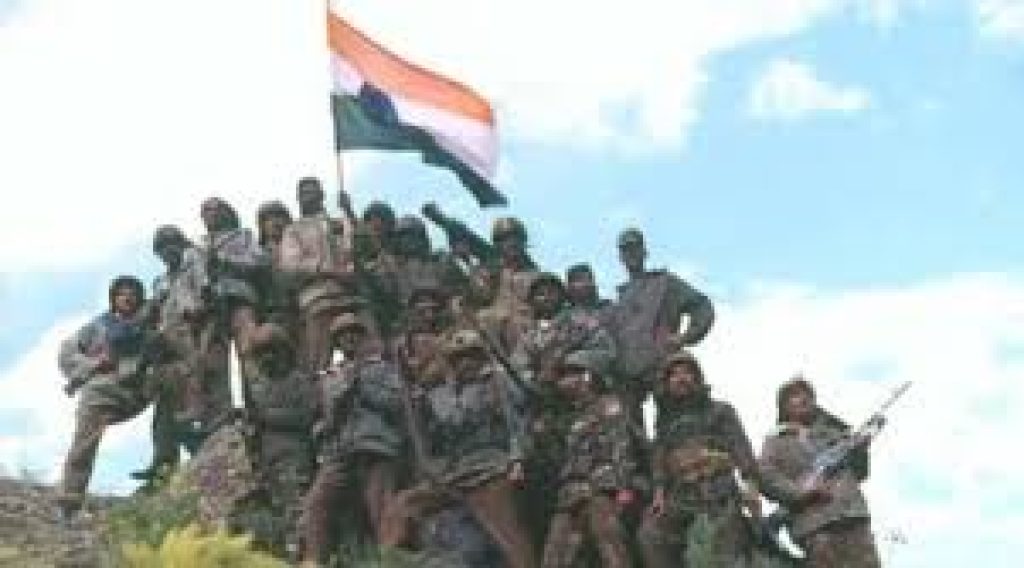
Kargil Vijay Diwas is observed each year on July 26 to honour the exceptional courage demonstrated by Indian armed forces personnel who ultimately gave for their country during the Kargil War (1999). This marks the end of the Kargil War, which took place from May 1999 to July 1999 between India and Pakistan.
What is Kargil Vijay Diwas?
About: Kargil Vijay Diwas or Kargil Victory Day is an important day marked each year on July 26 in India.
o The day celebrates India’s victory in the war with Pakistan in 1999 and pays homage to the courage and sacrifices borne by Indian soldiers in the war.
o The Kargil war of 1999 was both the first military confrontation in nuclearized SouthAsia, and arguably the first real war fought between two nuclearized states.
Background:
o India and Pakistan are no strangers to conflict, with one of the largest ones occurring in 1971 that was significant in the creation of Bangladesh.
o After the 1971 conflict North and East Pakistan became Bangladesh and Southern Pakistan became Pakistan, which were circumstances both countries have been trying to negotiate ever since, chiefly against one another and leading to competitions over territories like the Siachen glacier, through military outposts on nearby mountain ridges.
o India and Pakistan both conducted nuclear tests in 1998 and tensions escalated when Lahore Declaration was issued in February 1999 trying to negotiate the conflict over Kashmir through peace agreements, and bilateral resolutions.
o Winter of 1998 and 1999 involved the Pakistani armed forces covertly recruiting and training military personnel and deploying them across the Line of Control (LOC) to strategically gain ‘fortified’ positions to overlook NH 1A in the Drass and Batalik Sectors of Kargil, Ladakh.
o When Indian troops at the LOC engaged the infiltrators, they believed they were members of a terrorist group known as ‘jihadis’, but almost immediately recognized they were engaged with a well organized military attack.
- It was fought in the summer of 1999 along a 170km mountain frontier, stretching from Mashkoh Valley to Turtuk in the Kargil sector,
- In response, India launched Operation Vijay, deploying over 200,000 troops to the region to counter the incursion.
Significance of Kargil War Diwas:
- Since 1999, July 26 has been observed as Kargil Vijay Diwas to remember and honour the supreme sacrifices made by Indian soldiers during the war.
- The Kargil War memorial in Dras was built in 2000 by the Indian Army to commemorate the success of Operation Vijay in 1999.
- It was later renovated in 2014. It is also known as the “Dras War Memorial” due to its location in the town of Dras in the Kargil district of Jammu and Kashmir.
- The National War Memorial, inaugurated in 2019. It is dedicated to soldiers who sacrificed their lives in various conflicts and missions, including the Sino-Indian war in 1962, Indo-Pak wars in 1947, 1965, and 1971, Indian Peace Keeping Force Operations in Sri Lanka 1987-90, and the Kargil Conflict in 1999.
Impact of Kargil War:
- Global Recognition of the Line of Control (LoC): The international community largely recognized the LoC as the de facto border between India and Pakistan, reinforcing India’s stance on the territorial integrity of Jammu and Kashmir.
- Strengthened Strategic Partnerships: Kargil also marked the turning point in Indo- US relations. India was regarded as a responsible nuclear actor in the international arena leading to the next step in Strategic Partnership, culminating in the Indo-US Nuclear Deal.
- Diplomatic Gains: The war placed significant diplomatic pressure on Pakistan, culminating in a high-profile visit by Pakistan’s Prime Minister Nawaz Sharif to the U.S. on July 4, 1999, where he faced strong criticism from the US President. This international condemnation of Pakistan’s actions helped isolate it diplomatically.
- Highlighting Nuclear Diplomacy: The conflict brought global attention to the volatile relationship between India and Pakistan, especially concerning nuclear risks. The war underscored the potential for conflict escalation in a nuclear-armed region.
- Impact on Global Perception: The war highlighted India’s military capabilities and its ability to effectively manage and respond to regional conflicts, enhancing its global stature as a rising power with robust defence capabilities.