
Late Holocene Migration of the One-Horned Rhinoceros to Northeast India

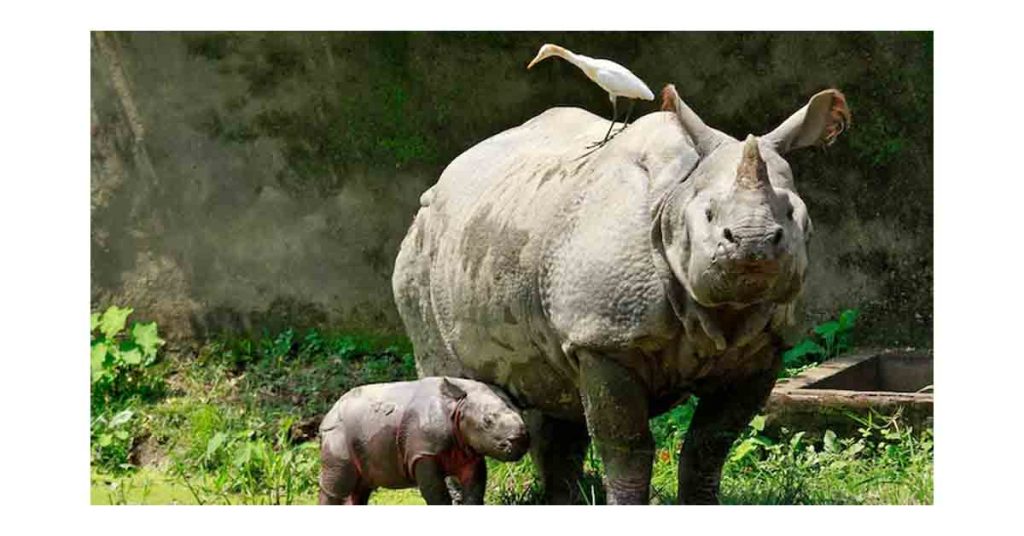
Scientific analysis of palaeoecological and palaeoherbivory records from Kaziranga National Park suggests that the Indian one-horned rhinoceros (Rhinoceros unicornis) migrated to Northeast India during the late Holocene period. The study indicates that improving climatic conditions in the Brahmaputra floodplains, combined with increasing human pressure in western and northern parts of the subcontinent, gradually pushed this megaherbivore eastward.
Using biotic proxies, researchers reconstructed long-term vegetation patterns and grazing histories, showing that Kaziranga’s grassland–wetland mosaic offered a stable refuge. The findings underline that present-day rhino distribution is not static but shaped by historical climate change and human–environment interactions.
Scientists from Birbal Sahni institution of Palaeosciences (BSIP), an autonomous institute of the Department of Science and Technology (DST), used pollens from mud below wetlands in KNP to trace the first long-term palaeoecological records in relation to the palaeoherbivory from KNP.
The study (published in journal, ‘Catena‘ (Elsevier)) highlights that Kaziranga’s present landscape differs markedly from its past and documents the regional extinction of megaherbivores, including the Indian rhinoceros, from northwestern India due to climatic amelioration during late Holocene, especially during the Little Ice Age and increasing human activities. In contrast, northeastern India remained relatively climatically stable, facilitating eastward migration and eventual concentration of rhinoceroses in Kaziranga.
The study which examined the reasons behind the decline and present confinement of megaherbivores, especially the Indian one-horned rhinoceros, to Kaziranga National Park shows through fossil evidence that the species was once widely distributed across the Indian subcontinent, but this distribution greatly reduced since the Holocene. Over the last ~3300 years, northeastern India remained relatively climatically stable with lower human pressure, while habitat loss, climate deterioration, and overhunting in northwestern regions forced rhinoceroses to migrate eastward and eventually concentrate in Kaziranga.