
Maharashtra Grants Agricultural Status to Livestock and Poultry Farming

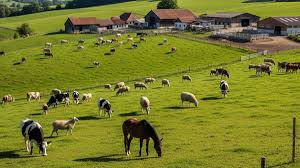
In a landmark policy shift, Maharashtra has become the first state in India to recognize livestock farming (including poultry) as agriculture. On July 11, 2025, the Maharashtra Cabinet approved the historic policy decision to recognize the importance of animal husbandry in rural development and the rural economy with a view to bringing equality to the rights of crop cultivators and livestock farmers.
The recognition, which was about 37 million livestock farmers will beneficiate from receiving frontier benefits, will open up livestock farmers to receive subsidies, lower tariffs, and institutional credit .
Importance of This Move
The recognition of livestock farming as agriculture will provide policy implications. Livestock farms will now receive agricultural tariff for agricultural electricity and will be able to avoid higher costs, which are previously charged to commercial businesses. Tax relief from local levies, credit eligibility, subsidies to solar equipment are allowed for the first time. The changes clearly recognize animal husbandry as an important pillar of agriculture.
Key features and benefits
• Electricity tariff will be paid for poultry sheds, fish ponds, and cattle shelters on agriculture subsidised agricultural rate.
• Tax relief will allow for local levies and access taxes to be charged at agriculture rates not commercial rates.
• Agricultural credit will allow livestock farmers to obtain Kisan Credit Cards (KCC) as well as agricultural loans at lower rates of interest as well as be eligible for other benefits in schemes, such as, Deshmukh Interest Relief Scheme.
• Subsided Solar equipment which will allow chickens to have chicken sheds that have infrastructure that has power to pump drinking water and other that also has power if there is a requirement.
Sector Impact
• Poultry: The reduction of electricity costs will allow broiler units and hatcheries to expand and increase production of meat and eggs.
• Dairy: This will support small and medium herd owners with reduced utility bills and better access to finances.
• Sheep & Goat: Important for marginal farmers, sheep and goats would improve its viability at agricultural tariffs.
• Fisheries: Aquaculture will benefit as well with improved access to subsides and utility costs.
Economic and policy impacts
The government estimates its move would add another ₹7,080 crore of annual income because of this policy development, which could revolutionise rural livelihood, while aligning with the agriculture-nominated policy priorities of ICAR and NITI Aayog, responding to the recommendation of scientific livestock development; a necessity for productivity, disease management and resilience. In addition, it is likely to provide value chain returns to milk, meat, eggs, leather, wool, and processed outputs.
Challenges
Despite the enthusiasm for this move, some experts have raised concerns about to what degree the action could be an action, given its effectiveness. It is important for government authorities to work on resolving issues around land-use class, zoning, and bureaucracy governing smallholder agriculture so that this could develop a more effective form of governing livestock policy. Monitoring of the implementers and building upon their capacity would also be important, so the benefits will trickle down to smallholder farmers.