
Rann of Kutch

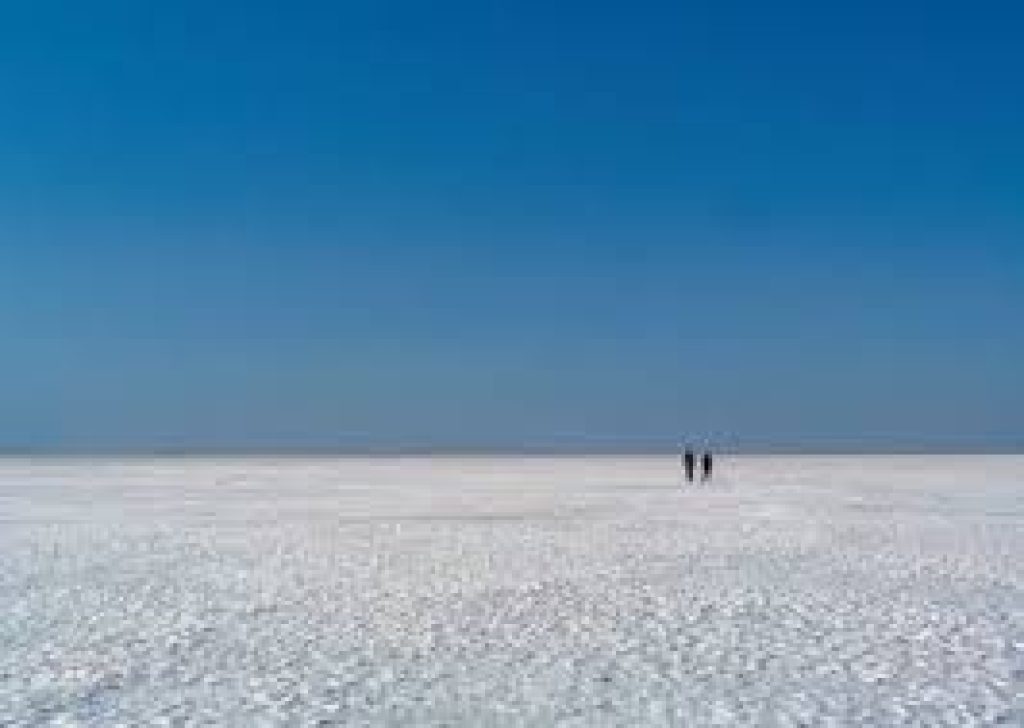
The Rann of Kutch is an extensive salt marsh found primarily in the Kutch district of the state of Gujarat in India, but it also extends a small bit into the Sindh province in Pakistan. The word for “desert” in Hindi is “Rann.”
Key aspects:
Geography:
• The Rann of Kutch is one of the largest salt deserts in the world. Its total area is about 26,000 square kilometers (10,000 square miles).
• It consists of the Great Rann of Kutch in the north, and the Little Rann of Kutch in the southeast side, which are separated from each other by the mainland of Kutch.
• The surface of the Rann is generally flat and very close to sea level, so there are frequent floods.
• It floods each year during the monsoon season (from June to September) because of local rainy and river runoff and becomes a wetland.
• When the rains stop, the flatness of the area allows for rapid evaporation and the entire area will become a white, cracked salt plain.
• There are elevated areas of sandy land (bets or medaks) which stay dry from flood waters.
• The Rann of Kutch is bounded by the Thar Desert to the north, the low hills of Kutch to the south, as well as the Arabian Sea to the west an the Gulf of Kutch to the southeast.
Climate:
• The Rann of Kutch has a semi-arid climate with distinct seasons.
• The summers (April – June) are extremely hot. Average temperatures are around 44 degrees celsius, with highs approaching 50 degrees celsius.
• The monsoon (June – September) brings concentrated rainfall.
•Winters (November to February) are cool and pleasant, with temperatures potentially dropping to or below freezing point at night, while daytime temperatures range from 10-28°C.
History:
• The region had been inhabited for centuries as far back as the Bronze Age, and the Indus Valley Civilization had several settlements here, including Dholavira, one of the largest Harappan sites occurring in India. Some scholars believe the Rann was an island archipelago that could be easily navigated during that time.
• The Rann was a shallow part of the Arabian Sea and geological uplift stilled its connection to the sea.
• The Ghaggar River once ran up into the Rann of Kutch.
• The region was within the boundaries of the Mauryan Empire, and subsequently the Gupta Empire.
• The Jadeja dynasty governed the area next until the British East India Company established control of the area in the 19th century.
• Mahatma Gandhi led protests against the British ban on salt harvesting in the Rann of Kutch.
• The northern boundary of the Great Rann of Kutch is part of the international boundary between India and Pakistan.
Ecology and Wildlife:
• Despite the harsh conditions, the Rann of Kutch is home to a unique ecosystem.
• The vegetation consists mainly of grassland and thorn scrub.
Wildlife includes:
• Indian wild ass,
• chinkara,
• nilgai,
• blackbuck,
• wolf,
• striped hyena,
• desert wildcat,
• caracal.
• The region is home to important bird watching sites, recorded over 200 species including flamingos.
• The Little Rann of Kutch has a link with the Indian Wild Ass Sanctuary.
Tourism and Culture:
• The Rann Utsav is a lively three-month-long festival occurring annually from December to February nearby Dhordo village, which highlights the local culture, handicrafts, music, and dance.
•Visitors can experience the unique landscape, especially under the full moon.
•Other attractions include Dholavira, Bhuj, and various wildlife sanctuaries.
•Local crafts like embroidery and weaving are significant to the Kutchi culture.