

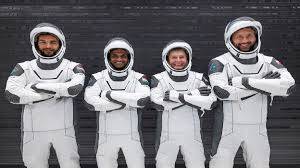
On 25 June 2025 at 12:01 pm IST, Group Captain Shubhanshu Shukla, Indian Air Force, began his ascent to the International Space Station on SpaceX’s Falcon 9 Block 5 from Launch Complex 39A, Kennedy Space Center. This is the second to have gone to space and the first Indian to live and work on the ISS.
Who Is Shubhanshu Shukla?
Shubhanshu Shukla was born on 10 October 1985, in Lucknow, Uttar Pradesh, graduated from the National Defence Academy in 2005, and joined the IAF Fighter Stream in June 2006. By March 2024 he was a Group Captain with over 2,000 hours of flying experience on combat aircraft like Su 30 MKI, MiG 21/29, Jaguar and Hawk, and a member of the Gaganyaan astronaut cadre through ISRO (Indian Space Research Organization) since 2019, completing training in Russia and Bengaluru, and joined the Ax 4 mission crew in early 2024.
Falcon 9 Block 5 & Crew Dragon: A Safe Pair
The Falcon 9 Block 5 rocket was certified by NASA in November 2020; it is a reusable, medium-lift rocket recognized for its 100% success rate for crewed missions and redundant systems. The mission uses a new Crew Dragon capsule, operated autonomously, resulting in the four-member international crew travelling to the ISS.
A Global Crew and Mission Objectives
The crew represents a truly global experience as Axiom 4 command will comprise former NASA astronaut Peggy Whitson, mission specialists from Poland and Hungary, and pilot Shukla. The crew is tasked to accomplish approximately 60 scientific experiments over 14 days, including seven designed in India, across microgravity, biology and materials science.
A Milestone for the Journey to Space for India
This mission is India’s first government backed presence on the ISS and its re-emergence to human spaceflight since Rakesh Sharma flew in 1984. This mission is also an extension of the Gaganyaan programme and firmly places India alongside other nations capable of traveling to space.
Technical Delays plus Final Countdown
The launch was delayed several times due to weather issues, technical, and safety checks including a liquid oxygen leak in early June. In the end, the team was able to resolve all matters and the final launch window for the mission opened on 25 June.