
Sixth Schedule

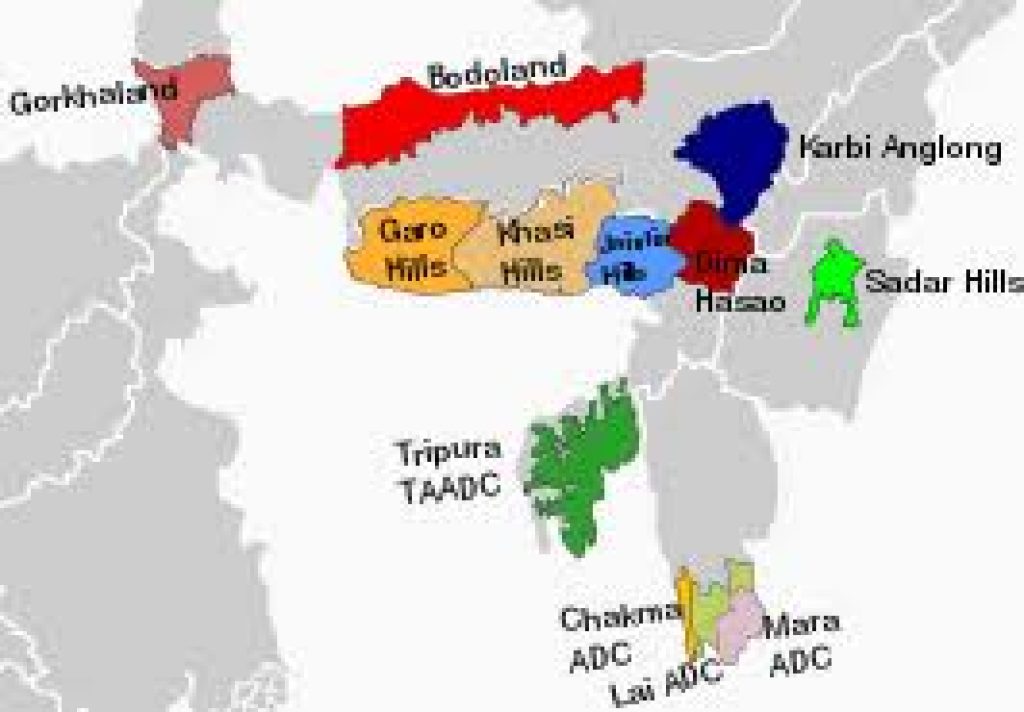
The Sixth Schedule of the Indian Constitution includes provisions related to the Administration of Tribal Areas in the States of Assam, Meghalaya, Tripura and Mizoram. The Sixth Schedule allows for the Administration of certain tribal areas in the form of Autonomous Districts and Autonomous Regions. The policies of the Sixth Schedule are included pursuant to Articles 244(2) and 275(1) of the Indian Constitution.
Sixth Schedule of Indian Constitution Introduction
- One important provision included in the Sixth Schedule is that these tribal areas are to be administered as an Autonomous District and Autonomous Regions.
- Under the provisions of the Sixth Schedule the Governor of the State will confirm which area or areas to be described as administrative units of Autonomous Districts or Autonomous Regions.
- The Governor of the state has the power to establish a new Autonomous District/Region or change the territorial jurisdiction or name of any Autonomous District or Autonomous Region.
- Originally, it consisted of two parts A and B, but at present, there are 10 such areas in four parts as listed below:
| Tribal Areas under Sixth Schedule of Indian Constitution | |
| Part I (Assam) | The North-Cachar Hills District (Dima Haolang) The Karbi-Anglong District The Bodoland Territorial Area District |
| Part II (Meghalaya) | The Khasi Hills District The Jaintia Hills District The Garo Hills District |
| Part II-A (Tripura) | The Tripura Tribal Areas District |
| Part III (Mizoram) | The Chakma District The Mara District The Lai District |
Features of the Sixth Schedule of the Indian Constitution
The various administrative characteristics contained in the Sixth Schedule are as follows:
- The tribal areas in the four states of Assam, Meghalaya, Tripura and Mizoram have been constituted as autonomous districts but are not outside the executive authority of the state concerned.
- In an autonomous district there may be different tribes, and the governor has the power to divide a district into several autonomous regions.
- Each Autonomous District shall have a District Council consisting of not more than thirty members, of whom four shall be nominated by the Governor, the others elected by adult franchise.
- Elected members will have a term of five years (unless the council is dissolved earlier) and the nominated members will hold office during the pleasure of the governor.
- Each autonomous region has its own Regional Council.
Administration of Tribal Areas - The Sixth Schedule provides for the establishment of Autonomous District Councils, and Regional Councils, with certain legislative, executive, judicial and financial powers.
- However, the administrative powers and duties of these District Council and Regional Council vary from State to State.
- The functions and powers of the District Council and Regional Councils as provided in the Sixth Schedule can be summarized as follows:
Importance of the Exclusive Provisions of Sixth Schedule
• There is logic in the exclusive provisions regarding only four states based on:
• The tribes in Assam, Meghalaya, Tripura and Mizoram assimilated very little into the lifestyle and ways of the other people in these states.
• These tribal areas have at that time been anthropological specimens.
• The tribal communities in other parts of India have to a greater extent adopted the culture of the dominant communities where they live.
• In contrast, the tribes in Assam, Meghalaya, Tripura and Mizoram retained their roots of culture, customs and civilization.
• The result being these tribal areas are treated differently by the Constitution of India and sizeable autonomy is provided to these tribal communities. As self-Governance.
• The majority of tribal societies recognised as “Scheduled Tribes” have been living in isolation on the hills and forests in various parts across the country.
• Thus making the governance of these tribal areas a recurring thorny affair.