
Somnath Temple — A Millennium of Faith, revival and continuity

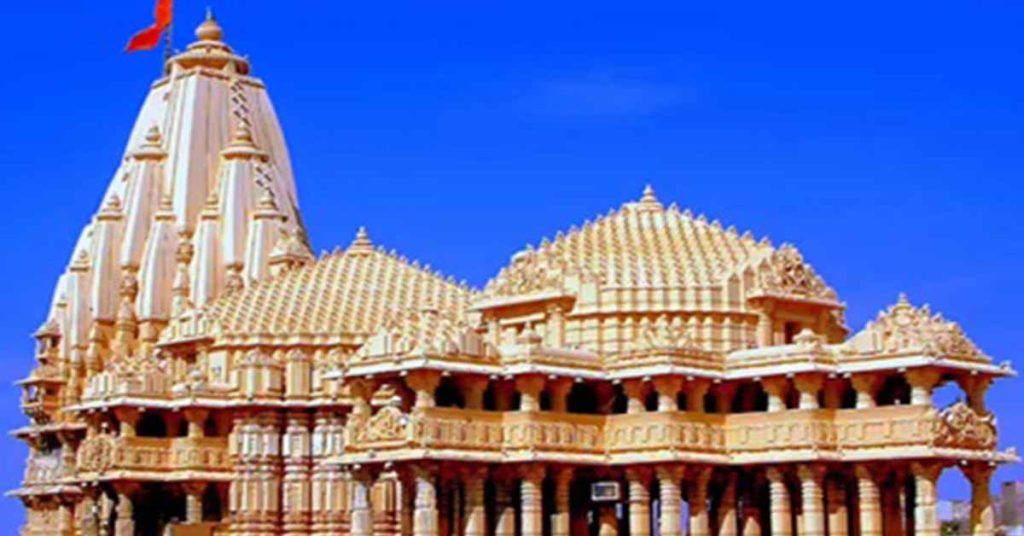
The Somnath temple’s history spans a thousand years since Mahmud of Ghazni’s raid in 1026. Despite repeated invasions in the medieval period, the shrine was rebuilt multiple times — notably under Kumarapala of the Solanki dynasty and later by the Chudasama rulers — symbolising continuity of faith and resilience.
After Independence, its reconstruction (1947–51) was revived by Sardar Vallabhbhai Patel. Architect Prabhashankar Sompura rebuilt the temple using traditional techniques, restoring Somnath as both a sacred space and a cultural emblem.
Key Facts Regarding the Somnath Temple
Location and Religious Importance
- Situated at Prabhas Patan, Gujarat, on the Arabian Sea coast
- Recognised as the first Jyotirlinga among the 12 sacred Jyotirlingas of Lord Shiva
- Mentioned in:
- Rig Veda
- Skanda Purana
- Shiva Purana
- Shreemad Bhagavatam
- Identified as the Neejdham Prasthan Leela Sthal, where Lord Krishna is believed to have undertaken his final earthly journey
Sacred Geography
- Located at the confluence of Kapila, Hiran, and Saraswati rivers with the sea
- The Tirth Stambh (Abadhit Samudra Marg) symbolises an uninterrupted sea route to the South Pole, reflecting ancient Indian astronomical and geographical knowledge
2026 Milestone: The year 2026 marks 1,000 years since the 1026 CE attack, with the “Somnath Swabhiman Parv” celebrating its enduring legacy of faith.