
AI Trading Strategies: The Complete Guide to AI-Powered Algorithmic Trading in 2026
Secondary Keywords:
- AI Trading Course
- AI Trading Nanodegree
- Machine Learning for Trading
- Reinforcement Learning Trading
- Algorithmic Trading Course
- Quantitative Trading
- Python Trading Course
- Stock Market AI
- AI for Finance
- Backtesting Trading Strategies
Artificial Intelligence is transforming the financial industry. From hedge funds to retail traders, AI-powered trading systems are helping investors analyze massive amounts of financial data, identify profitable opportunities, and execute trades with greater speed and accuracy than traditional methods.

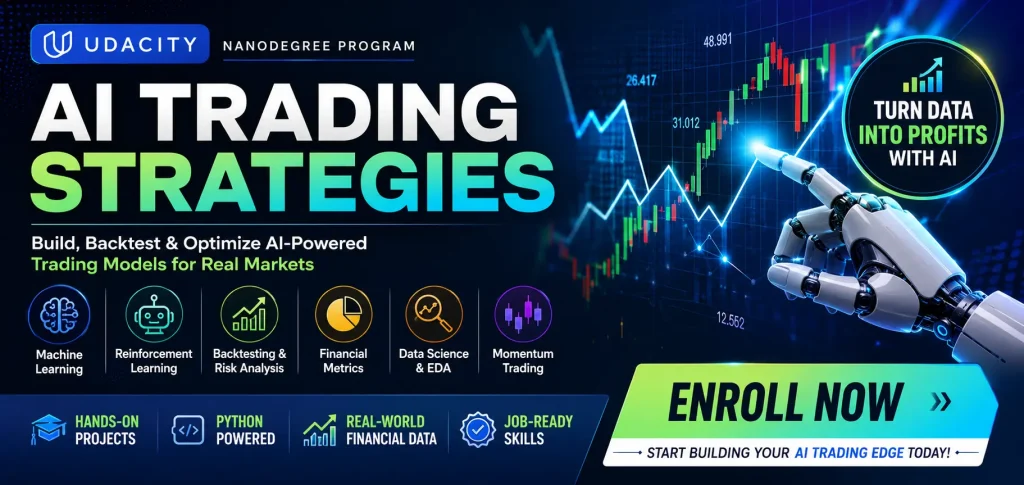
AI Trading Strategies: Learn to Build Intelligent Trading Systems Using Artificial Intelligence
If you’re interested in combining Python, machine learning, data science, and finance, the Udacity AI Trading Strategies Nanodegree is one of the most practical online programs available.
Instead of focusing solely on theory, this project-based program teaches you how to design, build, optimize, and backtest real AI trading models using industry-standard tools and techniques.
Whether you’re an aspiring quantitative analyst, data scientist, software engineer, or active trader, this program provides the skills needed to develop intelligent trading systems for today’s financial markets.
Why AI is Revolutionizing Trading
Traditional trading strategies often rely on fixed rules and historical analysis. AI-powered trading takes this a step further by allowing algorithms to:
- Learn from historical market data
- Detect hidden market patterns
- Adapt to changing market conditions
- Improve predictions over time
- Automate portfolio decisions
- Reduce emotional bias
- Optimize trading performance
Today, investment firms increasingly rely on machine learning engineers, quantitative researchers, and AI specialists to develop next-generation trading systems.
What You’ll Learn
The AI Trading Strategies Nanodegree covers the complete lifecycle of an AI trading model.
You’ll learn how to:
- Build machine learning pipelines
- Clean and preprocess financial datasets
- Engineer predictive features
- Create supervised learning models
- Apply unsupervised learning techniques
- Build reinforcement learning trading agents
- Backtest investment strategies
- Measure portfolio performance
- Optimize AI models
- Deploy robust trading solutions
Unlike many introductory AI courses, this program focuses entirely on financial markets.
Course Curriculum
1. Building an AI Workflow for Trading
Every successful AI trading system begins with a structured workflow.
You’ll learn:
- Preparing financial datasets
- Trading signal generation
- Machine learning workflows
- RSI trading algorithms
- Model development lifecycle
- Backtesting basics
Topics Covered
- AI workflows
- Financial datasets
- Supervised learning
- Unsupervised learning
- Reinforcement learning
- Trading indicators
2. Machine Learning for Trading
The course introduces multiple machine learning techniques used in quantitative finance.
Supervised Learning
Learn how to predict future market behavior using:
- Linear Regression
- Logistic Regression
- Decision Trees
- Classification Models
You’ll also understand:
- Training vs testing data
- Cross validation
- Bias vs variance
- Model evaluation
Unsupervised Learning
Discover hidden relationships within financial data.
Topics include:
- K-Means Clustering
- Principal Component Analysis (PCA)
- Portfolio grouping
- Risk factor identification
These methods help traders discover market structures that aren’t immediately visible.
Reinforcement Learning
One of the most exciting parts of the program.
Instead of predicting prices directly, reinforcement learning allows an AI agent to learn trading decisions through interaction with historical market data.
You’ll study:
- Q-Learning
- Deep Q Networks (DQN)
- Reward functions
- State spaces
- Action spaces
- Trading environments
Preparing Financial Data
Good data produces good models.
This section teaches professional data preparation techniques.
You’ll learn:
- Data cleaning
- Missing value handling
- Feature engineering
- Data normalization
- Data transformation
- Time-series preprocessing
Python libraries include:
- Pandas
- NumPy
- Plotly
- Matplotlib
These tools are widely used in quantitative finance.
Exploratory Data Analysis (EDA)
Before building a model, traders need to understand their data.
You’ll learn how to:
- Visualize stock prices
- Identify trends
- Detect anomalies
- Explore correlations
- Analyze distributions
- Create interactive charts
EDA helps uncover valuable insights before training machine learning models.
Feature Engineering for AI Trading
Feature engineering is often more important than choosing the algorithm itself.
You’ll learn how to create trading features such as:
- Moving averages
- RSI
- Momentum
- Volatility
- Lagged returns
- Price ratios
- Volume indicators
Better features often lead to significantly improved prediction accuracy.
Evaluating Trading Performance
Many beginners focus only on profits.
Professional traders focus on risk-adjusted returns.
The course teaches industry-standard metrics including:
Annualized Return
Measures yearly investment performance.
Volatility
Shows the variability of returns.
Sharpe Ratio
Evaluates returns relative to total risk.
Sortino Ratio
Focuses specifically on downside risk.
Calmar Ratio
Measures return against maximum drawdown.
Maximum Drawdown
Calculates the largest portfolio loss from peak to trough.
Understanding these metrics is essential for building robust trading systems.
Backtesting Trading Strategies
Backtesting allows traders to evaluate strategies using historical market data before risking real capital.
You’ll learn:
- Walk-Forward Validation
- Portfolio simulation
- Strategy visualization
- Risk analysis
- Performance comparison
Proper backtesting helps identify weaknesses and reduce overfitting.

Reinforcement Learning Trading Project
One of the highlights of the program is building an AI trading agent from scratch.
You’ll:
- Create financial states
- Design trading actions
- Build a Q-learning model
- Train the agent
- Evaluate performance
- Optimize rewards
- Backtest strategies
This project closely resembles real-world quantitative research.
Optimizing AI Models
Machine learning models rarely perform well on the first attempt.
The course teaches optimization techniques including:
- Hyperparameter tuning
- Grid Search
- Random Search
- Regularization
- Model monitoring
- Drift detection
- Performance evaluation
These techniques improve model robustness in changing market conditions.
Momentum-Based Trading
Momentum investing remains one of the most widely used quantitative strategies.
You’ll learn:
- Momentum indicators
- Statistical hypothesis testing
- Geometric Brownian Motion
- Monte Carlo Simulation
- Black-Scholes Model
- Confidence intervals
You’ll also build a complete momentum trading system using Python.
Hands-On Projects
Practical projects include:
- Data transformation for trading models
- Exploratory data analysis
- Dynamic investment strategy backtesting
- Reinforcement learning trading agent
- AI stock prediction model optimization
- Momentum trading algorithm for the S&P 500
These portfolio projects demonstrate real-world skills to employers.
Programming Tools You’ll Use
Throughout the course, you’ll work with:
- Python
- Pandas
- NumPy
- SciPy
- Matplotlib
- Plotly
- SQLite
- MySQL
- YFinance
- Jupyter Notebook
These are among the most widely used technologies in quantitative finance and machine learning.
Who Should Take This Course?
This Nanodegree is ideal for:
- Data Scientists
- Python Developers
- Software Engineers
- Financial Analysts
- Quantitative Researchers
- Stock Market Enthusiasts
- Algorithmic Traders
- Machine Learning Engineers
- AI Developers
- Finance Professionals
Prerequisites
To get the most from this course, you should have:
- Basic Python programming
- High school mathematics
- Basic statistics
- Introductory machine learning knowledge
- Interest in financial markets
Prior trading experience is helpful but not mandatory.
Career Opportunities
Completing this program can prepare you for roles such as:
- Quantitative Analyst
- Algorithmic Trader
- Machine Learning Engineer
- AI Research Engineer
- Financial Data Scientist
- Quant Developer
- Risk Analyst
- Portfolio Analyst
As AI adoption grows across finance, demand for these skills continues to increase.
The Udacity AI Trading Strategies Nanodegree is an excellent choice for learners who want practical experience at the intersection of artificial intelligence, machine learning, and quantitative finance. With a strong emphasis on real-world projects, Python programming, and rigorous backtesting, it equips you with the skills to design, evaluate, and optimize AI-driven trading systems.
Whether your goal is to pursue a career in quantitative finance or build your own algorithmic trading strategies, this program provides a solid foundation and hands-on experience that can help you stand out in a rapidly evolving field.
Frequently Asked Questions (FAQ)
Is this course suitable for beginners?
It is best suited for learners with basic Python programming and an understanding of statistics. Beginners can still benefit but may need to strengthen these prerequisites first.
Do I need trading experience?
No. While familiarity with financial markets is helpful, the course explains core trading concepts and emphasizes practical implementation.
What programming language is used?
Python is the primary language, along with popular libraries such as Pandas, NumPy, Matplotlib, Plotly, and SciPy.
Will I build real projects?
Yes. The Nanodegree includes multiple hands-on projects, including reinforcement learning trading agents, momentum-based strategies, and AI model optimization.
Can this help me get a job?
The portfolio projects and practical skills align well with roles in quantitative finance, algorithmic trading, machine learning, and financial data science.