
Amrit Sarovar Scheme

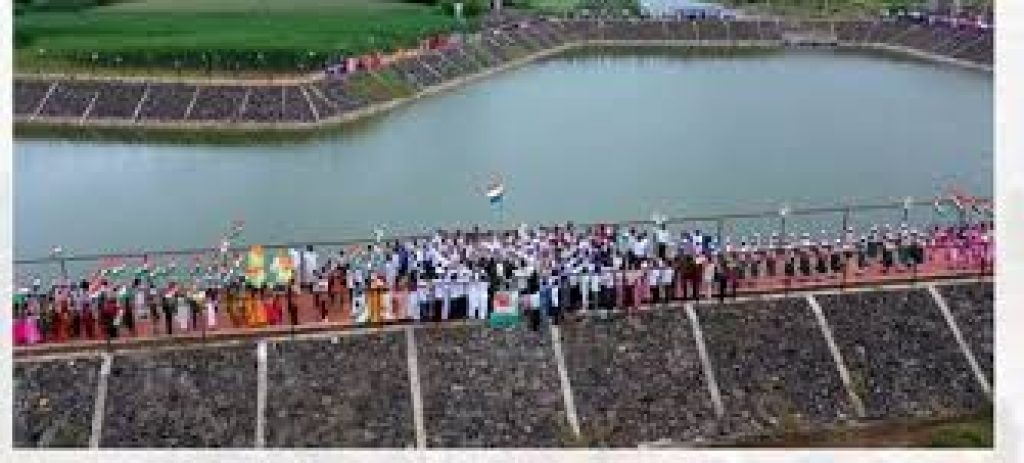
Mission Amrit Sarovar, which was initiated in April 2022, pledged to construct or rejuvenate 75 Amrit Sarovars (ponds) in each district, for a total of 50,000 ponds all across the country. Each Amrit Sarovar was to have a pondage area of about 1 acre (except in hill states/UTs), and a water holding capacity of some 10,000 cubic meters (except in hill states).
As on 20-03-2025, more than 68,000 Amrit Sarovars have been completed, a State-wise detail of which is at Annexure. This initiative played an important role in addressing the serious issue of water scarcity and improving surface and ground water availability in various places. These Sarovars provided immediate water needs, but they also created sustainable water sources and represented the Government commitment to environmental sustainability and community welfare over time.
Mission Amrit Sarovar works are being taken up by the States and Districts in convergence with various ongoing Schemes like Mahatma Gandhi National Rural Employment Guarantee Scheme (Mahatma Gandhi NREGS), 15th Finance Commission Grants, Pradhan Mantri Krishi Sinchayi Yojna themes such as Watershed Development Component, Har Khet ko Pani and also the States own schemes. The work can also involve public participation via crowdfunding and in ways of Corporate Social Responsibility.
Phase II of Mission Amrit Sarovar is to continue with a renewed -focus ensuring water is available, with community participation (Jan Bhagidaari), and also strengthening climate resilience, facilitating ecological balance and thus providing benefits for generations to come.
Peoples’ participation has been the key to the entire Mission. To encourage mobilization of citizens and non- Government resources for supplementing the Government’s efforts to achieve the target, explicit provisions have been made in the guidelines of the Mission Amrit Sarovar as follows:
- Laying the foundation stone for the Amrit Sarovar to be led by freedom fighter or her/his family member or by the family of martyr (post-independence) or a local Padma awardee, and in case no such citizen is available, by the eldest member of the local Gram Panchayat.
- Provision for people to participate by donating construction material, benches and by Shram Daan.
- If village community so desires, beautification works on the Sarovar site may mobilize necessary donations through crowd sourcing and CSR contributions.
- Provision has been made that on the occasion of Independence Day/ Republic Day, Tricolour to be hoisted at each Amrit Sarovar site, by the freedom fighter or his/her family member or by the family member of martyr or a local Padma Awardee. On Amrit Sarovar sites, National events are also being celebrated.
- Possible users of such water structure, including for irrigation, fishery or water chestnut cultivation, should be identified and creation of their group are encouraged.
According to the Mission Amrit Sarovar guidelines, maintaining and sustaining Amrit Sarovars requires the mapping and formation of user groups at each waterbody that largely consist of SHG members, and these user groups should be identified and coordinated properly so that the sarovars can be used and maintained appropriately. The user group will be responsible for the continuous utilization and maintenance of the Amrit Sarovar, including maintenance of any plantation activity. The user groups should voluntarily remove any silt from the catchment area after every monsoon.