

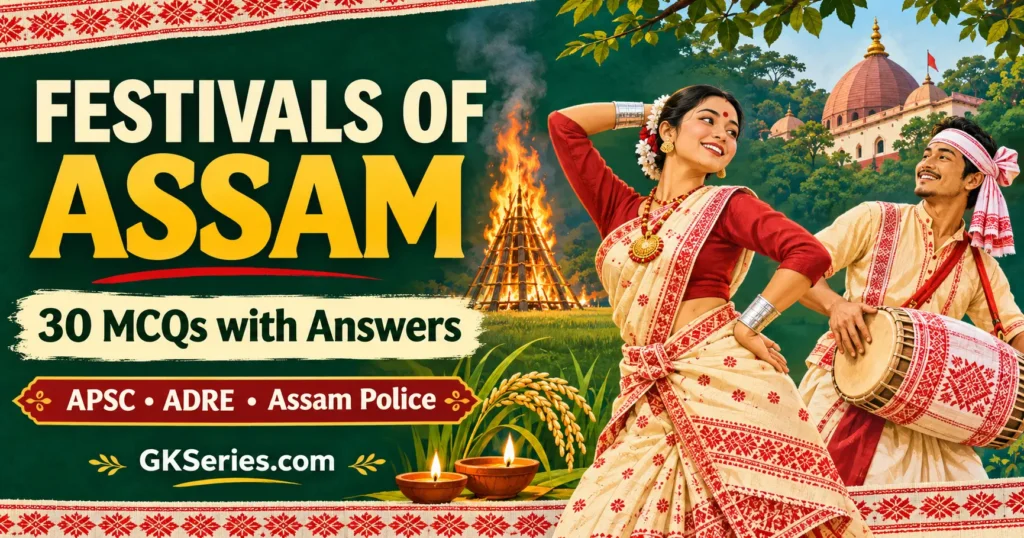
Festivals of Assam: 30 MCQs with Answers
Assam’s festivals reflect its farming seasons, community traditions and religious life. Bohag Bihu welcomes the Assamese New Year, Magh Bihu brings post-harvest feasting, and Kati Bihu is associated with lamps and prayers for growing crops. Other celebrations include Ali-Aye-Ligang of the Mising community, Bwisagu of the Bodos and the barter exchanges of Jonbeel Mela. These 30 questions on Festivals of Assam help you practise festival names, community associations, locations and customs. They are useful for APSC Prelims, ADRE, Assam Police and other state recruitment examinations. Read the explanations carefully to distinguish festivals with similar names or overlapping seasons.
Overview
Bihu is closely connected with Assam’s agricultural calendar, while many communities also maintain their own festivals. The Mising community celebrates Ali-Aye-Ligang, the Karbis observe Rongker, and the Dimasas celebrate Busu Dima. Religious gatherings include Ambubachi Mela at Kamakhya Temple, Krishna-centred Raas performances in Majuli and Buddhist celebrations among Tai communities. Festivals of Assam also include fairs such as Jonbeel Mela, where traditional barter remains a central attraction. For examination revision, connect each festival with its community, purpose and location. Remember that customary seasons and annual event dates are different, and local practices can vary.
One-Liner Points
- Assam’s three major Bihus are Bohag Bihu, Magh Bihu and Kati Bihu.
- Bohag Bihu is generally celebrated around mid-April.
- Magh Bihu is generally celebrated around mid-January.
- Kati Bihu is generally observed around mid-October.
- Magh Bihu is also called Bhogali Bihu.
- The meji bonfire is associated with Magh Bihu.
- Kati Bihu is also called Kongali Bihu.
- Lighting lamps near the tulsi plant and in paddy fields is associated with Kati Bihu.
- Bohag Bihu is also called Rongali Bihu.
- Bohag Bihu marks the Assamese New Year and the arrival of spring.
- Ali-Aye-Ligang is a sowing festival of the Mising community.
- Baishagu, also written Bwisagu, is associated with the Bodo community.
- Garjasali is associated with community prayer during Baishagu.
- Baikho is a festival of the Rabha community, commonly observed in May–June.
- Rongker is an important festival of the Karbi community.
- Ambubachi Mela is held at Kamakhya Temple in Guwahati.
- Majuli’s Raas Leela depicts episodes from the life of Lord Krishna.
- Rajini Gabra and Harni Gabra are associated with the Dimasa community.
- Bohaggiyo Bishu is a spring festival of the Deori community.
- Jonbeel Mela is known for the barter exchange of goods.
- Jonbeel Mela is closely associated with the Tiwa community.
- Busu Dima is a major festival of the Dimasa community.
- Bwisagu marks the beginning of the Bodo New Year.
- Bathow Puja is associated with the Bodo-Kachari community.
- Kherai is an important Bodo religious observance.
- The Dehing Patkai Festival is associated with Lekhapani in Tinsukia district.
- Bihu has broad participation across communities in Assam.
- Uruka is the eve of Magh Bihu.
- Goru Bihu is the first day of the traditional Rongali Bihu sequence.
- Manuh Bihu follows Goru Bihu and falls on the first day of Bohag.
- Magh Bihu celebrates the abundance associated with the winter harvest.
- Bohag Bihu is traditionally described as a seven-day celebration.
- The Dehing Patkai Festival takes its name from the Dehing River and Patkai range.
- Poi-Nun-Hok at Namphake is associated with the Tai Phake community.
- Poi Sangken is a Buddhist New Year water festival observed by Tai Khamti and Tai Phake communities.
- Barpeta’s Doul Utsav is also known as Fakuwa or Holi.
- Assam Tourism identifies Bansai Buddhist village at Balipathar, Bokajan, with the Sanken festival.
ASSAM HISTORY MCQS WITH ANSWERS
Festivals of Assam MCQs with Answers and Detailed Explanations
Question 1: Consider the following pairs of Bihu festivals and their usual months:
- Bohag Bihu — Bohag
- Magh Bihu — Magh
- Kati Bihu — Kati
Which of the pairs are correctly matched?
(a) 1 and 2 only
(b) 2 and 3 only
(c) 1 and 3 only
(d) 1, 2 and 3
Correct Answer: (d) 1, 2 and 3
Detailed Explanation:
All three pairs are correct. Bohag Bihu is celebrated around the beginning of Bohag, usually in mid-April. Magh Bihu is associated with Magh and mid-January, while Kati Bihu is associated with the transition into Kati around mid-October. Together, they mark different stages of Assam’s agricultural year. These are customary month associations; precise calendar dates can vary.
Key Points for Revision
- Bohag Bihu — Bohag, around mid-April.
- Magh Bihu — Magh, around mid-January.
- Kati Bihu — Kati, around mid-October.
- The three Bihus have different agricultural associations.
Question 2: Which object is traditionally associated with the communal bonfire and post-harvest observances of Magh Bihu?
(a) Meji
(b) Jaapi
(c) Xorai
(d) Gogona
Correct Answer: (a) Meji
Detailed Explanation:
A meji is a temporary structure traditionally burnt during Magh Bihu observances. Magh Bihu, also called Bhogali Bihu, is associated with feasting and post-harvest abundance. The other options are different cultural objects: a jaapi is traditional headgear, a xorai is a ceremonial offering tray, and a gogona is a musical instrument.
Key Points for Revision
- Meji — Magh Bihu bonfire structure.
- Magh Bihu is also called Bhogali Bihu.
- Jaapi — traditional headgear.
- Xorai — offering tray; gogona — musical instrument.

Question 3: Which Bihu is associated with lighting lamps in paddy fields and near the tulsi plant during a lean period in the agricultural cycle?
(a) Bohag Bihu
(b) Kati Bihu
(c) Magh Bihu
(d) Baishagu
Correct Answer: (b) Kati Bihu
Detailed Explanation:
Kati Bihu is associated with lighting lamps near the tulsi plant, in homes and in agricultural fields. It is also known as Kongali Bihu and falls during a comparatively lean period, before the main winter harvest has been gathered. Its observances emphasise prayer, protection of crops and hope for a good harvest.
Key Points for Revision
- Kati Bihu is also called Kongali Bihu.
- It is observed around mid-October.
- Lamps are associated with its observances.
- It precedes the main winter harvest.
Question 4: Which of the following best describes Bohag Bihu?
(a) A winter harvest festival held in Magh
(b) A spring festival associated with the Assamese New Year
(c) A festival of the Mising community associated with sowing
(d) A festival centred on Kamakhya Temple during the monsoon
Correct Answer: (b) A spring festival associated with the Assamese New Year
Detailed Explanation:
Bohag Bihu, also called Rongali Bihu, welcomes spring and the Assamese New Year. It is celebrated around mid-April. Option (a) describes Magh Bihu, while option (c) points to Ali-Aye-Ligang. Option (d) describes Ambubachi Mela at Kamakhya Temple.
Key Points for Revision
- Bohag Bihu — Rongali Bihu.
- Season: Spring.
- Occasion: Assamese New Year.
- Usual period: Mid-April.
Question 5: Ali-Aye-Ligang is principally associated with which community of Assam?
(a) Rabha
(b) Mising
(c) Karbi
(d) Bodo
Correct Answer: (b) Mising
Detailed Explanation:
Ali-Aye-Ligang is a spring agricultural festival of the Mising community. It marks the beginning of sowing and is traditionally observed on the first Wednesday of Gimur Polo, corresponding to Phagun in the Assamese calendar, generally in February. Its agricultural purpose helps distinguish it from harvest celebrations held after crops have been gathered.
Key Points for Revision
- Ali-Aye-Ligang — Mising community.
- It marks the beginning of sowing.
- Traditional timing: First Wednesday of Gimur Polo.
- It generally falls in February.
Question 6: Consider the following statements about Baishagu:
- It is associated with the Bodo community.
- It is celebrated around mid-April.
- A community prayer called Garjasali is associated with it.
Which of the statements given above are correct?
(a) 1 only
(b) 1 and 2 only
(c) 2 and 3 only
(d) 1, 2 and 3
Correct Answer: (d) 1, 2 and 3
Detailed Explanation:
Statement 1 is correct: Baishagu is a major festival of the Bodo community.
Statement 2 is correct: It is celebrated around mid-April and marks the arrival of the Bodo New Year.
Statement 3 is correct: Official cultural and tourism descriptions associate Garjasali with community prayer during the festival.
All three statements are therefore correct.
Key Points for Revision
- Baishagu — Bodo community.
- Usual period: Mid-April.
- It welcomes the Bodo New Year.
- Garjasali is associated with community prayer.
Question 7: Which community is associated with the festival Baikho?
(a) Mising
(b) Dimasa
(c) Rabha
(d) Karbi
Correct Answer: (c) Rabha
Detailed Explanation:
Baikho is associated with the Rabha community. Its rituals include prayers for agricultural prosperity and community well-being. The original question described it simply as a spring festival. That seasonal qualifier has been removed because Assam Tourism places its observance in May–June, making the community association the clearer fact to test.
Key Points for Revision
- Baikho — Rabha community.
- It has agricultural and religious significance.
- It is commonly observed in May–June.
- Ali-Aye-Ligang belongs to the Mising community.
Question 8: Rongker is an important festival of which community of Assam?
(a) Karbi
(b) Bodo
(c) Mising
(d) Rabha
Correct Answer: (a) Karbi
Detailed Explanation:
Rongker is an important festival of the Karbi community. It is associated with community rituals and prayers for collective welfare. For comparison, Baishagu belongs to Bodo traditions, Ali-Aye-Ligang to Mising traditions, and Baikho to Rabha traditions.
Key Points for Revision
- Rongker — Karbi community.
- Baishagu — Bodo community.
- Ali-Aye-Ligang — Mising community.
- Baikho — Rabha community.
Question 9: Ambubachi Mela is held at which major religious site in Assam?
(a) Hayagriva Madhava Temple, Hajo
(b) Kamakhya Temple, Guwahati
(c) Umananda Temple, Peacock Island
(d) Sivadol, Sivasagar
Correct Answer: (b) Kamakhya Temple, Guwahati
Detailed Explanation:
Ambubachi Mela is held at Kamakhya Temple on Nilachal Hill in Guwahati. It is a major annual religious gathering during the monsoon, generally in June. Its observance is connected with the sacred fertility traditions of Goddess Kamakhya. The other temples are important religious sites but are not the venue of this mela.
Key Points for Revision
- Ambubachi Mela — Kamakhya Temple.
- Location: Nilachal Hill, Guwahati.
- Usual month: June.
- Season: Monsoon.
Question 10: The Raas Leela festival performed in Majuli mainly depicts episodes from the life of which religious figure?
(a) Lord Rama
(b) Lord Shiva
(c) Lord Krishna
(d) Lord Buddha
Correct Answer: (c) Lord Krishna
Detailed Explanation:
Majuli’s Raas Leela presents episodes from the life of Lord Krishna through devotional drama, music and dance. It forms part of the island’s Vaishnavite cultural tradition. Satras, or Vaishnavite religious and cultural institutions, play an important role in these performances. The festival is generally associated with the autumn period of October–November.
Key Points for Revision
- Majuli Raas Leela — Lord Krishna.
- Tradition: Vaishnavite.
- Performances combine drama, music and dance.
- Satras are important centres of celebration.
Question 11: Rajini Gabra and Harni Gabra are festivals associated with which community of Assam?
(a) Deori
(b) Dimasa
(c) Rabha
(d) Mising
Correct Answer: (b) Dimasa
Detailed Explanation:
Rajini Gabra and Harni Gabra are associated with the Dimasa community. They should be distinguished from Bohaggiyo Bishu of the Deoris, Baikho of the Rabhas and Ali-Aye-Ligang of the Misings. Learning these community–festival pairs helps with both direct questions and matching exercises.
Key Points for Revision
- Rajini Gabra — Dimasa community.
- Harni Gabra — Dimasa community.
- Bohaggiyo Bishu — Deori community.
- Baikho — Rabha community.
Question 12: Bohaggiyo Bishu is a spring festival of which community?
(a) Deori
(b) Karbi
(c) Bodo
(d) Dimasa
Correct Answer: (a) Deori
Detailed Explanation:
Bohaggiyo Bishu is a spring festival of the Deori community. It is also encountered under names such as Deori Bihu or Ebaku Bishu. The celebration traditionally begins on the first Wednesday of Bohag. Although its season overlaps with other New Year celebrations, its community traditions are distinct.
Key Points for Revision
- Bohaggiyo Bishu — Deori community.
- It is a spring celebration.
- Traditional starting day: First Wednesday of Bohag.
- Ebaku Bishu is another associated name.
Question 13: Which traditional practice is a distinctive feature of Jonbeel Mela?
(a) Auctioning of royal elephants
(b) Barter exchange of goods
(c) Boat racing on the Brahmaputra
(d) Mask-making competitions
Correct Answer: (b) Barter exchange of goods
Detailed Explanation:
Jonbeel Mela is known for barter, meaning the direct exchange of goods without money in those transactions. Participants bring products and exchange them with others at the fair. This traditional practice is a central feature of the mela, though it does not mean that every transaction throughout the wider fair must be cashless.
Key Points for Revision
- Jonbeel Mela — traditional barter.
- Barter means exchanging goods directly.
- The fair is associated with the Morigaon region.
- It brings together hill and plains communities.
Question 14: Jonbeel Mela is most closely associated with which community?
(a) Tiwa
(b) Mising
(c) Deori
(d) Karbi
Correct Answer: (a) Tiwa
Detailed Explanation:
Jonbeel Mela is most closely associated with the Tiwa community and the traditional institution of the Gobha Raja. It is held near Jagiroad in Morigaon district. Although people from several communities participate, the fair’s historical and cultural association with the Tiwas is the answer sought here.
Key Points for Revision
- Jonbeel Mela — Tiwa community.
- Location: Near Jagiroad, Morigaon.
- Traditional association: Gobha Raja.
- Participation extends across communities.
Question 15: Busu Dima is a major festival associated with which community of Assam?
(a) Bodo
(b) Dimasa
(c) Rabha
(d) Deori
Correct Answer: (b) Dimasa
Detailed Explanation:
Busu Dima is a major festival of the Dimasa community. It is associated with harvest celebrations and community gatherings, including song and dance. Its name should not be confused with Bwisagu of the Bodos or Bohaggiyo Bishu of the Deoris.
Key Points for Revision
- Busu Dima — Dimasa community.
- It has a harvest association.
- Community song and dance are important features.
- Bwisagu is associated with the Bodos.
Question 16: Bwisagu is celebrated by the Bodo community and is associated with which occasion?
(a) Beginning of the Bodo New Year
(b) Completion of the tea plucking season
(c) Annual opening of Kamakhya Temple
(d) Start of the Deori sowing season
Correct Answer: (a) Beginning of the Bodo New Year
Detailed Explanation:
Bwisagu marks the beginning of the Bodo New Year. It is celebrated around mid-April, at roughly the same time as Bohag Bihu. Baishagu and Bwisagu are variant spellings used for this Bodo festival. The alternatives refer to unrelated activities or traditions.
Key Points for Revision
- Bwisagu — Bodo New Year.
- Usual period: Mid-April.
- Baishagu is a variant spelling.
- Its timing overlaps with Bohag Bihu.
Question 17: Bathow Puja is an important religious festival of which community in Assam?
(a) Bodo-Kachari
(b) Mising
(c) Tiwa
(d) Deori
Correct Answer: (a) Bodo-Kachari
Detailed Explanation:
Bathow Puja, also commonly written Bathou Puja, is associated with the Bodo-Kachari community. It belongs to the community’s traditional religious life. It should be distinguished from the Mising sowing festival Ali-Aye-Ligang and the Deori spring festival Bohaggiyo Bishu.
Key Points for Revision
- Bathow Puja — Bodo-Kachari community.
- Bathou is another common spelling.
- It is a religious observance.
- Kherai is also associated with Bodo religious traditions.
Question 18: Kherai is identified as one of the main festivals of which community?
(a) Dimasa
(b) Bodo
(c) Rabha
(d) Karbi
Correct Answer: (b) Bodo
Detailed Explanation:
Kherai is an important religious observance of the Bodo community. Official Bodoland tourism information identifies it as a prominent form of Bathow worship. It is therefore correctly linked with Bodo traditions, rather than Dimasa, Rabha or Karbi festivals.
Key Points for Revision
- Kherai — Bodo community.
- It has religious significance.
- It is associated with Bathow traditions.
- Bwisagu is another important Bodo festival.
Question 19: The Dehing Patkai Festival, organised at Lekhapani, is associated with which district?
(a) Tinsukia
(b) Majuli
(c) Morigaon
(d) Dima Hasao
Correct Answer: (a) Tinsukia
Detailed Explanation:
Lekhapani is in Tinsukia district, and official descriptions associate it with the Dehing Patkai Festival. The festival has been presented as a cultural and tourism event combining community fairs, tea heritage and outdoor activities. The question asks for its district association rather than the schedule of any particular edition.
Key Points for Revision
- Dehing Patkai Festival — Lekhapani.
- District: Tinsukia.
- Region: Eastern Assam.
- It combines cultural and tourism activities.
Question 20: Which statement best reflects the wider social character of Bihu in Assam?
(a) It is celebrated only by one tribal community.
(b) It is celebrated across communities in Assam, irrespective of caste, creed or religion.
(c) It is observed only in the Brahmaputra valley.
(d) It is exclusively a religious festival held at temples.
Correct Answer: (b) It is celebrated across communities in Assam, irrespective of caste, creed or religion.
Detailed Explanation:
Bihu has a broad social and cultural character in Assam. Participation is not restricted to one community or religion, and its celebrations extend beyond temple worship. Its connections with agriculture, music, dance and community life help explain its shared importance across the state.
Key Points for Revision
- Bihu has wide participation across communities.
- It is closely connected with agricultural life.
- It includes social and cultural celebrations.
- It is not restricted to temple rituals.
Question 21: What does the term Uruka refer to in the context of Magh Bihu?
(a) The first day of Bohag Bihu
(b) The eve of Magh Bihu
(c) The last day of Kati Bihu
(d) The cattle-worship day of Rongali Bihu
Correct Answer: (b) The eve of Magh Bihu
Detailed Explanation:
In the context of Magh Bihu, Uruka refers to the preceding evening, when families and communities traditionally gather for feasting. Temporary structures called bhelaghars may be built as part of the celebrations. The question’s Magh Bihu context is important because Uruka should not be confused with Goru Bihu of the Rongali Bihu sequence.
Key Points for Revision
- Magh Bihu Uruka — eve of the festival.
- Community feasting is a central feature.
- Bhelaghars are associated with the celebrations.
- Goru Bihu belongs to Rongali Bihu.
Question 22: Which day of Rongali Bihu is known as Goru Bihu?
(a) The first day
(b) The second day
(c) The final day
(d) The eve of the festival
Correct Answer: (a) The first day
Detailed Explanation:
Goru Bihu is counted as the first day of the traditional Rongali Bihu sequence. It is dedicated to cattle and falls on the last day of the Assamese month of Chot. Manuh Bihu follows on the first day of Bohag, marking the Assamese New Year. This distinction explains why Goru Bihu begins the festival sequence but does not itself fall on New Year’s Day.
Key Points for Revision
- Goru Bihu — first day of Rongali Bihu.
- It is associated with cattle.
- It falls on the last day of Chot.
- Manuh Bihu follows it.
Question 23: Manuh Bihu is observed on which day of Rongali Bihu?
(a) The day before Goru Bihu
(b) The second day, following Goru Bihu
(c) The final day of the seven-day celebration
(d) The eve of Magh Bihu
Correct Answer: (b) The second day, following Goru Bihu
Detailed Explanation:
Manuh Bihu follows Goru Bihu and is counted as the second day of Rongali Bihu. It falls on the first day of Bohag and marks the Assamese New Year. Its customs include seeking elders’ blessings and exchanging greetings and gifts.
Key Points for Revision
- Manuh Bihu follows Goru Bihu.
- It is the second day of Rongali Bihu.
- Calendar date: First day of Bohag.
- Occasion: Assamese New Year.
Question 24: Which Bihu is associated with the harvesting of grains?
(a) Bohag Bihu
(b) Kati Bihu
(c) Magh Bihu
(d) Ali-Aye-Ligang
Correct Answer: (c) Magh Bihu
Detailed Explanation:
Magh Bihu celebrates the abundance associated with the winter harvest. It is therefore also called Bhogali Bihu, reflecting its emphasis on food and feasting. Bohag Bihu welcomes spring and the new agricultural year, while Kati Bihu is associated with prayers for crops before the main winter harvest. Ali-Aye-Ligang is a Mising sowing festival.
Key Points for Revision
- Magh Bihu — harvest abundance.
- Alternative name: Bhogali Bihu.
- Bohag Bihu — spring and New Year.
- Kati Bihu — prayers for growing crops.
Question 25: According to Assam Tourism, Bohag Bihu is traditionally observed for about how long?
(a) One day
(b) Three days
(c) Seven days
(d) Fifteen days
Correct Answer: (c) Seven days
Detailed Explanation:
Bohag Bihu is traditionally described as a seven-day celebration, often referred to as the seven Bihus. Goru Bihu and Manuh Bihu begin this sequence. The traditional duration should be distinguished from modern stage programmes and local festivities, which may follow different schedules.
Key Points for Revision
- Traditional duration: Seven days.
- Bohag Bihu is also called Rongali Bihu.
- Goru Bihu begins the sequence.
- Local programmes may have different durations.
Question 26: The name “Dehing Patkai Festival” refers to which geographical features?
(a) The Dehing River and Patkai range
(b) The Jia Bharali River and Dafla Hills
(c) The Kopili River and Khasi Hills
(d) The Dhansiri River and Naga Hills
Correct Answer: (a) The Dehing River and Patkai range
Detailed Explanation:
The festival takes its name from the Dehing River and the Patkai range. These geographical references connect it with eastern Assam. Its association with Lekhapani in Tinsukia district provides another useful location clue. The river–hill combinations in the other options do not explain this festival’s name.
Key Points for Revision
- Dehing — river.
- Patkai — hill range.
- Festival location association: Lekhapani.
- District: Tinsukia.
Question 27: Poi-Nun-Hok, observed at Namphake village, is associated with which community?
(a) Tai Phake
(b) Bodo
(c) Tiwa
(d) Deori
Correct Answer: (a) Tai Phake
Detailed Explanation:
Assam Tourism identifies Poi-Nun-Hok at Namphake with Buddha Purnima, a major observance of the Tai Phake community. People gather at the Buddhist monastery for prayers and community activities. It should be distinguished from Poi Sangken, which is associated with the Buddhist New Year and water rituals.
Key Points for Revision
- Poi-Nun-Hok — Tai Phake community.
- Location: Namphake village.
- Associated observance: Buddha Purnima.
- Poi Sangken is a different festival.
Question 28: Poi Sangken is described by Assam Tourism as a water festival marking the Buddhist New Year of which communities?
(a) Tai Khamti and Tai Phake
(b) Bodo and Rabha
(c) Mising and Deori
(d) Karbi and Dimasa
Correct Answer: (a) Tai Khamti and Tai Phake
Detailed Explanation:
Poi Sangken is a Buddhist New Year water festival observed by Tai Khamti and Tai Phake communities. Water rituals, including the ceremonial washing of Buddha images, are important features. The other options combine communities associated with different festivals, such as Bwisagu, Baikho, Ali-Aye-Ligang and Busu Dima.
Key Points for Revision
- Poi Sangken — water festival.
- Occasion: Buddhist New Year.
- Communities: Tai Khamti and Tai Phake.
- It is generally celebrated in mid-April.
Question 29: Doul Utsav, celebrated prominently in Barpeta, is also known as which festival?
(a) Fakuwa or Holi
(b) Bhogali or Magh Bihu
(c) Bwisagu or Baishagu
(d) Ali-Aye-Ligang
Correct Answer: (a) Fakuwa or Holi
Detailed Explanation:
Doul Utsav is a prominent spring celebration in Barpeta and is also known as Fakuwa or Holi. Barpeta Satra is an important centre of the festivities. Its association with colour and Vaishnavite devotional traditions distinguishes it from Bihu and the other community festivals listed.
Key Points for Revision
- Doul Utsav — Fakuwa or Holi.
- Important location: Barpeta.
- Major cultural centre: Barpeta Satra.
- It is a spring celebration.
Question 30: According to Assam Tourism, the Sanken or Sangkran festival is celebrated at Bansai Buddhist village in which area?
(a) Balipathar, Bokajan
(b) Namphake, Naharkatia
(c) Lekhapani, Margherita
(d) Jagiroad, Morigaon
Correct Answer: (a) Balipathar, Bokajan
Detailed Explanation:
Assam Tourism identifies Bansai Buddhist village at Balipathar, Bokajan, as a location for the Sanken or Sangkran festival. Its description includes washing Buddha images, water sprinkling, prayers and community feasting. The listing gives 14–17 April for this local observance; that range should not be assumed to apply to every Sangken celebration or every annual edition.
Key Points for Revision
- Sanken location: Bansai Buddhist village.
- Area: Balipathar, Bokajan.
- Water rituals are important features.
- Annual and local schedules can vary.
Frequently Asked Questions
What are the three major Bihu festivals?
The three major Bihus are Bohag or Rongali Bihu, Magh or Bhogali Bihu, and Kati or Kongali Bihu. They are generally observed around mid-April, mid-January and mid-October, respectively.
What is the difference between Goru Bihu and Manuh Bihu?
Goru Bihu is the cattle-related first day of the Rongali Bihu sequence and falls on the last day of Chot. Manuh Bihu follows on the first day of Bohag, marking the Assamese New Year.
Which communities celebrate Ali-Aye-Ligang, Rongker and Baikho?
Ali-Aye-Ligang belongs to Mising traditions, Rongker to Karbi traditions, and Baikho to Rabha traditions. Their community associations are useful facts for Assam competitive examinations.
Why is Jonbeel Mela known for barter?
At Jonbeel Mela, participants traditionally exchange goods directly without money in those exchanges. The fair is closely associated with the Tiwa community and is held near Jagiroad in Morigaon district.
What is the difference between Poi Sangken and Poi-Nun-Hok?
Poi Sangken is a Buddhist New Year water festival. Assam Tourism identifies Poi-Nun-Hok at Namphake with Buddha Purnima. Both are associated with Tai Buddhist cultural life, but they mark different occasions.
Where are Ambubachi Mela and Doul Utsav celebrated?
Ambubachi Mela is held at Kamakhya Temple in Guwahati. Doul Utsav is celebrated prominently in Barpeta, with Barpeta Satra serving as an important centre.
Festivals of Assam are easier to remember when you connect each name with its community, season, location and main custom. Begin with the three Bihus, then revise community festivals, religious gatherings and fairs. Pay attention to distinctions such as Goru Bihu and Manuh Bihu, or Poi Sangken and Poi-Nun-Hok. Use the answer key to check your recall and return to the explanations wherever similar names cause confusion.