

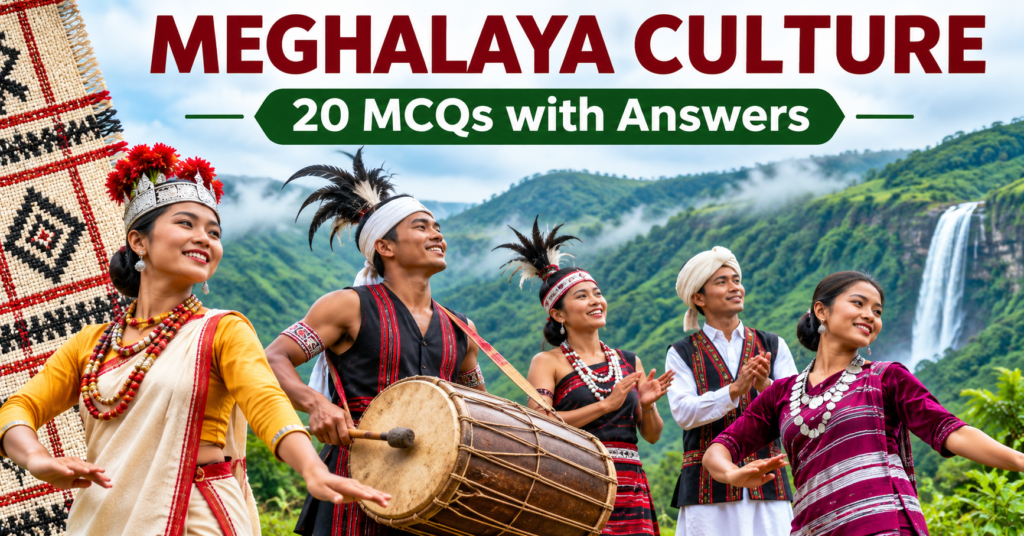
Meghalaya Culture Questions and Answers: 20 MCQs for Competitive Exams
Meghalaya’s culture includes distinctive festivals, music, dances, food, clothing and community traditions. These 20 questions cover festivals such as Wangala, Nongkrem and Behdienkhlam, along with Khasi and Garo musical instruments, traditional terms and the Garo textile Dakmanda. One question also covers the 2026 Golden Jubilee of the Wangala Festival. Use these Meghalaya Culture Questions and Answers to practise the links between a tradition, the community connected with it and its place or purpose. The topics are useful for Meghalaya civil service and other state recruitment examinations.
Overview
Meghalaya’s cultural traditions reflect the customs of its Khasi, Garo and Pnar communities. Wangala is a Garo post-harvest festival, while Nongkrem is a Khasi festival held at Smit. Behdienkhlam and Chad Sukra are Pnar traditions, with different links to community life and agriculture. Khasi and Garo culture also have distinctive terms for music, instruments, clothing and inheritance. The questions below include these static topics and facts about Dakmanda’s 2024 GI recognition and the Wangala Golden Jubilee announced for November 2026. Together, they help explain how Meghalaya’s cultural practices connect communities, places and daily life.
One-Liner Points
- Wangala is a Garo post-harvest festival held to give thanks to Saljong.
- Wangala is also known as the 100 Drums Festival.
- The Nongkrem Dance Festival is held at Smit and includes the Pomblang ceremony.
- Behdienkhlam is a major Pnar festival celebrated prominently at Jowai.
- Shad Suk Mynsiem is a Khasi dance also known as the “Dance of the Peaceful Hearts.”
- Laho is a Pnar dance in which a woman commonly dances between two men linking arms.
- Phawar is a chant-like form of Khasi music that may be composed spontaneously.
- Nokna is the Garo term for the heiress, generally the youngest daughter; her husband is called Nokrom.
- A’Chik is a general title used for different groups of the Garo people.
- Khasi, Garo and Jaintia communities are broadly described as matrilineal.
- The 2026 Wangala Golden Jubilee was announced for 11–14 November in West Garo Hills.
- Tangmuri is a kind of flageolet; nakra is a large drum and Ksing Padiah is a small drum.
- Duitara is a stringed instrument played with a wooden pick.
- Chigring is a bamboo stringed instrument used in Garo ceremonial music.
- Meghalaya Garo Textile, known as Dakmanda, received GI registration in 2024.
- Jadoh is a Khasi dish made with rice and pork.
- Mangona, also called Chugana, is a Garo post-funeral ceremony involving a bamboo structure called Delang.
- Jainsem is a traditional garment worn by Khasi women; Jymphong is associated with Khasi men.
- Kynjri Ksiar is a gold pendant associated with Khasi and Jaintia jewellery.
- Ka Khadduh refers to the youngest daughter eligible to inherit ancestral property in Khasi tradition.
- Chad Sukra is a Pnar pre-sowing spring festival.

MCQs with Answers and Detailed Explanations
Question 1: Wangala and Saljong
The Wangala Festival is a post-harvest festival of which community, held to give thanks to Saljong?
(a) Khasi
(b) Pnar
(c) Garo
(d) Bhoi
Correct Answer: (c) Garo
Detailed Explanation:
Wangala is an important post-harvest festival of the Garo community. It marks the end of agricultural work and celebrates the harvest. The festival includes music, dancing and the beating of drums. It is also known as the 100 Drums Festival. Wangala ceremonies include thanksgiving to Saljong, a deity associated with agricultural abundance.
Key Points for Revision
- Wangala is a Garo festival.
- It is celebrated after the harvest.
- It is also called the 100 Drums Festival.
Question 2: Nongkrem Dance Festival
Where is the Nongkrem Dance Festival held?
(a) Smit
(b) Jowai
(c) Tura
(d) Nongpoh
Correct Answer: (a) Smit
Detailed Explanation:
The Nongkrem Dance Festival is a Khasi religious festival held at Smit, near Shillong. It includes prayers for a good harvest, peace and prosperity. One important part of the celebration is the Pomblang ceremony, which involves a goat sacrifice. Jowai is strongly associated with Behdienkhlam, while Smit is the venue linked with Nongkrem.
Key Points for Revision
- Nongkrem is a Khasi festival.
- Its venue is Smit.
- The Pomblang ceremony is part of the festival.
Question 3: Behdienkhlam and the Pnars
Which statement about Behdienkhlam is correct?
(a) It is a Garo post-harvest festival held in Tura.
(b) It is an important Pnar festival held at Jowai and associated with the Niamtre faith.
(c) It is a Khasi spring dance held at Smit.
(d) It is a Bhoi festival held at Nongpoh.
Correct Answer: (b) It is an important Pnar festival held at Jowai and associated with the Niamtre faith.
Detailed Explanation:
Behdienkhlam is a major festival of the Jaintia Hills, with important celebrations in Jowai. It is observed by Pnars, including those who follow the traditional Niamtre faith. The festival includes processions, music and rituals associated with community well-being. It is distinct from Wangala, the Garo post-harvest festival, and Nongkrem, the Khasi festival held at Smit.
Key Points for Revision
- Behdienkhlam is associated with the Pnars of Jaintia Hills.
- Jowai is a major celebration venue.
- The traditional faith named in the question is Niamtre.
Question 4: Shad Suk Mynsiem
Shad Suk Mynsiem is a traditional dance of which community?
(a) Garo
(b) Khasi
(c) Pnar
(d) Hajong
Correct Answer: (b) Khasi
Detailed Explanation:
Shad Suk Mynsiem is a traditional ritual dance of the Khasi community. It is connected with the agricultural cycle and expresses ideas about fertility, harmony and community life. Men and women participate, with customary roles and conditions governing the dance. The name is also translated as the “Dance of the Peaceful Hearts.”
Key Points for Revision
- Shad Suk Mynsiem is a Khasi dance.
- It is connected with the agricultural cycle.
- It is also called the “Dance of the Peaceful Hearts.”
Question 5: Laho Dance
Which formation is commonly associated with the Laho Dance of the Pnar community?
(a) A group of dancers forms two parallel lines while beating drums.
(b) Two young men link arms with a woman between them as they dance.
(c) Dancers perform alone while carrying swords and shields.
(d) Dancers move in a circle around a large wooden post.
Correct Answer: (b) Two young men link arms with a woman between them as they dance.
Detailed Explanation:
Laho is a dance of the Pnar, or Jaintia, community. A common formation places a woman between two young men, with all three linking arms as they dance. A rhythmic reciter may lead the performance with couplets. This linked-arm formation is different from the two parallel lines of dancers associated with Wangala.
Key Points for Revision
- Laho is a Pnar dance.
- A woman commonly dances between two men linking arms.
- A rhythmic reciter may accompany the performance.
Question 6: Khasi Music and Phawar
In Khasi music, what is a phawar?
(a) A type of ceremonial drum
(b) A harvest dance
(c) A chant, often composed spontaneously for an occasion
(d) A traditional house for unmarried Garo youth
Correct Answer: (c) A chant, often composed spontaneously for an occasion
Detailed Explanation:
Phawar is a basic form of Khasi music. It is more like a chant than a conventional song and may be composed on the spot for a particular occasion. It is a vocal form, not a drum or dance. A Nokpante, meanwhile, is a traditional house for unmarried Garo male youth.
Key Points for Revision
- Phawar is a Khasi musical form.
- It is chant-like rather than a conventional song.
- It may be composed spontaneously.
Question 7: Garo Heiress
In the Garo family system, what is the traditional term for the heiress, generally the youngest daughter?
(a) Nokma
(b) Nokna
(c) Nokpante
(d) Ma’chong
Correct Answer: (b) Nokna
Detailed Explanation:
In the Garo family system, the heiress is generally the youngest daughter and is called the Nokna. Her husband is called the Nokrom. Nokma refers to a village headman, while Ma’chong refers to a Garo lineage or clan. A Nokpante is a traditional house for unmarried male youth.
Key Points for Revision
- Garo society is matrilineal.
- Nokna is the term for the heiress, generally the youngest daughter.
- Her husband is called Nokrom; a village headman is called Nokma.
Question 8: A’Chik
The term A’Chik is used in Meghalaya’s official Garo cultural profile to refer to:
(a) A traditional Garo name used for different groups of the Garo people
(b) A Khasi chant
(c) A Pnar wooden festival structure
(d) The Khasi festival held at Smit
Correct Answer: (a) A traditional Garo name used for different groups of the Garo people
Detailed Explanation:
A’Chik is a general title used for different groups of the Garo people. The groups named in the official profile include Ambeng, Atong, Matchi and Chibok. The term relates to Garo identity and community groups; it is not the name of a dance, musical form or festival.
Key Points for Revision
- A’Chik is a general title for different Garo groups.
- The groups include Ambeng, Atong, Matchi and Chibok.
- It is a community term, not a festival name.
Question 9: Matrilineal Communities
Which three major communities of Meghalaya are described as matrilineal?
(a) Khasi, Garo and Jaintia
(b) Khasi, Bodo and Mizo
(c) Garo, Naga and Rabha
(d) Jaintia, Karbi and Dimasa
Correct Answer: (a) Khasi, Garo and Jaintia
Detailed Explanation:
The Meghalaya Biodiversity Board describes the Khasi, Garo and Jaintia communities as matrilineal. In a matrilineal system, descent or inheritance is traced through the mother’s line. The specific rules and customs can differ between communities and groups, so this broad description does not mean that every practice is identical.
Key Points for Revision
- The three communities named are Khasi, Garo and Jaintia.
- Matrilineal descent is traced through the mother’s line.
- Customs may vary between communities and groups.
Question 10: Wangala Golden Jubilee in 2026
The Meghalaya Government announced the Golden Jubilee celebration of the 100 Drums Wangala Festival in 2026. What period and location were announced for the celebration?
(a) 1–4 April, East Khasi Hills
(b) 11–14 November, West Garo Hills
(c) 15–18 July, West Jaintia Hills
(d) 20–23 December, Ri-Bhoi
Correct Answer: (b) 11–14 November, West Garo Hills
Detailed Explanation:
The Meghalaya Government announced the Golden Jubilee celebration for 11–14 November 2026 in West Garo Hills. The announcement marked 50 years of the 100 Drums Wangala Festival and said the celebration would feature 1,000 drums. Wangala’s cultural roots remain connected with Garo harvest traditions and thanksgiving to Saljong.
Key Points for Revision
- The Golden Jubilee marked 50 years of the festival.
- The announced dates were 11–14 November 2026.
- The announced location was West Garo Hills, with 1,000 drums.
Question 11: Tangmuri
Which instrument is described as a kind of flageolet in the Meghalaya Department of Arts and Culture’s account of Khasi music?
(a) Nakra
(b) Duitara
(c) Tangmuri
(d) Ksing Padiah
Correct Answer: (c) Tangmuri
Detailed Explanation:
Tangmuri is a wind instrument used in Khasi music and is described as a kind of flageolet. The nakra is a large drum, while Ksing Padiah is a small drum. Duitara is a stringed instrument played with a wooden pick. These instruments belong to different categories of traditional music.
Key Points for Revision
- Tangmuri is a wind instrument.
- Nakra is a large drum.
- Ksing Padiah is a small drum; Duitara is stringed.
Question 12: Duitara
The Duitara, used in Meghalaya’s traditional music, is which kind of instrument?
(a) A stringed instrument
(b) A pair of cymbals
(c) A bamboo wind instrument
(d) A large drum
Correct Answer: (a) A stringed instrument
Detailed Explanation:
Duitara is a stringed instrument. The Meghalaya Arts and Culture Department describes it as being played by striking its strings with a wooden pick. It is different from percussion instruments such as cymbals and drums, as well as wind instruments such as the Tangmuri.
Key Points for Revision
- Duitara is a stringed instrument.
- It is played with a wooden pick.
- It is distinct from drums, cymbals and wind instruments.
Question 13: Chigring
What kind of instrument is the Garo chigring?
(a) A brass cymbal
(b) A bamboo stringed instrument
(c) A buffalo-horn trumpet
(d) A reed flute
Correct Answer: (b) A bamboo stringed instrument
Detailed Explanation:
Chigring is a bamboo stringed instrument associated with Garo ceremonial music. The Meghalaya Department of Arts and Culture lists it alongside other instruments used in the ceremony. Horn-trumpets called adils, brass cymbals and reeds are separate instruments.
Key Points for Revision
- Chigring is a Garo bamboo stringed instrument.
- Adils are horn-trumpets.
- Garo ceremonial music may also use cymbals and reeds.
Question 14: Dakmanda and GI Recognition
Which traditional textile product from Meghalaya’s Garo community received a GI tag in 2024?
(a) Jainsem
(b) Meghalaya Garo Textile (Dakmanda)
(c) Ryndia
(d) Paila
Correct Answer: (b) Meghalaya Garo Textile (Dakmanda)
Detailed Explanation:
Meghalaya Garo Textile, known as Dakmanda, was registered as a Geographical Indication product in 2024. A GI registration identifies a product with a recognised geographical origin. Dakmanda is a traditional Garo textile. Jainsem is associated with Khasi women’s clothing, while Paila refers to traditional jewellery.
Key Points for Revision
- Dakmanda is a traditional Garo textile.
- Meghalaya Garo Textile was registered as a GI product in 2024.
- A GI registration links a product to its recognised geographical origin.
Question 15: Jadoh
Which two main ingredients are used to make Jadoh, a well-known Khasi dish?
(a) Rice and pork
(b) Sticky rice and fish
(c) Millet and chicken
(d) Bamboo shoots and beef
Correct Answer: (a) Rice and pork
Detailed Explanation:
Jadoh is a well-known dish associated with Khasi cuisine. It is made with rice and pork and is often served with other local foods, including Dohkhleh and Tungrymbai. The dish is a familiar example of Meghalaya’s regional food traditions.
Key Points for Revision
- Jadoh is associated with Khasi cuisine.
- Its main ingredients are rice and pork.
- It is often served with Dohkhleh and Tungrymbai.
Question 16: Mangona or Chugana
What kind of Garo ceremony is Mangona, also known as Chugana?
(a) A post-funeral ceremony
(b) A spring sowing festival
(c) A wedding dance
(d) A harvest thanksgiving ceremony
Correct Answer: (a) A post-funeral ceremony
Detailed Explanation:
Mangona, also called Chugana, is a Garo post-funeral ceremony. A small bamboo structure called a Delang is erected in the courtyard during the rites. The ceremony includes singing and dancing as part of the community’s funeral customs. Wangala, by contrast, is a Garo post-harvest festival.
Key Points for Revision
- Mangona is also called Chugana.
- It is a Garo post-funeral ceremony.
- The bamboo structure used in the ceremony is called Delang.
Question 17: Jainsem
Which traditional garment is worn by Khasi women?
(a) Dakmanda
(b) Jainsem
(c) Daksaria
(d) Jymphong
Correct Answer: (b) Jainsem
Detailed Explanation:
Jainsem is a traditional garment worn by Khasi women. In a Meghalaya Government cultural profile, it is described as falling loosely to the ankles. Dakmanda and Daksaria are associated with Garo textiles, while Jymphong is associated with Khasi men’s clothing.
Key Points for Revision
- Jainsem is a traditional Khasi women’s garment.
- Jymphong is associated with Khasi men’s clothing.
- Dakmanda is associated with Garo textile traditions.
Question 18: Kynjri Ksiar
In the Meghalaya Government profile, Kynjri Ksiar refers to:
(a) A Khasi women’s dress
(b) A Garo bamboo stringed instrument
(c) A gold pendant worn by Khasi and Jaintia people
(d) A type of Pnar harvest dance
Correct Answer: (c) A gold pendant worn by Khasi and Jaintia people
Detailed Explanation:
Kynjri Ksiar is a pendant made of 24-carat gold and associated with Khasi and Jaintia jewellery. The profile also describes Paila as a string of thick red coral beads worn on festive occasions. These are jewellery terms, not names for clothing, instruments or dances.
Key Points for Revision
- Kynjri Ksiar is a gold pendant.
- It is associated with Khasi and Jaintia jewellery.
- Paila refers to thick red coral beads worn on festive occasions.
Question 19: Ka Khadduh
In Khasi tradition, what does the term Ka Khadduh refer to?
(a) The youngest daughter who is eligible to inherit ancestral property
(b) The eldest son of the family
(c) The village headman
(d) A ceremonial dance leader
Correct Answer: (a) The youngest daughter who is eligible to inherit ancestral property
Detailed Explanation:
Ka Khadduh is the Khasi customary term for the youngest daughter eligible to inherit ancestral property. The term is connected with Khasi matrilineal customs. It differs from Nokna, the Garo term for the heiress, generally the youngest daughter.
Key Points for Revision
- Ka Khadduh is a Khasi customary term.
- It refers to the youngest daughter eligible to inherit ancestral property.
- Nokna is the Garo term for the heiress, generally the youngest daughter.
Question 20: Chad Sukra
Chad Sukra is a pre-sowing spring festival of which community?
(a) Garo
(b) Khasi
(c) Pnar
(d) Hajong
Correct Answer: (c) Pnar
Detailed Explanation:
Chad Sukra is a pre-sowing spring festival of the Pnar, or Jaintia, community. It takes place before agricultural work begins, and fields are not ploughed until the festival is complete. The tradition includes community rituals and honours nature.
Key Points for Revision
- Chad Sukra is a Pnar festival.
- It takes place before sowing and other agricultural work.
- It is associated with community rituals and respect for nature.
Frequently Asked Questions
Which community celebrates Wangala?
Wangala is a post-harvest festival of the Garo community. It is also known as the 100 Drums Festival.
Where is the Nongkrem Dance Festival held?
The Nongkrem Dance Festival is held at Smit, near Shillong. It is a Khasi religious festival.
What is the difference between Nokna and Ka Khadduh?
Nokna is the Garo term for the heiress, generally the youngest daughter. Ka Khadduh is the Khasi customary term for the youngest daughter eligible to inherit ancestral property.
Which Meghalaya textile received GI recognition in 2024?
Meghalaya Garo Textile, known as Dakmanda, was registered as a GI product in 2024.
What is Chad Sukra?
Chad Sukra is a pre-sowing spring festival of the Pnar community. Agricultural work begins after the festival is completed.
Meghalaya’s cultural traditions connect each community with its festivals, music, food and customary practices. As you revise these Meghalaya Culture Questions and Answers, focus on the links between the tradition, the community and its purpose or place. Pay special attention to similar terms, such as Nokna and Ka Khadduh, and to the 2026 Wangala Golden Jubilee dates.