UGC NET(National Eligibility Test) Defence and Strategic studies - Previous Years Solved Papers | Paper II November 2017
- (1) Mehbooba Mufti
- (2) Syed Ali Geelani
- (3) Farooq Shaikh
- (4) Yasin Malik
Answer: Option (2)
- (1) Karl Haushofer
- (2) Moltke
- (3) Mahan
- (4) Mustafa Kemal Ataturk
Answer: Option (2)
⭐ Make GKSeries Your Preferred Source on Google
Add GKSeries as Preferred Source- (1) 45 Years
- (2) 46 Years
- (3) 40 Years
- (4) 50 Years
Answer: Option (3)
- (1) Raymond Aron
- (2) Kissinger
- (3) Ray S Cline
- (4) Micheal Madelbaum
Answer: Option (1)
- (1) Hitler
- (2) Karl Haushofer
- (3) Ferdinand foch
- (4) Erich Luddendorff
Answer: Option (2)
- (1) William Mitchell
- (2) G. Douhet
- (3) Alexender De Seversky
- (4) Wing Commander Do Little
Answer: Option (2)
- (1) Carl Haushofer
- (2) A. Jomini
- (3) H.J. Mackinder
- (4) A.T. Mohan
Answer: Option (2)
- (1) Giulio Dohet
- (2) Alexander de Serversky
- (3) Billy Michell
- (4) Warner
Answer: Option (1)
- (1) J.L. Nehru
- (2) Mahatma Gandhi
- (3) George Liska
- (4) Marshal Tito
Answer: Option (3)
- (1) Just War Theory
- (2) Game Theory
- (3) Deterrence Theory
- (4) Balance of Power Theory
Answer: Option (2)
- (1) Carl Von Clausewitz
- (2) A. Jomini
- (3) B. H. Liddell Hart
- (4) Michael Howard
Answer: Option (1)
- (1) Maj Gen D. K. Palit
- (2) Col Donald Portway
- (3) Col E D Shinton
- (4) Capt B.H Liddell Hart
Answer: Option (2)
- (1) Strategic Deception
- (2) Strategic Manoeuvrability
- (3) Tactical Deception
- (4) Technological Deception
Answer: Option (2)
Assertion (A) : There is no victory in a conventional war of limited nature, unless the objectives are defined at the outbreak of conflict.
Reason (R) : A limited war is fought in a limited geographical area, with limited resources and limited objectives.
- (1) (A) is correct, but (R) is not correct
- (2) (A) is not correct, but (R) is correct
- (3) Both (A) and (R) are not correct
- (4) Both (A) and (R) are correct, and (R) is supportive of (A)
Answer: Option (4)
- (1) Vladimir Putin
- (2) Alexie Kosigyn
- (3) Breznev
- (4) Boris Yeltsin
Answer: Option (1)
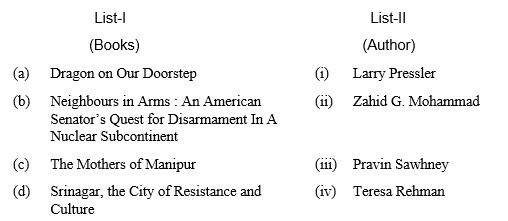
- (1) (iii) (i) (iv) (ii)
- (2) (iv) (iii) (ii) (i)
- (3) (ii) (iv) (iii) (i)
- (4) (i) (ii) (iii) (iv)
Answer: Option (1)
- (1) (a) (b) (d) (c)
- (2) (d) (a) (c) (b)
- (3) (c) (a) (d) (b)
- (4) (b) (c) (a) (d)
(a) Paris Peace Accord
(b) Intermediate - Range Nuclear Forces Treaty
(c) Sea-bed Arms Control Treaty
(d) Camp David Accord
Answer: Option (3)
Assertion (A) : The fundamental purpose of Indian nuclear weapons is to deter the use and threat of use of nuclear weapons by any state or entity against India and its forces.
Reason (R) : India will not be the first to initiate a nuclear strike, but will respond with punitive retaliation should deterrence fail.
- (1) (A) is correct, but (R) is not correct
- (2) (A) is not correct, but (R) is correct
- (3) Both (A) and (R) are not correct
- (4) Both (A) and (R) are correct, and (R) is supportive of (A)
Answer: Option (4)
Assertion (A) : ISIS is a festering wound not only in the region of West Asia, but in fact, the entire world.
Reason (R) : ISIS continues to spread terrorism and violence across West Asia and Europe.
code :- (1) Both (A) and (R) are true
- (2) Both (A) and (R) are false
- (3) (A) is true, but (R) is false
- (4) (A) is false, but (R) is true
Answer: Option (1)
- (1) Supply of resources to combat power
- (2) To position those resources on the battle field
- (3) Sustaining of resources throughout the execution of operations
- (4) Training of combat forces
Answer: Option (4)
- Resources seeking motives of the refugees
- Strategic motivation
- Offensive motives of internationalization
- Market motives of internationalization
Answer: Option (1)
Assertion (A) : Global warming and disasters are persistent issues to deal with, throughout the world.
Reason (R) : Disasters and climate change are likely to be exacerbated both in frequency and intensity.
- (1) Both (A) and (R) are correct, but (R) is not the explanation of (A) with regard to causal factors.
- (2) Both (A) and (R) are not correct
- (3) (A) is correct, but (R) is not correct
- (4) (A) is not correct, but (R) is correct
Answer: Option (1)
Assertion (A) : The growth of piracy, maritime crime and terrorism are likely to pose serious security challenges to sea lines of communication (S L O C) in the Indian Ocean Region (IOR).
Reason (R) : Exploitation of minerals and oceanic riches is also likely to remain a source of conflict in the years ahead as land-based sources are exhausted and new explorations are made in the deep sea and beyond.
- (1) Both (A) and (R) are correct, but (R) is not the explanation of (A)
- (2) (A) is correct, but (R) is not correct
- (3) (A) is not correct, but (R) is correct
- (4) Both (A) and (R) are not correct, nor is (R) the explanation of (A)
Answer: Option (1)
Assertion (A) : Human beings by utilising their knowledge, skills, talents, energies and other mental and physical capabilities construct and reconstruct geographical landscape for their own welfare.
Assertion (A) : In shaping the geographical landscape, the process of migration plays a significant role in the distribution and redistribution of population.
- (1) Both (A) and (R) are not correct
- (2) Both (A) and (R) are correct
- (3) (A) is correct, but (R) is not correct
- (4) (A) is not correct, but (R) is correct
Answer: Option (2)
- (1) Jawahar Lal Nehru
- (2) Mahatma Gandhi
- (3) S. N. Dasgupta
- (4) S. Radhakrishnan
Answer: Option (2)
- (1) Barry Buzan
- (2) Simon Dalby
- (3) Gwyn Prins
- (4) Jessica Mathews
Answer: Option (3)
Assertion (A) : Cross - border migrations resulting in demographic pressure are likely to increase, particularly in impoverished regions, creating large - scale demographic upheavals leading to grave security threats.
Reason (R) : Such situations will exacerbate internal political instability and societel conflicts, eventually leading to indomitable challenges of governance and authority.
- (1) (A) is correct, but (R) is not correct
- (2) (A) is not correct, but (R) is correct
- (3) Both (A) and (R) are correct
- (4) Both (A) and (R) are not correct
Answer: Option (3)
Assertion (A) The asymmetry arises because one side can gain an advantage by choosing to fight in a way that the opponent is not prepared for.
Reason (R) : Opponent can neutralise technological superiority by using guerrilla tactics and urban warfare.
- (1) Both (A) and (R) are correct
- (2) (A) is correct, but (R) is not correct
- (3) Both (A) and (R) are not correct
- (4) (A) is not correct, but (R) is correct
Answer: Option (1)
- (1) Immanuel Kant
- (2) M. K. Gandhi
- (3) Johan Galtung
- (4) Mother Teresa
Answer: Option (1)
- (1) Robert Cox
- (2) Horkheimar
- (3) Win Jones
- (4) J. Hybermass
Answer: Option (1)
- (1) Rebecca Grant
- (2) Bernice A Carroll
- (3) Joshua Goldstein
- (4) J.G. Stem
Answer: Option (1)
- (1) Saddam Hussein
- (2) Osam Bin Laden
- (3) Abul Khaled-al-Suri
- (4) V. Prabhakaran
Answer: Option (2)
- (1) Raymond Aron
- (2) Robert Jervis
- (3) George Kennan
- (4) Barry Buzan
Answer: Option (3)
- (1) M. Sheehan
- (2) H. Kissinger
- (3) G. Shultz
- (4) Bernard Brodie
Answer: Option (4)
- (1) Brundtland Commission
- (2) Canberra Commission
- (3) World Bank
- (4) UNF CCC
Answer: Option (1)
- (1) USA
- (2) France
- (3) Israel
- (4) Germany
Answer: Option (3)
- (1) R. W. Jones
- (2) R. Cox
- (3) H. Kahn
- (4) Andrew Marshall
Answer: Option (4)
- (1) (a) (b) (c) (d)
- (2) (b) (c) (a) (d)
- (3) (c) (d) (b) (a)
- (4) (d) (c) (a) (b)
Answer: Option (2)
Assertion (A) : India has nuclear weapons for the contribution they make to its national security in an uncertain and anarchic world by preventing others from attempting nuclear blackmail and coercion against it.
Reason (R) : Nuclear weapons have served the expected purpose for India in terms of ‘No-First-Use’ policy & assured retaliation.
- (1) Both (A) and (R) are correct, and (R) is supportive explanation of (A)
- (2) Both (A) and (R) are not correct. Nor is (R) supportive of (A)
- (3) (A) is correct, but (R) is not correct
- (4) (A) is not correct, but (R) is correct
Answer: Option (1)
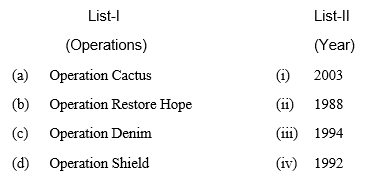
- (1) (ii) (iv) (i) (iii)
- (2) (iv) (iii) (ii) (i)
- (3) (i) (ii) (iii) (iv)
- (4) (iii) (i) (iv) (ii)
Answer: Option (1)
- (1) Solar energy
- (2) Wind energy
- (3) Biomass energy
- (4) Thermal energy
Answer: Option (4)
Assertion (A) : In determining whether or not the environment is truely a security issue, the element of threat is important.
Reason (R) : So Continuing acts of environmental degradation can be seen to present ecological threats to stability and peace.
- (1) Assertion (A) is correct, but Reason (R) is not correct
- (2) Both (A) and (R) are correct
- (3) Assertion (A) is incorrect and Reason (R) is correct
- (4) Both (A) and (R) are not correct
Answer: Option (2)
Assertion (A) : The best strategy to ensure our security and to build a desirable peace is to support the advance of democracy else where.
Reason (R) : Democracies don’t attack each other.
- (1) (A) is correct, but (R) is not correct
- (2) (A) is not correct, (R) is correct
- (3) Both (A) and (R) are not correct
- (4) Both (A) and (R) are correct but (R) is not the correct argument of (A)
Answer: Option (4)
- (1) A. B. Vajpayee
- (2) K. Subrahmanyam
- (3) Subrahmanyam Jaishankar
- (4) Naresh Chandra
Answer: Option (2)
- (1) Varuna
- (2) Malabar
- (3) Ajeya
- (4) Indra
Answer: Option (3)
Assertion (A) : Cyber crimes have altered the nature of conflicts by blurring the line between state and non-state actors.
Reason (R) : Cyber crimes are likely to thrive with the fielding of virtual currency, Internet of things, cloud technology, drones, robotics, big data, dark net, deep web and so on.
- (1) Both (A) and (R) are correct
- (2) (A) is correct, but (R) is not correct
- (3) (A) is not correct, but (R) is correct
- (4) Both (A) and (R) are not correct
Answer: Option (4)
- (1) Mumbai
- (2) Port Blair
- (3) Visakhapattnam
- (4) Kochi
Answer: Option (4)
- (1) Mumbai Docks
- (2) Cochin Shipbuilding Yard
- (3) Garden Reach Workshop
- (4) Hindustan Ship Building Yard
Answer: Option (4)
- (1) Rawat Bhatta
- (2) Kalpakkam
- (3) Narora
- (4) Tarapur
Answer: Option (2)
Assertion (A) : India needs a comprehensive National Security Strategy urgently. There is limited understanding on what constitutes National Security, with the result that we lack comprehensive planning.
Reason (R) : A comprehensive approach to National Security will enable India to protect the life, liberty and welfare of its citizens from external and internal challenges and threats from both state and non - state actors, and ensure a milieu of all inclusive growth.
- (1) Both (A) and (R) are correct
- (2) Both (A) and (R) are not correct
- (3) (A) is correct, but (R) is not correct
- (4) (A) is not correct, but (R) is correct
Answer: Option (1)
UGC NET Defence and Strategic studies November 2017 Paper III