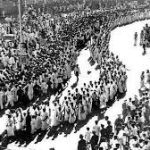
The Indian Freedom Movement, an anti-colonial struggle that lasted around a hundred years, sought to bring an end to British rule in the Indian subcontinent. It concluded with a bittersweet victory, where the people achieved freedom and independence, but were left with the painful reality of being divided into two nations: India and Pakistan.
Key Phases of the Indian Freedom Struggle:
- Early Nationalist Phase (1885-1905):
In 1885, the Indian National Congress was founded – the Congress played an important coordinating role for Indian nationalists together and pursued the idea of self-government for India. - Rise of Extremism (1905-1918):
The anti-colonial Swadeshi Movement and the home rule Movement emerged during this period advocating greater autonomy which challenged British rule. - Gandhian Phase (1919-1947):
Mahatma Gandhi led a mass-based anti-colonial struggle in India using the idea of Satyagraha or non-violent action, steering the anti-colonial struggle to a new level with mass mobilization. - Summary of Key Movements and Events:
- Champaran Satyagraha (1917): Gandhi’s first significant campaign in India focusing on the plight of indigo farmers.
- Non-Cooperation Movement (1920): An influential movement for Indians to boycott British institutions and goods.
- Civil Disobedience Movement (1930-1934): The Salt March led public mobilization as a symbolic protest against the salt tax.
- Quit India Movement (1942): Indian Independence Movement sought immediate independence from British forces.
- Jallianwala Bagh Massacre (1919): British troops fired upon an unarmed crowd ensuing Anti-colonial sentiment towards British colonial officials.
- Partition of India (1947): British Government divided the country into India and Pakistan; resulting in mass population displacements and sectarian violence.
Revolutionary Movements:
Alongside a non-violent movement in the nation were groups such as the Ghadar Party and individuals such as Bhagat Singh and Chandra Shekhar Azad engaged in revolutionary practices contributing towards independence.
Key Figures:Mahatma Gandhi: A famous leader in India who fought for independence with the principle of non-violent resistance.
• Sardar Vallabhbhai Patel: A prominent figure who helped make all princely states part of the Indian Union.
• Jawaharlal Nehru: He was the nation’s first Prime Minister, played a major role in achieving independence and helped build post-independent India.
• Subhas Chandra Bose: A nationalist who assembled the Indian National Army to oppose the British from a distance, during World War II.
• Rani Lakshmibai: A queen from Jhansi who fought the British when they attacked during the Sepoy Mutiny in 1857.
Bhagat Singh: Bhagat Singh was a hero of the early 20th-century Indian Independence Movement. He was a vocal critic of British raj in India and was involved in two high-profile attacks on British authorities—one on a local police chief and the other on the Central Legislative Assembly in Delhi.
• Chandra Shekhar Azad was a fighter who stood up against British rule.
• Bagha Jatin: The leader of the Jugantar party in the province of Bengal.