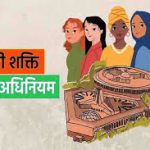
The Nari Shakti Vandan Adhiniyam, also known as the Women’s Reservation Bill, is a milestone legislation in India that reserves seats for women in the Lok Sabha (the lower house of India’s Parliament), in State Legislative Assemblies, and the Legislative Assembly of the National Capital Territory of Delhi.
Key Highlights:
- Constitutional Amendment: The Nari Shakti Vandan Adhiniyam is the Constitution (One Hundred and Sixth Amendment) Act, 2023. It would amend the Constitution of India to facilitate this reservation.
- Reservation: The Act provides that thirty-three (33%) percent of all the seats in the Lok Sabha, State Legislative Assemblies, and the Assembly of the National Capital Territory of Delhi shall be reserved for women. The reservation applies to the reserved seats for Scheduled Castes (SCs) and Scheduled Tribes (STs) in the concerned durable legislation, in other words, a quota within a quota.
- Coming into Force: The reservation will come into force after the next delimitation takes place, which will be determined by the census that occurs after the start of the Act. The current delimitation is based on the 2001 census and is frozen until the census after 2026. Thus, the reservation will likely not be operative for some time in an election sense.
- Period: The reservation for women will be for an initial period of fifteen (15) years, from the date it comes into force. Parliament will have to later decide to extend the period.
- • Election Seats for Women: The seats reserved for women in each election will be chosen by a rotation process set by a law passed by Parliament following every delimitation. As a result, there will be seats reserved for women in each election.
- Passage in Parliament: The Bill for this Act was passed by both houses of the Indian Parliament with near-unanimous support in September 2023, marking a significant moment after decades of debate and attempts to enact such legislation.
- Objective: The main purpose of the Nari Shakti Vandan Adhiniyam is to increase the number of women in Indian legislatures which helps empower them and encourages their greater involvement in policy-making and running the government. It deals with the fact that women have been underrepresented in these important positions in the past.
- Exclusions: The reservation is not used in the Rajya Sabha (upper house of Parliament) or in the State Legislative Councils (where they exist).