The National Mission for a Green India or the publicly known Green India Mission (GIM), is one of eight Missions under the National Action Plan on Climate Change (NAPCC) directed by the national government. It was launched in February, 2014 to protect the biological resources of our nation and the livelihoods supporting them from the threat of adverse climate change, and to acknowledge forestry as an important source of ecological sustainability, biodiversity conservation and food-, water- and livelihood-security. It proposes to protect, restore and enhance India’s shrinking forest cover and adapt to and mitigate climate change impacts. It proposes to take a holistic view of greening as a process that is not limited to just planting trees. GIM seeks to enhance multiple ecosystem services including biodiversity, water and biomass, mangroves, wetlands, critical habitats etc., as well as carbon sequestration in forests.
The Mission will work towards increasing carbon sinks in sustainably managed forests and other ecosystems, adapting vulnerable species/ecosystems to climate change and adaptation of forest-dependent communities. The GIM goals include increased forest/tree cover and better quality of forest cover in millions of hectares of forest/non-forest lands, improving ecosystem services including biodiversity carbon sequestration and hydrology services as well as provisioning ecosystem services such as fuel, fodder and timber and non-timber forest produces for households who live in and around forests, increased forest-based livelihood outputs from households living in and around forests. The incorporation of the Traditional Ecological Knowledge of communities and utilization of forestry science and technology will enhance the Mission impacts.
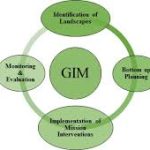
GIM also aims at convergence with complementary schemes and programmes for better coordination in developing forests and their fringe areas in a holistic and sustainable way, which is required to address the challenges being faced in environment, forest and wildlife sectors. A multidisciplinary team, both from Govt. and NGOs will be mandated to facilitate planning and implementation at cluster/landscape unit level. The Mission’s emphasis on the landscape approach i.e. landscapes as large contiguous areas of forest/ non forest land, at different scale/levels provide better opportunity to meet targets for both National and State Forest policy. An integrated cross-sectoral approach would be implemented on both public as well as private lands with the involvement of grass root level organizations and local communities in planning, decision making, implementation and monitoring. Moreover, GIM would take into account the forces of de-greening operating across the country and thereby give special emphasis to relate to processes that halt ‘de-greening’.