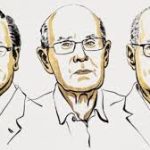
The 2025 Nobel Prize in Chemistry has been awarded to Susumu Kitagawa from Kyoto University, Richard Robson from the University of Melbourne, and Omar M Yaghi from the University of California, Berkeley, for their groundbreaking work on metal-organic frameworks. When announcing the award, the Royal Swedish Academy of Sciences highlighted that this trio has “created new rules” in the field of chemistry by designing an innovative type of molecular architecture.
According to release, the award was given for “developing a new form of molecular architecture.” In their designs, metal ions act as cornerstones, connected by long organic molecules made of carbon. Together, these metal ions and molecules come together to form crystals with large cavities. These porous materials are known as metal-organic frameworks (MOFs). By tweaking the building blocks used in MOFs, chemists can tailor them to capture and store specific substances. MOFs can also facilitate chemical reactions or even conduct electricity.
The journey began back in 1989 when Richard Robson started experimenting with positively charged copper ions and a four-armed molecule, which led to the creation of a crystal filled with numerous cavities. Although his initial attempts were unstable, when these components were combined, they bonded to create a well-ordered, spacious crystal—almost like a diamond brimming with countless cavities.
Between 1992 and 2003, Susumu Kitagawa and Omar Yaghi advanced the field: Kitagawa demonstrated gas flow through these frameworks and their potential flexibility, while Yaghi developed highly stable MOFs that could be modified for specific functions.
“Metal-organic frameworks have enormous potential, bringing previously unforeseen opportunities for custom-made materials with new functions,” said Heiner Linke, Chair of the Nobel Committee for Chemistry.
Some researchers believe that metal–organic frameworks have such huge potential that they will be the material of the twenty-first century. Time will tell, but through the development of metal–organic frameworks, Susumu Kitagawa, Richard Robson and Omar Yaghi have provided chemists with new opportunities for solving some of the challenges we face. They have thus – as Alfred Nobel’s will states – brought the greatest benefit to humankind.