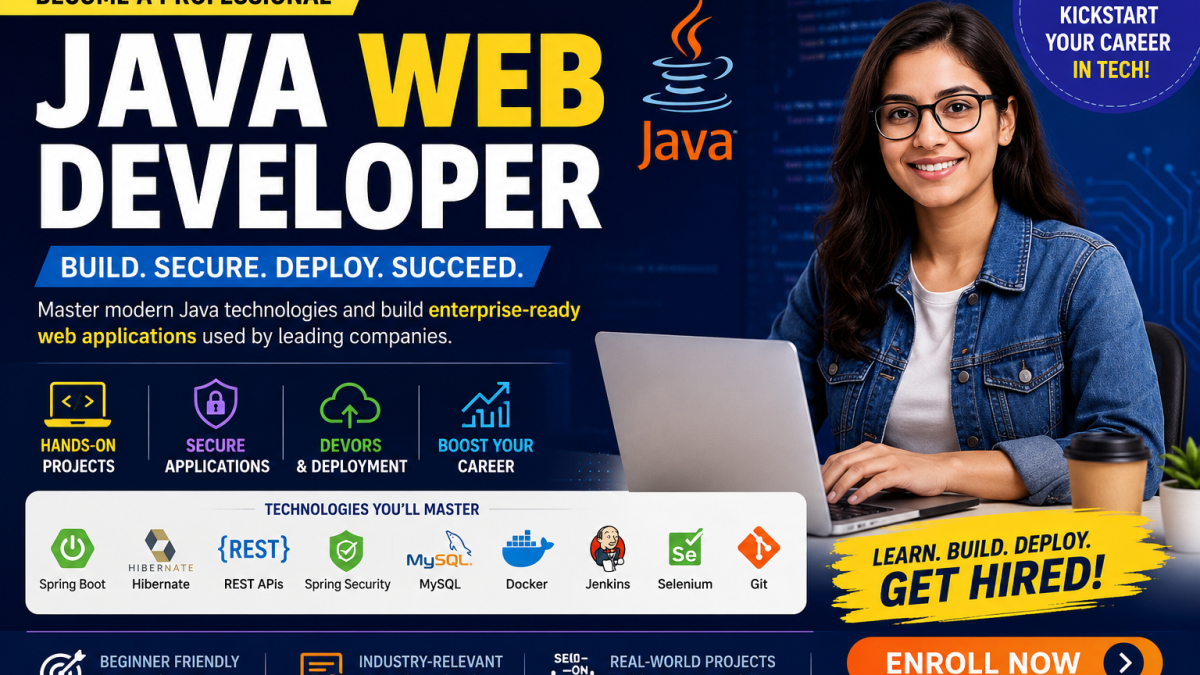
Java Web Developer Course: Build Enterprise-Ready Java Applications with Spring Boot, REST APIs & DevOps
Java remains one of the most in-demand programming languages for enterprise software development. Thousands of companies worldwide rely on Java to build secure, scalable, and high-performance applications. From banking and healthcare to e-commerce and cloud computing, Java powers mission-critical systems used by millions of users every day.
JOIN JAVA WEB DEVELOPER COURSE
If you’re looking to become a professional backend or full-stack developer, the Java Web Developer Course provides a comprehensive learning path covering modern Java technologies, enterprise frameworks, testing, databases, APIs, security, and DevOps.
This program goes far beyond basic Java programming. You’ll learn how to build production-ready web applications using Spring Boot, Spring MVC, Hibernate, REST APIs, GraphQL, Docker, Jenkins, Selenium, and many other technologies used by leading software companies.
Why Learn Java Web Development?
Java consistently ranks among the world’s most popular programming languages because it offers:
- Platform independence
- Excellent performance
- Strong security
- Massive ecosystem
- Enterprise adoption
- Cloud compatibility
- High-paying career opportunities
Organizations including banks, insurance companies, airlines, government agencies, startups, and Fortune 500 companies continue to invest heavily in Java applications.
Java Web Developer Course Overview
Duration: Approximately 3–5 months (self-paced)
Level: Intermediate
Ideal For
- Java developers
- Software engineering students
- Backend developers
- Full-stack developers
- IT professionals
- Career changers
- Computer science graduates
Skills You’ll Learn
Completing the Java Web Developer Course can prepare you for roles including:
- Build enterprise web applications
- Develop RESTful APIs
- Secure applications using Spring Security
- Implement authentication and authorization
- Work with relational databases
- Build microservices
- Create GraphQL APIs
- Perform automated testing
- Deploy applications using Docker
- Build CI/CD pipelines
- Manage application logging and monitoring
Course Modules
1. Java Web Development Fundamentals
The course starts with modern Java web development concepts.
You’ll learn:
- Spring Framework
- Spring MVC
- Spring Boot
- Dependency Injection
- MVC Architecture
- Java Servlets
- Thymeleaf Templates
- Spring Managed Components
- Java Annotations
- Maven
Technologies Covered
- Spring Boot
- Spring MVC
- Maven
- Thymeleaf
- Java Servlets
- IntelliJ IDEA
2. Spring Boot Configuration
Spring Boot dramatically simplifies Java application development.
Topics include:
- Spring Boot setup
- Configuration files
- Bean management
- Profiles
- Environment variables
- Auto configuration
- Component scanning
- Dependency Injection
By the end, you’ll understand how enterprise Java applications are structured.
3. Object Relational Mapping (ORM)
Modern Java applications interact with databases through ORM frameworks.
You’ll learn:
- Hibernate
- JPA
- Spring Data JPA
- Entity relationships
- Repository Pattern
- JPQL
- DAO Pattern
- Transactions
Database Topics
- CRUD operations
- SQL queries
- Joins
- Constraints
- Relationships
- Database transactions
- JDBC
4. REST APIs and Web Services
Almost every modern application communicates through APIs.
This module teaches:
- REST architecture
- HTTP methods
- Status codes
- JSON
- XML
- API documentation
- Swagger/OpenAPI
- GraphQL
- SOAP
You’ll Build
- CRUD APIs
- Authentication APIs
- Database-backed APIs
- Secure REST services
5. GraphQL
GraphQL has become increasingly popular for flexible APIs.
Topics include:
- GraphQL schema
- Queries
- Mutations
- Resolvers
- API optimization
Benefits include:
- Reduced over-fetching
- Faster frontend development
- Better client flexibility
6. Spring Security
Security is essential for enterprise applications.
You’ll learn:
- Authentication
- Authorization
- Password hashing
- JWT Authentication
- Encryption
- Spring Security
- Role-based access
- API security
Security Topics
- Password encryption
- BCrypt
- JWT Tokens
- Login systems
- User roles
- Secure endpoints
7. Application Testing
Software quality is critical.
The course includes comprehensive testing techniques.
Topics include:
- Unit Testing
- Integration Testing
- Functional Testing
- Happy Path Testing
- Negative Testing
- JUnit
- Selenium
Testing Tools
- JUnit
- Selenium
- Spring Testing Framework
8. Selenium Automation
Automation testing is highly valued in software companies.
You’ll learn:
- Browser automation
- UI testing
- Functional testing
- Test scripting
- Automated regression testing
9. Microservices
Modern enterprise applications often use microservices.
Topics include:
- Microservice architecture
- Service communication
- API Gateway concepts
- Independent deployment
- Service scalability
10. Data Persistence
You’ll build enterprise-grade database applications using:
- Spring Data JPA
- Hibernate ORM
- SQL
- Repository Pattern
- DTOs
- DAO Layer
- Entity relationships
11. Docker
Containerization is now an industry standard.
You’ll learn:
- Docker basics
- Docker images
- Containers
- Dockerfiles
- Application deployment
12. Jenkins and CI/CD
Learn how modern companies automate software delivery.
Topics include:
- Jenkins
- Continuous Integration
- Continuous Deployment
- Automated builds
- Automated testing
- Deployment pipelines
13. Logging & Monitoring
Professional applications require monitoring.
You’ll learn:
- Logging
- Splunk
- Application metrics
- Error tracking
- Performance monitoring
Tools You’ll Master
Throughout the course, you’ll gain practical experience with:
- Java
- Spring Boot
- Spring MVC
- Spring Security
- Hibernate
- JPA
- MyBatis
- Maven
- Docker
- Jenkins
- Selenium
- JUnit
- Swagger
- GraphQL
- REST APIs
- Git
- Splunk
- IntelliJ IDEA
- SQL
- JDBC
- Thymeleaf
Real-World Projects
During the course, you’ll build projects such as:
- Employee Management System
- REST API Backend
- Authentication System
- Secure Login Application
- Database-driven Web Application
- Microservice-based Application
- Dockerized Spring Boot Project
- Automated Testing Framework
These projects strengthen your portfolio and demonstrate practical skills to employers.
Prerequisites
Before enrolling, you should have:
- Basic SQL knowledge
- Intermediate Java programming skills
- Ability to communicate effectively in written and spoken English
If you’re comfortable with Java fundamentals such as classes, inheritance, collections, exception handling, and object-oriented programming, you’re ready to begin.
Career Opportunities After Completion
Completing the Java Web Developer Nanodegree can prepare you for roles including:
- Java Developer
- Backend Developer
- Spring Boot Developer
- Full Stack Java Developer
- REST API Developer
- Software Engineer
- Web Application Developer
- Enterprise Application Developer
- Java Microservices Developer
- API Developer
Frequently Asked Questions (FAQs)
Is this course suitable for beginners?
It is best suited for learners with intermediate Java knowledge. Beginners should first learn Java fundamentals and basic SQL before enrolling.
Will I learn Spring Boot?
Yes. Spring Boot is one of the core technologies covered throughout the program.
Does the course include REST API development?
Absolutely. You’ll build and secure RESTful APIs, document them with Swagger, and also explore GraphQL and SOAP web services.
Are databases included?
Yes. You’ll work extensively with SQL, Hibernate, JPA, Spring Data JPA, JDBC, transactions, and repository design patterns.
Does it cover DevOps?
Yes. The curriculum introduces Docker, Jenkins, CI/CD workflows, logging, monitoring, and application deployment practices.
Will I build real projects?
Yes. The course emphasizes practical, portfolio-ready projects that demonstrate your ability to develop enterprise Java applications.
The Java Web Developer Course is an excellent choice for developers for developers who want to transition from writing standalone Java programs to building enterprise-grade web applications. By mastering Spring Boot, REST APIs, Hibernate, Spring Security, testing frameworks, and DevOps tools, you’ll gain the practical skills expected in modern Java development roles.
Whether your goal is to become a backend developer, full-stack engineer, or software architect, this program provides a solid foundation for creating scalable, secure, and production-ready Java applications.