Master Large Language Models (LLMs): The Complete AI Course to Build RAG Systems, AI Agents & Multi-Agent Applications in 2026
Artificial Intelligence is transforming every industry, and Large Language Models (LLMs) are at the heart of this revolution. From ChatGPT and Claude to Gemini, Llama, and DeepSeek, modern LLMs are powering intelligent chatbots, coding assistants, search engines, content generators, customer support systems, and enterprise knowledge platforms.
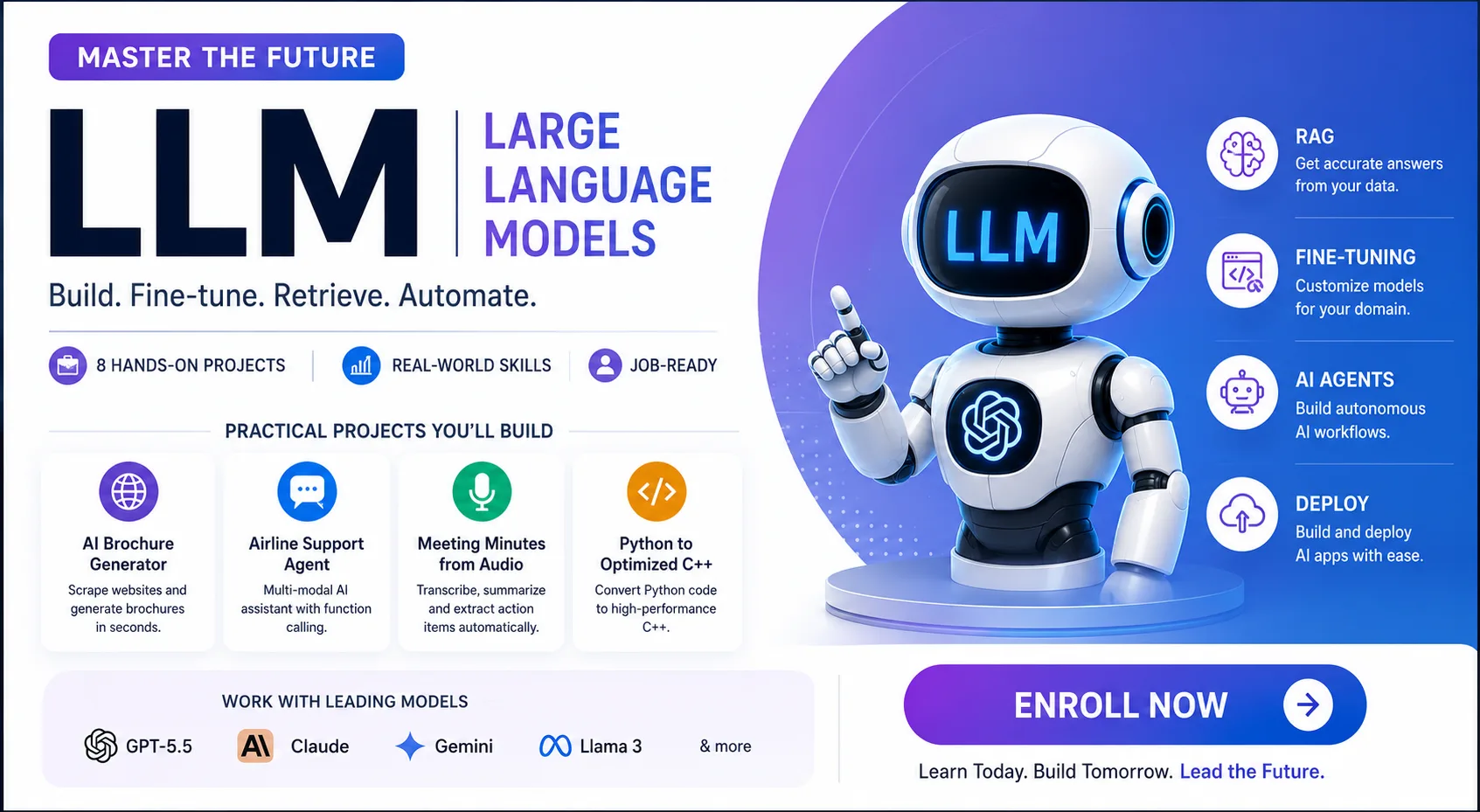
Master Large Language Models (LLMs): Build Production-Ready AI Applications from Scratch
If you’re looking to build real-world AI applications instead of just learning theory, a Large Language Models (LLM) course with hands-on projects is one of the best investments you can make in your AI career.
In this guide, we’ll explore what you’ll learn, the practical projects you’ll build, the latest LLM technologies you’ll master, and why LLM engineering is one of the highest-paying AI skills in 2026.
What Are Large Language Models (LLMs)?
Large Language Models are advanced AI systems trained on massive datasets to understand and generate human-like text. They can perform a wide range of tasks, including:
- Answering questions
- Writing code
- Creating reports
- Summarizing documents
- Translating languages
- Generating content
- Solving complex reasoning problems
- Automating workflows
- Powering intelligent AI agents
Popular LLMs include:
- GPT-5.5
- Claude
- Gemini
- Llama
- Qwen
- DeepSeek
- Mistral
- Gemma
- Phi
- Mixtral
Modern AI applications increasingly combine these models with external tools, retrieval systems, and autonomous agents to solve complex business problems.
Why Learn LLM Engineering?
The demand for AI engineers has grown rapidly as organizations adopt generative AI for automation, customer service, software development, and knowledge management.
Learning LLM engineering enables you to build:
- AI chatbots
- Customer support assistants
- Enterprise knowledge bases
- Document search systems
- AI coding assistants
- Automated report generators
- Intelligent web applications
- Autonomous AI agents
- Multi-agent systems
- AI-powered productivity tools
These skills are valuable across startups, enterprises, and consulting projects.
What You’ll Learn
This course focuses on practical implementation rather than theory alone. You’ll gain experience with:
- Prompt engineering
- LLM APIs
- Retrieval-Augmented Generation (RAG)
- Vector databases
- Embeddings
- Function calling
- AI agents
- Multi-agent systems
- Fine-tuning
- Open-source LLM deployment
- Multimodal AI
- Evaluation and optimization
- Production-ready AI application development
Hands-On Projects Included
Project 1: AI-Powered Brochure Generator
Build an AI application that intelligently navigates company websites, extracts relevant information, and automatically generates professional brochures.
Skills You’ll Learn
- Web scraping
- Intelligent navigation
- HTML parsing
- Prompt engineering
- Content generation
- Automated marketing materials
Project 2: Multi-Modal Airline Customer Support Agent
Develop an AI-powered airline assistant capable of understanding customer requests and interacting with backend systems through function calling.
Features include:
- Flight booking
- Reservation management
- Ticket cancellation
- Baggage information
- Customer assistance
- User interface development
Technologies:
- Function calling
- Tool integration
- Multimodal AI
- API integration
- Conversational AI
Project 3: AI Meeting Minutes Generator
Create a tool that converts meeting audio into structured summaries and actionable insights.
The application automatically:
- Transcribes meetings
- Identifies key discussion points
- Generates summaries
- Creates action items
- Assigns follow-up tasks
You’ll work with both open-source and proprietary speech and language models to compare performance and capabilities.
Project 4: Python to Optimized C++ Converter
Build an AI-powered code transformation system that converts Python programs into optimized C++ implementations for improved execution speed where appropriate.
You’ll explore:
- Code generation
- Performance optimization
- Compiler-aware transformations
- Benchmarking
- AI-assisted software engineering
This project demonstrates how LLMs can accelerate software development and optimization.
Project 5: Enterprise AI Knowledge Worker Using RAG
One of the most valuable enterprise AI applications is a Retrieval-Augmented Generation (RAG) system.
In this project you’ll build an AI assistant that can:
- Search company documents
- Understand policies
- Retrieve technical information
- Answer employee questions
- Provide accurate, source-grounded responses
You’ll learn:
- Embeddings
- Vector databases
- Semantic search
- Document chunking
- Retrieval pipelines
- RAG architecture
Project 6: Product Price Prediction Using Frontier Models
Learn how frontier LLMs can be used for structured prediction tasks by estimating product prices from short descriptions.
This project covers:
- Prompt design
- Model evaluation
- Prediction accuracy
- Performance comparison
Project 7: Fine-Tuning Open-Source Models
Instead of relying solely on hosted APIs, you’ll fine-tune an open-source LLM using modern parameter-efficient techniques.
Topics include:
- LoRA
- QLoRA
- PEFT
- Hugging Face Transformers
- Dataset preparation
- Model evaluation
Fine-tuning allows models to specialize in domain-specific tasks while keeping computational costs manageable.
Project 8: Autonomous Multi-Agent Deal Finder
Bring together multiple AI agents that collaborate to discover product deals and notify users automatically.
Example workflow:
- Research agent
- Product search agent
- Price comparison agent
- Discount verification agent
- Notification agent
This capstone introduces orchestration, planning, and autonomous workflows—key concepts in advanced AI systems.
Compare RAG, Fine-Tuning, and Agentic Workflows
One of the strengths of this course is that it teaches when to use each major LLM enhancement technique.
Retrieval-Augmented Generation (RAG)
Best suited for:
- Enterprise knowledge bases
- Frequently changing information
- Document search
- Customer support
Advantages:
- No retraining required
- Easy knowledge updates
- Reliable responses grounded in retrieved documents
Fine-Tuning
Ideal for:
- Domain-specific language
- Specialized classification
- Consistent response style
- Task-specific optimization
Advantages:
- Tailored model behavior
- Better performance on specialized tasks
- Lower inference costs for repeated workloads
Agentic Workflows
Useful when AI must:
- Plan tasks
- Use external tools
- Call APIs
- Search databases
- Coordinate multiple steps
Applications include research assistants, workflow automation, and autonomous business processes.
Frontier vs Open-Source LLMs
You’ll compare leading proprietary and open-weight models to understand their strengths, trade-offs, and ideal use cases.
Frontier Models
- GPT-5.5
- Claude
- Gemini
- Grok
- Command-series models
- Amazon Nova models
Open-Source Models
- Llama
- Qwen
- Mistral
- Gemma
- DeepSeek
- Phi
- Mixtral
- Falcon
You’ll learn how to select the right model based on performance, cost, latency, deployment requirements, and licensing.
Tools and Technologies Covered
Throughout the course, you’ll gain experience with a modern AI engineering stack, including:
- Python
- LangChain
- LangGraph
- LlamaIndex
- CrewAI
- AutoGen
- Hugging Face
- Transformers
- OpenAI APIs
- ChromaDB
- FAISS
- Pinecone
- Weaviate
- Milvus
- Streamlit
- Gradio
- FastAPI
- Docker
- Git
- Vector embeddings
Who Should Take This Course?
This course is ideal for:
- Software developers
- Python programmers
- Machine learning engineers
- Data scientists
- AI enthusiasts
- Technical founders
- Automation specialists
- Backend developers
- Students interested in generative AI
- Professionals transitioning into AI engineering
Some familiarity with Python is recommended, but many concepts are introduced through practical, project-based learning.
Career Opportunities After Completion
The skills covered in this course prepare you for roles such as:
- LLM Engineer
- AI Application Developer
- Generative AI Engineer
- AI Solutions Architect
- Machine Learning Engineer
- Prompt Engineer
- AI Automation Developer
- RAG Engineer
- Conversational AI Developer
- AI Research Engineer
These roles are increasingly in demand as organizations integrate AI into their products and operations.
Why This Course Stands Out
Unlike courses that focus only on prompting, this program emphasizes building end-to-end AI applications. You’ll create systems that retrieve knowledge, call external tools, process audio, generate code, and coordinate multiple AI agents.
By the end, you’ll have a portfolio of practical projects demonstrating your ability to design, build, and deploy modern LLM-powered solutions.
Large Language Models are reshaping how software is built and how businesses operate. Mastering technologies such as Retrieval-Augmented Generation, fine-tuning, multimodal AI, and autonomous agents gives you a strong foundation for developing production-ready AI applications.
Whether your goal is to advance your career, build AI-powered products, or explore cutting-edge research, this comprehensive LLM course provides hands-on experience with the tools and techniques used in today’s AI industry.