Gkseries.com


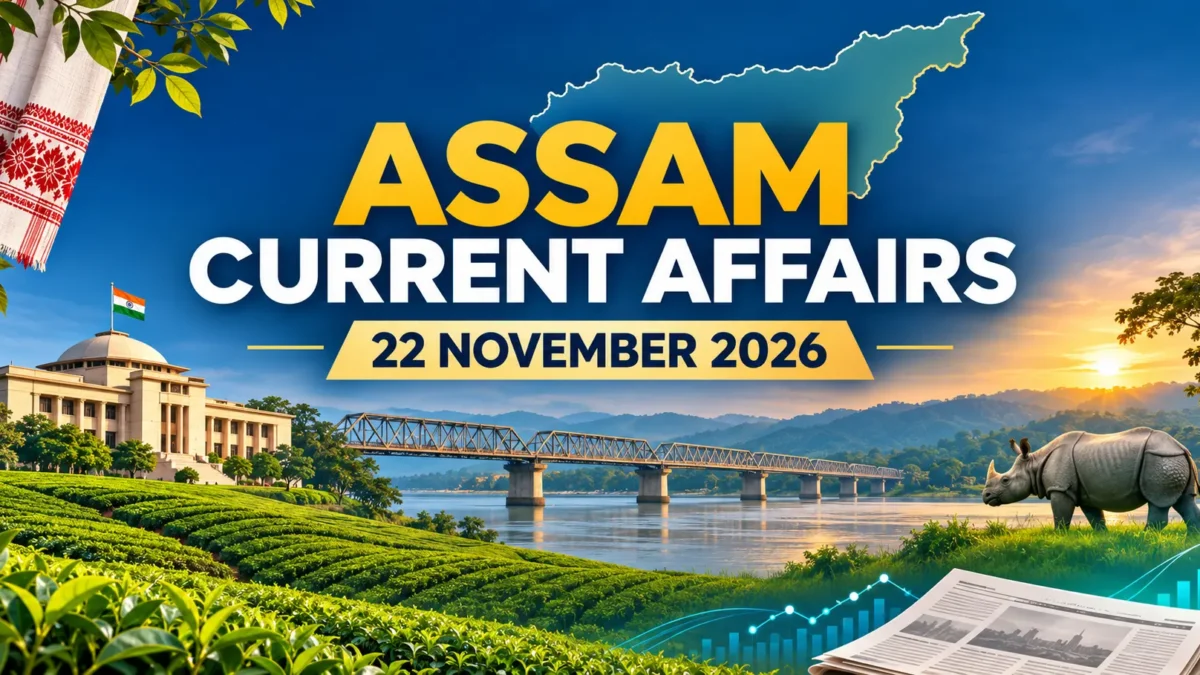
On 21 November 2026, IMD warned of heavy rain in three Barak Valley districts. The National Center for Seismology also recorded an earthquake in Karbi Anglong. Assam issued tenders for skill-training equipment, a pig semen laboratory, power transmission work, drinking-water booths and riverbank protection. Other topics include river-control structures, Assam–Mizoram border coordination and a drug-awareness workshop in Silchar. Some items took place on 19 or 20 November and are included as carry-forwards. A tender means that bids are being invited; it does not mean the work is complete.
Introduction
This post covers 10 Assam current-affairs topics for UPSC and APSC aspirants. It explains what happened and why each topic matters.
Assam Current Affairs 22 November 2026
1. Heavy-Rain Warning for Barak Valley
The Regional Meteorological Centre in Guwahati warned of heavy rain, thunderstorms and lightning in Cachar, Hailakandi and Sribhumi. The warning was valid until 8:30 a.m. on 22 November.
IMD uses the term “heavy rainfall” for 64.5 to 115.5 millimetres of rain in 24 hours. “Isolated” means that heavy rain may affect only a few places. It does not mean that every place in the district will receive heavy rain. A forecast tells people what may happen; it is not a record of rain that has already fallen.
Weather warnings help people and public agencies prepare. In Assam, heavy rain can cause waterlogging, disrupt travel and raise river levels. The IMD office in Guwahati also provides weather information to help issue flood warnings for the Brahmaputra and Barak rivers.
Why it matters: Clear warnings and local action plans can help reduce harm during severe weather.
APSC GS TEST SERIES
2. Earthquake Recorded in Karbi Anglong
The National Center for Seismology recorded a reviewed magnitude 3.6 earthquake in Karbi Anglong at 9:08 p.m. on 21 November. The reported depth was 34 kilometres.
The earthquake’s focus is where it starts below the Earth’s surface. The epicentre is the place on the surface directly above the focus. Magnitude measures the size of an earthquake. Intensity describes how strongly it is felt in a particular place. Intensity can differ from one location to another.
This earthquake is a reminder that Assam needs safe buildings and public preparedness. It does not predict when another earthquake will happen. NIDM lists Guwahati in seismic Zone V. Government guidance recommends earthquake-safe construction and checks of important buildings.
Why it matters: Safe construction, building inspections and public awareness can reduce earthquake risk.
3. Proposed Pig Semen Laboratory at Sonapur
Assam issued a tender to set up a pig semen collection and processing laboratory at the Government Pig Breeding Farm in Sonapur under the National Livestock Mission. This is a proposal at the tender stage; it does not mean that the laboratory is already operating.
The laboratory would support artificial insemination. This method uses collected semen to help a female animal become pregnant without natural mating. It is not cloning: the young animal gets genetic material from both parents.
The Department of Animal Husbandry and Dairying says that pig semen services can help farmers use selected breeding stock. Its technical guidance also explains the need for clean laboratory conditions, semen quality checks, disease testing and safe handling.
Why it matters: Better breeding services may help livestock farmers, but they need trained staff, veterinary support and careful disease control.
4. ShankarNagar–Hojai Power Transmission Tender
A tender was published for a 132 kV power transmission line between ShankarNagar and Hojai. The work also includes a bay at Sankardevnagar Grid Substation. The tender is a planned project, not proof that the line has been built.
Assam Electricity Grid Corporation Limited (AEGCL) manages the state’s power transmission system. Its role is to carry electricity to distribution networks.
The “132 kV” figure refers to voltage. It does not tell us by itself how much electricity the line can carry. The amount depends on other factors, including current, equipment and grid conditions.
Why it matters: Transmission lines help move electricity, but they must work with substations and local distribution networks to improve supply.
5. Drinking-Water Booths in Bongaigaon
Bongaigaon Municipal Board invited bids to build four public drinking-water booths in Wards 1, 3, 4 and 5. The work is listed under a Fifteenth Finance Commission tied grant. The tender does not show that the booths are already built or supplying water.
A tied grant is money that must be used for specific purposes. The Fifteenth Finance Commission set aside tied grants for services such as drinking water, sanitation and waste management. Article 280 of the Constitution covers Finance Commission recommendations for both municipalities and Panchayats.
Building the booths is only one step. They also need safe water, regular testing, repairs and clear arrangements for daily operation.
Why it matters: Local government needs funds and the capacity to keep public services working after construction.
6. Assam–Mizoram Border Meeting
Officials from Assam’s Hailakandi district and Mizoram’s Kolasib district met on 19 November. They agreed to maintain the existing situation along the border and conduct joint patrols. They also discussed forest-area activity and cooperation against drug trafficking.
This was a local administrative arrangement. It does not settle the boundary between the two states. The officials also referred to the NCORD system, which helps government agencies work together on drug-related issues. NCORD is for narcotics coordination, not for deciding state borders.
Why it matters: Regular communication between neighbouring districts can help manage local issues and reduce tension.
7. Drug-Awareness Workshop in Silchar
On 20 November, the Press Information Bureau’s Guwahati office held a “Vartalap” media workshop in Silchar. Journalists, police officials and experts discussed the media’s role in the Nasha Mukt Bharat Abhiyaan. This was a workshop, not a new law or policy.
The campaign combines action against drug supply with public awareness, prevention, treatment and rehabilitation. People who need treatment may still need support even when authorities take action against trafficking.
Media reports can help people find reliable information and support. They should avoid unverified claims and language that shames people who need treatment.
Why it matters: Drug-related issues need both law enforcement and health services, supported by responsible public communication.
One-Line Points for Revision
- Barak Valley: IMD warned of isolated heavy rain in Cachar, Hailakandi and Sribhumi.
- Karbi Anglong: NCS recorded a reviewed magnitude 3.6 earthquake at a depth of 34 km.
- Sonapur: A tender was issued for a proposed pig semen laboratory under the National Livestock Mission.
- Power transmission: AEGCL tendered a 132 kV line between ShankarNagar and Hojai.
- Bongaigaon: Four public drinking-water booths were tendered under a tied grant.
- Porcupines: Permeable river structures can slow water and encourage sediment to settle.
- Border meeting: Hailakandi and Kolasib officials agreed to maintain the status quo and conduct joint patrols.
- Silchar workshop: PIB held a media discussion on the Nasha Mukt Bharat Abhiyaan
These topics show how Assam’s local news connects with wider issues such as disaster preparation, education, farming, power supply, public services, river management and health. Remember to check what has actually happened: a forecast is not an observation, a tender is not a completed project, and a local border arrangement is not a final settlement.