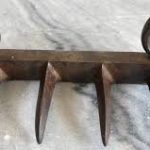
The term “Bagh Nakh,” meaning “tiger claw” in Hindi and Marathi, refers to a traditional Indian weapon made up of a bar with curved blades. It’s designed to slip over the knuckles or be tucked away in the palm for stealthy slashing or stabbing. This weapon is well-known for its association with Chhatrapati Shivaji Maharaj, who is said to have used it to take down Bijapur Sultanate general Afzal Khan.
Design and Function:
- The Bagh Nakh, often referred to as “Wagh Nakh” in Marathi, is a fierce claw-like weapon crafted for close combat.
- It generally has four or five curved blades that are secured to a crossbar or glove, allowing for rapid and lethal attacks.
- Designed to slice through skin and muscle, it’s definitely a weapon to be reckoned with.
Historical Significance:
The weapon is most famously linked to Chhatrapati Shivaji Maharaj, the founder of the Maratha Empire, who reportedly used it to defeat Bijapur Sultanate general Afzal Khan in 1659. According to The Hindu, this weapon was returned to India from London’s Victoria and Albert Museum for a special display in Maharashtra. The Bagh Nakh stands as a powerful symbol of Maratha strength and the clever tactics employed by Shivaji Maharaj.
- Other Names and Usage:
- In Punjabi, it’s known as “Sher Panja” (lion’s claw).
- It was also used by Nihang Sikhs, who often held one in their left hand while wielding a larger weapon in the right.
- Shree Amritsar Sword describes the weapon as a popular weapon among the Maratha warriors.
- Materials:
- The claws are typically made of carbon steel, while the crossbar and rings are made of brass.