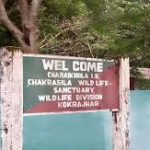
Chakrashila Wildlife Sanctuary is a wildlife sanctuary located in the Kokrajhar district and some bordering areas of Dhubri district of Assam, India. It is well known for the golden langur and is the second protected habitat for golden langur, after Manas National Park, in India.
Chakrashila Hill was first designated as reserve forest in 1966 and on July 14, 1994 it was designated as a sanctuary by the Government of Assam. Nature’s Beckon, a local environmental activist group, played a key role in this designation.
The sanctuary covers an area of 45.568 km2 (4556.8 hectares) and it is approximately 6 km from Kokrajhar town, 68 km from Dhubri town and 219 km from Lokpriya Gopinath Bordoloi International Airport, Guwahati. The sanctuary is principally a hilly expanse running north-south. There are two lakes (Dheer Beel and Diplai Beel) to the east and west of the sanctuary which contribute to the eco-system of the sanctuary. The lower hilly reaches are covered with sal coppice regeneration while the middle and upper reaches are covered with mixed deciduous forests.
This sanctuary has various mammals and birds, twenty-three species of reptiles including snakes, lizards and turtles, and more than forty species of butterfly. Some of the mammal species recorded in this sanctuary are Indian short-tailed mole, Indian flying fox, short nosed fruit bat, Indian false vampire, Indian pipistrelle, rhesus macaque, Chinese pangolin, Asiatic jackal and Bengal fox. Hornbills are also found here. It also protects a number of endangered species of animals.
A total of 119 species of birds have been recorded in the Chakrashila Wildlife Sanctuary. This number includes three globally threatened species.Some of the species recorded here include black francolin (Francolinus francolinus), jungle bush quail (Perdicula asiatica), lesser whistling duck, cinnamon bittern, Indian pond heron, cattle egret, purple heron, red-necked falcon, red-headed vulture, greater spotted eagle, and bronze-winged jacana.