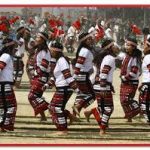
Cheraw or Bamboo dance is a dance of the Mizo culture of Mizoram, where six to eight people, are holding two sticks of bamboo each and are balancing another bamboo in a horizontal position on the ground. The males then clap the bamboos in a rhythm for the females to step on the space between the beating bamboos.
Key Points:
• It is a folk dance of Mizoram performed with bamboo sticks.
• Most likely classified as foreign origin, as the females dancing to the rhythms of bamboo while the men tapping long pairs of bamboos in rhythmic beats.
• Cheraw dance is characterized by the use of bamboo staves, arranged on the ground in the cross and horizontal pattern.
• Female dancers step in and out of the bamboo block while the male dancers establishing the bamboo staves in rhythmic rhythms.
• Cheraw remains one of the oldest dances of Mizoram and became a characteristic of nearly every celebration in Mizoram.
• The movements depicted in nature such as the swaying of trees and the flight of birds, served as inspirations for the dancers steps.
• The swiftness and skill of the performers are remarkable, but the dance’s beauty is enhanced with the colorful attire.
• The female dancers wear; Thihna (the necklace), a Vakiria (bamboo head-dress with bright objects as decoration like feathers), a Kawrchei (blouse), and a Puanchei (sarong) all in white, red, green, and black.
• The male dance is wearing a bandana and a Mizo shawl.
This dance is performed at festivals like Chapchar Kut, weddings, harvest festivals, and other community gatherings