

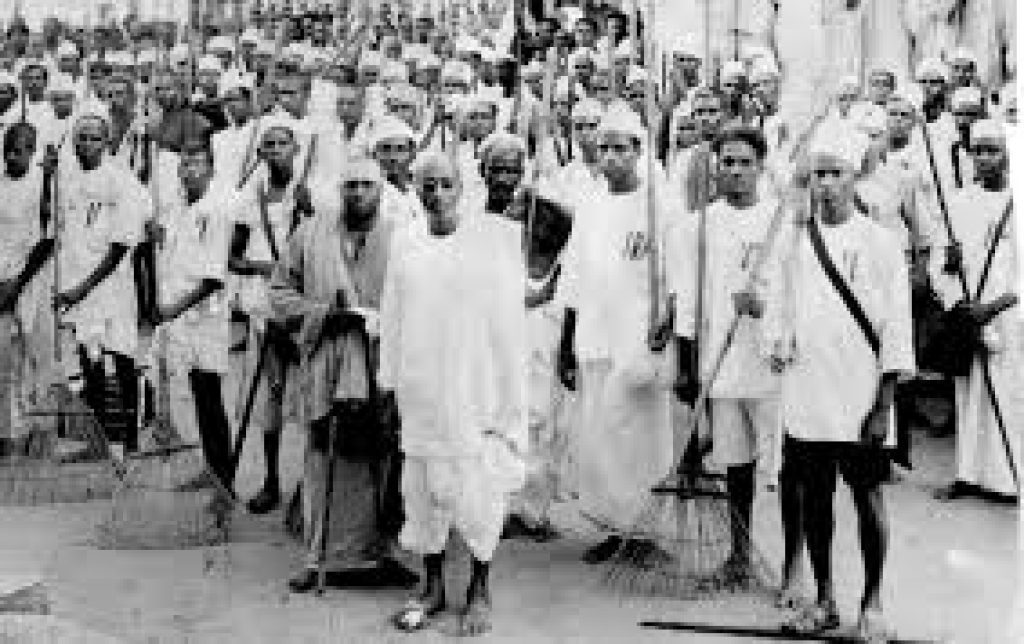
Under the leadership of Mahatma Gandhi, the Civil Disobedience Movement (CDM) was a crucial moment in India’s fight for freedom and began in 1930. After the Non-Cooperation Movement (happening between 1920 and 1922), aimed at directly challenging British authority by deliberately breaking unjust laws.
The reasons behind the Civil Disobedience Movement:
Failure of the Simon Commission (1927-28): None of the commission’s members were Indian, and its report did not find favor with most people.
India’s people began calling for Purna Swaraj (Complete Independence) from the British. At the Lahore session in 1929, the Indian National Congress announced that its top aim was Purna Swaraj.
Gandhi’s Eleven Demands: In January 1930, Gandhi sent British leaders eleven demands that related to various problems of economics, politics, and society. What had the longest impact was the ending of the salt tax. When the demands were not granted, the government allowed the war to start.
Economic Depression: Economic problems created by the Great Depression added to the resentment against British rule.
Key Features and Programme of the Civil Disobedience Movement:
- Breaking the Salt Law (Salt Satyagraha): This was the symbolic launch of the movement. Gandhi, along with 78 followers, embarked on the Dandi March from Sabarmati Ashram to the coastal village of Dandi, where they made salt by evaporating seawater on April 6, 1930, defying the government’s salt monopoly.
- Non-Payment of Taxes: Land revenue and other taxes were not paid by people from several parts of the country.
- Boycott of British Goods: People in France worked hard to cut out the use of British goods.
- Boycott of Government Institutions: This ranged from schools, colleges, law courts, and services provided by the government.
- Picketing of Liquor and Foreign Cloth Shops: Peaceful protests were organized outside shops selling liquor and foreign goods.
- Forest Satyagraha: In some regions, people defied forest laws, such as those restricting access to forest produce.
- Resignations from Government Posts: Indians holding government positions were urged to resign.
Mahatma Gandhi’s Role:
- Gandhi led the movement by setting the ideology and choosing a strategy of non-violent action.
- Millions in India were paid attention by his breaking of the salt law in Dandi.
- He gathered aid from people from every sector, including women, students, peasants, and tribals.
Spread of the Movement:
The Civil Disobedience Movement spread rapidly across India, with various regional leaders and local initiatives:
- Tamil Nadu: C. Rajagopalachari was one of those who participated in a salt march from Tiruchirappalli to Vedaranniyam.
- Bengal: The Salt Satyagraha and the campaign against chowkidari tax were among the most influential movements.
- North-West Frontier Province: Under Badshah Khan’s leadership, the Khudai Khidmatgars made a major impact.
- Bihar and Uttar Pradesh: The peasants refused to give the revenue and chowkidari tax.
- Bombay: Workers from the textile industry went on strike, and marches were organized in the cities.
Civil Disobedience Movement in Assam:
Assam took part in the Civil Disobedience Movement, showing its loyalty to the nation.
- Salt Satyagraha: Although being landlocked, salt satyagrahas were carried out throughout Assam to protest against the law on salt.
- Picketing and Boycotts: Stores that offered foreign items and liquor were surrounded by pickets. Students and teachers did not participate in government institutions.
- Non-Payment of Taxes: People protested against some of the taxes they were required to pay.
- Local Leadership: Many important roles in encouraging people in Assam were taken by leaders like Gopinath Bordoloi, Tarun Ram Phukan, Nabin Chandra Bardoloi, Chandranath Sarma, and Omeo Kumar Das.
- Women’s Participation: Many Assamese women took part in various protests such as processions and picketing. She played an active role in the independence movement by leading revolutions.
- Cunningham Circular (1930): The British government issued the Cunningham Circular to discourage students from participating in the movement by threatening to withhold recognition from schools that allowed political activities. This repressive measure, however, led to further defiance, with many students leaving government schools to join nationalist schools.
- Kamakshya Prasad Das: A nationalist from Kamrup, he played a significant role in organizing the CDM in the region and faced imprisonment.
What the Civil Disobedience Movement Achieved and How Far It Could Go:
- Mass Mobilization: More people and women, especially in rural areas, joined the CDM than they had the Non-Cooperation Movement.
- Weakening of British Authority: It helped to weaken British rule and proved once more how strong Indian nationalism was.
- International Attention: The march to Dandi and the harsh way it was handled caught the attention of many countries, making it clear how the British governed.
- Gandhi-Irwin Pact (1931): Because of the movement, Gandhi discussed things with Lord Irwin, the Viceroy, who agreed to release all political prisoners and allow some changes to the salt tax, while the Congress agreed to stop the CDM and send a team to the Second Round Table Conference.
- Resumption and Withdrawal: The CDM was restarted after the Second Round Table Conference ended in 1932, though a combination of government suppression and growing disagreements within the movement led to its weakness. It was finally withdrawn in 1934.
- Limited Muslim Participation: The Non-Cooperation Movement saw less active involvement from Muslims because of several factors, such as the rapidly increasing influence of the Muslim League.
- No Immediate Independence: The cause did not succeed in gaining complete independence at first, but the pressure put on the British government by the masses made a big difference.