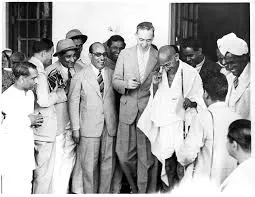
The Cripps Mission Proposals (1942) were the British government’s plan to negotiate a form of Indian self-governance during World War II, dominion status, and the establishment of a Constituent Assembly after the end of the War. Primarily due to British distrust of Indian leadership, the British government rejected these proposals in the mid-1940’s, a suicidal stance that triggered the Quit India Movement. The aim of this article is to study the Cripps Mission Proposals, their intention, the response of Indian political groups, and their impact on the freedom struggle.
What are the Cripps Mission Proposals
• The Cripps Mission was a British initiative during World War II to placate Indian aspirations for self-governance, and simultaneously secure Indian support for the war effort.
• The Cripps Mission was led by Sir Stafford Cripps, a member of the War Cabinet. The Cripps Mission, met Indian leaders on an all-political basis, traveled to India and arrived on the 22 March 1942.
• The proposals were advanced on the 30 March 1942, and were rejected by the major Indian political groups, and was later a significant turning point in India’s struggle for independence.
Background of Cripps Mission Proposals
• By 1942, the world was engulfed in the war; and the British were being addressed by the United States and their ally China regarding growing unrest in India, as well as growing demands for freedom and independence in general.
• The Indian National Congress, various other political groups had been seeking more autonomy; however, India’s erstwhile distrust beginning with the August Offer was deepening worse in 1942.
• British leaders were now aware of India’s strategic value notionally contemplative of cooperating in the war effort for heritage and future purposes. They also opined that the proposals would sugar-coat metaphoric actions attempting to ameliorate the expectations still fully asserting independence.
Cripps Mission Main Proposals
• Constituent Assembly Formation: After the war, a Constituent Assembly would be convened to write India’s constitution.
o Elections would be conducted through proportional representation by the provincial assemblies to fill the members.
o The princes would appoint representatives to the Assembly.
• Indian Union and Dominion Status: India would have dominion status, which allows for self-governance, but India,at the same time, would remain part of the British Commonwealth.
o The Indian Union would have autonomy to join international organisations such as United Nations and establish its own relationship with the international community.
• Accepting the New Constitution: The British Government would accept the constitution by the Constituent Assembly, but with two specific conditions:
o Provinces which were unwilling to join the Indian Union could leave, make their own constitution, and make their independent unions.
o A treaty would be made between the British Government and the Government of India to ensure the transfer of power, and to ensure protection for minorities.
• Constant British Power: The British Government would continue to have power in India until the transfer of power was complete, especially in regards to providing security of the defence of India.
o This provision was put in place to maintain stability for the British Government and their military interests at this time of global conflict.
Members of Cripps Mission
- TheCripps Missionwas sent to India inMarch 1942during World War II to negotiate constitutional reforms.
- It was led bySir Stafford Cripps,a senior British politician and member of the War Cabinet.
- Other prominent members of the mission includedLord Privy Seal, Sir Reginald Maxwell,and officials from the British government.
- The mission aimed to gain Indian support for the war effort by offering adominion statusafter the war and the possibility of framing a new constitution.
- However, its proposals were rejected by major Indian political parties, including the Congress and the Muslim League, as they failed to address key demands like full independence and safeguards for minorities.
Impact of Cripps Mission
• A Fundamental Change in Gandhi’s Thinking: Gandhi became convinced that India’s safety meant the British must leave, particularly due to the prospect of a Japanese invasion.
• Trigger for ‘Quit India’ Movement: The failure of the Cripps Mission led to the ‘Quit India’ Resolution on 14 July 1942 which escalated demands for British withdrawal.
• Demonstration of British Weakness: The mission also illustrated the British in their failure to respond to Indian goals, [There could be a focus on the terms ‘magnitude’ or ‘end’] rather only further separating the nationalists from them.