Electrical Circuits for APGCL Junior Manager Exam: Syllabus, Notes, Formulae and PYQ-Based MCQs
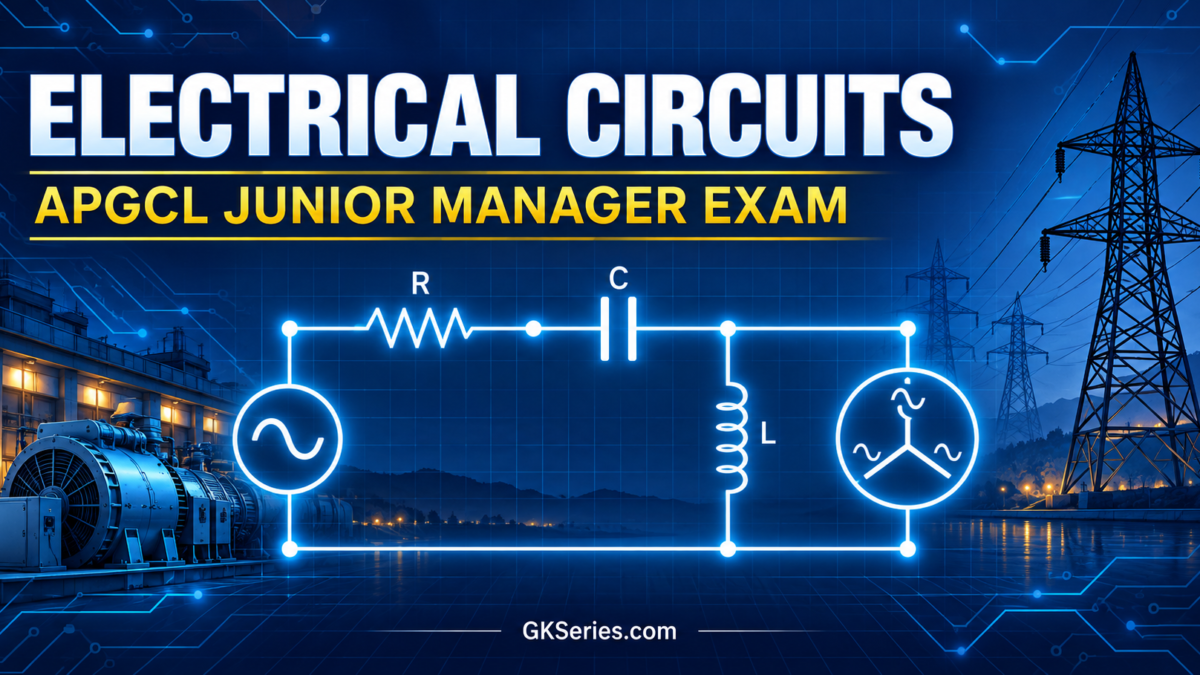
Electrical Circuits for APGCL Junior Manager Exam
The subject Electrical Circuits is one of the important subjects in Electrical Engineering for APGCL Junior Manager exam. It lays down the foundation for the study of electrical machines, measurements, power systems, protection, and power electronics.
Numerical questions related to KCL, KVL, nodal analysis, mesh analysis, network theorems, transient analysis of RL and RC circuits, AC circuits, resonance, three phase circuits, and power factor need to be prepared in the subject Electrical Circuits for the exam APGCL Junior Manager Electrical.
TAKE FREE MOCK TEST FOR APGCL JUNIOR MANAGER EXAM
Overview
APGCL Junior Manager – Electrical Circuits:
This subject deals with DC and AC network analysis by applying rules and theorems of circuits. The important topics in this area are resistance, inductance, capacitance, Kirchhoff’s laws, Thevenin and Norton equivalents, maximum power transfer, transient analysis, resonance, star-delta transformation, and three-phase power. It is advisable to practice both concept-based objective type questions and formula based numericals as definitions can be asked directly in the exam.
Electrical Circuits Syllabus for APGCL JM
| Topic | Important areas |
|---|---|
| Basic circuit elements | Resistance, inductance, capacitance, independent/dependent sources |
| Circuit laws | Ohm’s law, KCL, KVL, source transformation |
| Network analysis | Node-voltage method, mesh-current method, supernode and supermesh |
| Network theorems | Superposition, Thevenin, Norton, maximum power transfer |
| Transients | RL, RC and RLC circuits; time constant |
| AC circuits | Phasors, impedance, admittance, active/reactive/apparent power |
| Resonance | Series and parallel resonance, bandwidth, quality factor |
| Three-phase circuits | Star/delta connection, balanced load, two-wattmeter method |
| Two-port networks | Basic parameters and network behaviour |
Core Concepts You Must Revise
1. Kirchhoff’s Laws
- KCL: Algebraic sum of currents at a node is zero.
- KVL: Algebraic sum of voltages around any closed loop is zero.
- KCL is based on conservation of charge.
- KVL is based on conservation of energy.
2. Circuit Theorems
- Thevenin’s theorem: Replace a linear two-terminal network by one voltage source in series with one resistance/impedance.
- Norton’s theorem: Replace the same network by one current source in parallel with one resistance/impedance.
- Superposition theorem: Analyse one independent source at a time; deactivate the others.
- Maximum power transfer theorem: For DC circuits, maximum power reaches the load when \(R_L=R_{Th}\).
3. RL and RC Transients
- RL time constant: \(\tau=L/R\)
- RC time constant: \(\tau=RC\)
- A circuit is considered practically settled after about \(5\tau\).
- Inductor current cannot change instantaneously.
- Capacitor voltage cannot change instantaneously.
4. AC Circuit Basics
- Inductive reactance: \(X_L=2\pi fL\)
- Capacitive reactance: \(X_C=\frac{1}{2\pi fC}\)
- Impedance in series RL circuit: \(Z=\sqrt{R^2+X_L^2}\)
- Power factor: \(\cos\phi=R/Z\)
- Active power: \(P=VI\cos\phi\)
- Reactive power: \(Q=VI\sin\phi\)
- Apparent power: \(S=VI\)
5. Resonance
In a series RLC circuit, resonance occurs when:\[ X_L=X_C \]
At resonance:
- Net reactance is zero.
- Impedance is minimum in a series RLC circuit.
- Current is maximum.
- Power factor becomes unity.
In a parallel resonant circuit:
- Input impedance is maximum.
- Line current is minimum.
- Current magnification occurs.
6. Three-Phase Circuit Formulae
\[ P=\sqrt{3}V_LI_L\cos\phi \]\[ Q=\sqrt{3}V_LI_L\sin\phi \]\[ S=\sqrt{3}V_LI_L \]
For star connection:\[ V_L=\sqrt{3}V_{ph}, \qquad I_L=I_{ph} \]
For delta connection:\[ V_L=V_{ph}, \qquad I_L=\sqrt{3}I_{ph} \]
Quick Revision Formulae
- \(V=IR\)
- \(P=VI=I^2R=\frac{V^2}{R}\)
- \(W_L=\frac{1}{2}LI^2\)
- \(W_C=\frac{1}{2}CV^2\)
- \(Q=CV\)
- \(Y=\frac{1}{Z}\)
- \(f_r=\frac{1}{2\pi\sqrt{LC}}\)
- \(R_Y=\frac{R_\Delta}{3}\) for a balanced delta network
- \(R_\Delta=3R_Y\) for a balanced star network
PYQ-Based Electrical Circuits MCQs for APGCL JM
1. In a circuit, the algebraic sum of currents meeting at a node is zero. This is known as:
A. Ohm’s law
B. Kirchhoff’s Current Law
C. Kirchhoff’s Voltage Law
D. Faraday’s law
Correct Answer: B. Kirchhoff’s Current Law
Explanation: KCL states that total current entering a junction equals total current leaving it. It follows conservation of electric charge.
Exam: SSC JE Electrical, 2018
2. A 5 Ω resistor carries a current of 2 A. Power dissipated is:
A. 5 W
B. 10 W
C. 20 W
D. 40 W
Correct Answer: C. 20 W
Explanation: \(P=I^2R=2^2\times5=20\) W.
Exam: SSC JE Electrical, 2018
3. A 40 μF capacitor is charged to 500 V. Charge stored is:
A. 0.002 C
B. 0.02 C
C. 0.2 C
D. 2 C
Correct Answer: B. 0.02 C
Explanation: \(Q=CV=40\times10^{-6}\times500=0.02\) C.
Exam: SSC JE Electrical, 2016
4. In a series RL circuit, \(L=0.6\) H and \(R=30\ \Omega\). Time constant is:
A. 0.2 s
B. 0.02 s
C. 0.5 s
D. 0.05 s
Correct Answer: B. 0.02 s
Explanation: \(\tau=L/R=0.6/30=0.02\) s. The circuit reaches near steady state in about \(5\tau=0.1\) s.
Exam: SSC JE Electrical, 2018
5. Capacitive reactance is 60 Ω at 50 Hz. Its value at 60 Hz is:
A. 40 Ω
B. 50 Ω
C. 60 Ω
D. 72 Ω
Correct Answer: B. 50 Ω
Explanation: \(X_C\) is inversely proportional to frequency. Thus, \(X_{C2}=60\times50/60=50\ \Omega\).
Exam: SSC JE Electrical, 2018
6. The admittance of a circuit is \(0.03-j0.04\) siemen. Its impedance is:
A. \(12+j16\ \Omega\)
B. \(12-j16\ \Omega\)
C. \(16+j12\ \Omega\)
D. \(8+j8\ \Omega\)
Correct Answer: A. \(12+j16\ \Omega\)
Explanation: \(Z=1/Y\). On rationalising, \(Z=(0.03+j0.04)/0.0025=12+j16\ \Omega\).
Exam: SSC JE Electrical, 2022
7. A balanced delta network has 36 Ω resistance in each phase. Equivalent star resistance per phase is:
A. 6 Ω
B. 12 Ω
C. 18 Ω
D. 36 Ω
Correct Answer: B. 12 Ω
Explanation: For balanced networks, \(R_Y=R_\Delta/3=36/3=12\ \Omega\).
Exam: SSC JE Electrical, 2018
8. In a series RLC circuit at resonance, the impedance is:
A. Maximum
B. Minimum
C. Infinite
D. Zero for every practical circuit
Correct Answer: B. Minimum
Explanation: At resonance, \(X_L=X_C\), so reactive effects cancel. The remaining impedance is essentially resistance only.
9. For maximum power transfer in a DC network:
A. \(R_L=0\)
B. \(R_L\gt R_{Th}\)
C. \(R_L=R_{Th}\)
D. \(R_L\lt R_{Th}\)
Correct Answer: C. \(R_L=R_{Th}\)
Explanation: Maximum load power is delivered when load resistance equals Thevenin resistance seen from the load terminals.
10. A three-phase system has line voltage 250 V and line current 40 A. Apparent power is:
A. 10 kVA
B. 13.86 kVA
C. 17.32 kVA
D. 20 kVA
Correct Answer: C. 17.32 kVA
Explanation: \(S=\sqrt3V_LI_L=1.732\times250\times40=17.32\) kVA.
Exam: SSC JE Electrical, 2018
Preparation Strategy for APGCL Junior Manager
- Start with KCL, KVL, series-parallel circuits and source transformation.
- Learn node and mesh analysis through daily numerical practice.
- Memorise the conditions and limitations of Thevenin, Norton, superposition and maximum power transfer theorems.
- Practise at least 20 questions each on RL/RC transients, AC impedance, resonance and three-phase power.
- Maintain one formula notebook for circuit theory.
- Solve numerical questions without a calculator wherever possible.
- Revise errors from mock tests, especially sign conventions, phasor angles and unit conversions.
Frequently Asked Questions
Is Electrical Circuits important for APGCL Junior Manager Electrical?
Yes. It is a foundation topic and directly supports questions from machines, measurements, power systems, protection and power electronics.
Which circuit topics are most important?
KCL, KVL, node analysis, mesh analysis, network theorems, RC/RL transients, resonance, AC power, star-delta conversion and three-phase circuits are the highest-priority areas.
Are numerical questions expected?
Yes. Candidates should expect direct formula questions as well as moderate numerical problems involving impedance, power factor, resonance, transients and three-phase power.
How should I revise Electrical Circuits quickly?
Revise formulas daily, solve topic-wise MCQs, practise previous-year patterns and make a short list of common mistakes in signs, units, phasor angles and star-delta relations.
Electrical Circuits could be an examinable topic in APGCL Junior Manager test provided that the revision of topics and formulas is done effectively. First, gain understanding on the laws and theories related to circuits and networks, then proceed with the study of transients, AC analysis, resonance, and three-phase circuits.