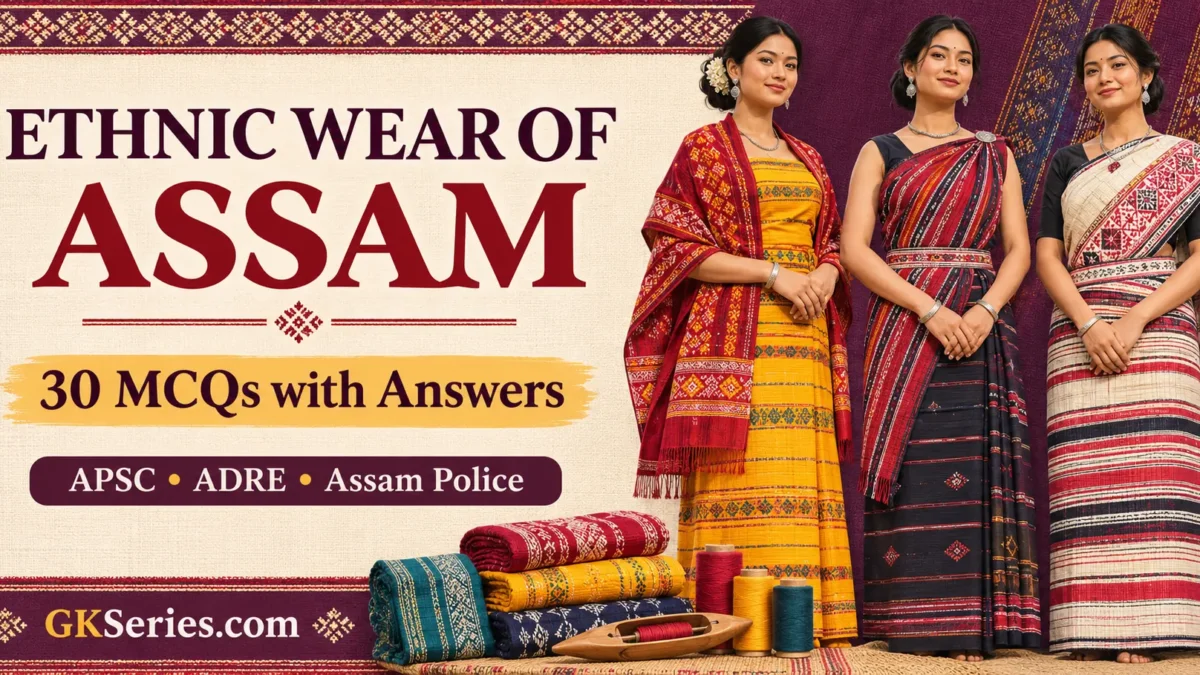
Ethnic Wear of Assam: 30 MCQs with Answers
Assam’s communities have distinct clothing traditions, from the Bodo Dokhona and Jwmgra to the Karbi Pekok and Dimasa Rigu. These garments differ in how they are worn, the occasions they mark and the designs woven into them. This set of 30 questions on Ethnic Wear of Assam covers traditional garments, head coverings, ceremonial scarves and bridal attire. It is useful for APSC Prelims, ADRE, Assam Police and other state recruitment examinations. As you practise, connect each garment with its community and function. Some English spellings vary between cultural records, so pay attention to the wording of each question.
Overview
Traditional clothing in Assam includes wraparound garments, upper-body cloths, headgear and ceremonial textiles. Bodo women wear the Dokhona with the Jwmgra, while the Aronai is an important Bodo scarf used during cultural occasions and felicitation. Karbi clothing includes the Pini, Pekok and men’s Poho headgear. Mising women’s attire includes the Ege, and Dimasa women wear garments such as the Rigu and Rikhaosa. Ethnic Wear of Assam also includes Deori, Rabha and Hajong clothing traditions. Garment names may have different spellings, and descriptions sometimes reflect a particular locality or publication rather than every practice within a community.
One-Liner Points
- Dokhona is a traditional garment worn by Bodo women.
- Aronai is a Bodo cloth used to honour or felicitate people.
- Jwmgra is an upper-body scarf worn by Bodo women with the Dokhona.
- Pekok is an upper-body drape associated with Karbi women.
- Pini is a traditional lower garment associated with Karbi women.
- Ege is a lower wraparound garment worn by Mising women.
- Ri:bi and Gaseng are upper-body cloths associated with Mising women.
- Rigu is a lower-body garment worn by Dimasa women.
- Sgaopha or phagri refers to traditional Dimasa men’s headgear.
- Rifan and Kambung are associated with Rabha women’s attire.
- Rifan is described as a lower garment, while Kambung covers the upper body.
- NCERT identifies Hura as a head-dress in its description of Mising women’s attire.
- NCERT lists mibu-galuk, tongali and gonroo among Mising men’s garments.
- Poho is traditional headgear worn by Karbi men.
- NCERT describes pinicamflak as a shorter version of the mekhela.
- NCERT describes the Deori women’s Igo as extending from below the shoulders to the ankles.
- Gathiki is identified as a head covering in NCERT’s account of Deori women’s attire.
- Rangputin is identified as the Hajong women’s lower garment in NCERT.
- Pasra or Agrun is identified as the Hajong women’s upper garment in NCERT.
- Pakri is recorded as headgear in descriptions of Dimasa men’s attire.
- Dokhona Thaosi is associated with Bodo bridal and ceremonial dress.
- A government handloom entry identifies yellow Matha Dokhona with bridal attire.
- Agor refers to decorative designs or motifs in Bodo textiles.
- The Aronai can be draped across the chest and shoulders as a mark of honour.
- Rikhausa is described as an upper-body cloth similar to a chaddar.
- IGNCA compares the Dimasa men’s Risha to a dhoti.
- IGNCA describes a deep-green Risha in its account of Dimasa attire.
- Rikhaosa is associated with dances and ceremonial occasions in IGNCA’s description.
- Rikhausa and Rikhaosa are spelling forms encountered in descriptions of Dimasa clothing.
- Traditional garment names should be learned alongside their community, wearer and function.
Assam History Multiple Choice Questions(MCQs) and Answers
Ethnic Wear of Assam MCQs with Answers and Detailed Explanations
Question 1: The Dokhona is a traditional garment worn by women of which community in Assam?
(a) Karbi
(b) Mising
(c) Bodo
(d) Dimasa
Correct Answer: (c) Bodo
Detailed Explanation:
Dokhona is a traditional garment worn by Bodo women. It is a wraparound cloth that forms a central part of their traditional attire. The Chirang district administration identifies it specifically with Bodo women. Karbi, Mising and Dimasa women have their own garment traditions, including Pekok, Ege and Rigu respectively.
Key Points for Revision
- Dokhona — Bodo women.
- It is a wraparound garment.
- It forms an important part of Bodo textile traditions.
Question 2: Which statement best describes the traditional use of the Aronai among the Bodos?
(a) It is a lower garment worn by Mising women.
(b) It is a traditional cloth used to honour or felicitate people.
(c) It is a turban worn by Dimasa men.
(d) It is a Karbi waist belt.
Correct Answer: (b) It is a traditional cloth used to honour or felicitate people.
Detailed Explanation:
The Aronai is an important Bodo traditional cloth used to honour guests and felicitate people. It may also be worn as a scarf and used during cultural occasions. The question asks for its ceremonial role. It is not the Mising women’s lower garment, a Dimasa turban or a Karbi waist belt.
Key Points for Revision
- Aronai — Bodo traditional scarf.
- It is used in felicitation.
- It also appears in cultural performances and celebrations.
Question 3: Which of the following is identified as part of the traditional attire of Bodo women, along with the Dokhona?
(a) Jwmgra
(b) Pekok
(c) Rigu
(d) Rifan
Correct Answer: (a) Jwmgra
Detailed Explanation:
Jwmgra is worn by Bodo women with the Dokhona. It serves as a scarf or cloth covering the upper body. Pekok belongs to Karbi clothing traditions, Rigu to Dimasa attire, and Rifan to Rabha attire. The pairing of Dokhona and Jwmgra is therefore the relevant Bodo association.
Key Points for Revision
- Dokhona and Jwmgra — Bodo women’s attire.
- Jwmgra — upper-body scarf.
- Pekok — Karbi; Rigu — Dimasa.
Question 4: In traditional Karbi women’s attire, what is the Pekok?
(a) A lower garment worn from the waist to the knee
(b) An upper-body drape pinned above the right shoulder
(c) A men’s turban
(d) A scarf used to honour guests
Correct Answer: (b) An upper-body drape pinned above the right shoulder
Detailed Explanation:
A publication hosted by the Ministry of External Affairs describes the Pekok, also written pe-kok, as an upper-body drape pinned above the right shoulder. It distinguishes this from the pinicamflak worn from the waist towards the knee. The shoulder detail is part of that particular description of Karbi attire.
Key Points for Revision
- Pekok — Karbi women’s upper-body drape.
- It is described as pinned above the right shoulder.
- Pinicamflak is a separate lower garment.
Question 5: The Pini is a traditional garment associated with which community of Assam?
(a) Bodo
(b) Karbi
(c) Dimasa
(d) Rabha
Correct Answer: (b) Karbi
Detailed Explanation:
Pini is associated with Karbi women’s traditional attire and is worn as a lower garment. Pekok is an upper-body cloth in the same clothing tradition. Garment names and styles can vary between descriptions, but the community association tested here is Karbi.
Key Points for Revision
- Pini — Karbi women’s garment.
- Its function is that of a lower garment.
- Pekok is associated with the upper body.
Question 6: In descriptions of Mising women’s traditional attire, what is the Ege?
(a) A lower wraparound garment
(b) A man’s turban
(c) A Bodo ceremonial scarf
(d) A Karbi waist belt
Correct Answer: (a) A lower wraparound garment
Detailed Explanation:
Ege is a lower garment worn by Mising women, wrapped around the waist and extending down the body. Community descriptions distinguish it from upper-body cloths such as Ri:bi and Gaseng. It should not be confused with the Bodo Aronai or Karbi clothing accessories.
Key Points for Revision
- Ege — Mising women’s lower garment.
- It is worn as a wraparound.
- Ri:bi and Gaseng are upper-body cloths.
Question 7: The Rigu is a traditional garment worn by women of which community in Assam?
(a) Bodo
(b) Dimasa
(c) Karbi
(d) Mising
Correct Answer: (b) Dimasa
Detailed Explanation:
Rigu is a lower-body garment worn by Dimasa women. IGNCA describes it as a skirt-like garment comparable to an Assamese mekhela. Different accounts may use variant spellings or describe additional pieces of the outfit, but Rigu is firmly associated with Dimasa women’s attire.
Key Points for Revision
- Rigu — Dimasa women.
- It covers the lower body.
- It is described as skirt-like or wraparound clothing.
Question 8: The term sgaopha or phagri refers to which item in traditional Dimasa men’s attire?
(a) A headgear or turban
(b) A lower-body wrap
(c) A shoulder cloth worn by women
(d) A waist belt
Correct Answer: (a) A headgear or turban
Detailed Explanation:
Sgaopha or phagri refers to a turban or head covering associated with Dimasa men. These terms identify headgear, rather than a lower garment or belt. Spellings differ across English-language descriptions of Dimasa clothing.
Key Points for Revision
- Sgaopha/phagri — Dimasa men’s headgear.
- It is a turban.
- English spellings may vary.
Question 9: Which pair of garment names is associated with Rabha women in a study of the Rabha community in western Assam?
(a) Dokhona and Jwmgra
(b) Pekok and Pinicamflak
(c) Rifan and Kambung
(d) Rigu and Rajanthai
Correct Answer: (c) Rifan and Kambung
Detailed Explanation:
The study identifies Rifan as a garment for the lower part of a Rabha woman’s body and Kambung as an upper-body cloth. The other pairs belong to Bodo, Karbi and Dimasa clothing traditions. These names reflect the terminology recorded in the study; forms and usage can vary within the wider community.
Key Points for Revision
- Rifan and Kambung — Rabha women.
- Rifan — lower garment.
- Kambung — upper-body cloth.
Question 10: Consider the following pairs:
- Bodo — Dokhona
- Karbi — Pekok
- Mising — Ege
- Dimasa — Rigu
Which of the pairs are correctly matched?
(a) 1 and 2 only
(b) 1, 2 and 3 only
(c) 2, 3 and 4 only
(d) 1, 2, 3 and 4
Correct Answer: (d) 1, 2, 3 and 4
Detailed Explanation:
All four pairs are correct. Dokhona belongs to Bodo women’s attire, Pekok to Karbi women’s attire, Ege to Mising women’s attire, and Rigu to Dimasa women’s attire. Each of the other answer codes leaves out at least one correctly matched pair.
Key Points for Revision
- Bodo — Dokhona.
- Karbi — Pekok.
- Mising — Ege.
- Dimasa — Rigu.
Question 11: In an NCERT description of Mising women’s traditional attire, which item is identified as a head-dress?
(a) Hura
(b) Poho
(c) Gathiki
(d) Aronai
Correct Answer: (a) Hura
Detailed Explanation:
NCERT identifies Hura as a head-dress in its description of Mising women’s attire. The same passage mentions sampan around the waist and galuk on the upper body. The source qualifier matters because other community descriptions use additional clothing terms. Poho is associated with Karbi men’s headgear, while Gathiki is identified with Deori women’s head covering.
Key Points for Revision
- Hura — Mising women’s head-dress in NCERT.
- Sampan and galuk appear in the same description.
- Poho — Karbi men’s headgear.
Question 12: The garments mibu-galuk, tongali and gonroo are listed by NCERT as part of the traditional attire of men of which Assam community?
(a) Dimasa
(b) Mising
(c) Bodo
(d) Hajong
Correct Answer: (b) Mising
Detailed Explanation:
NCERT lists mibu-galuk, tongali and gonroo among the traditional garments worn by Mising men. The trio should therefore be remembered as a community–attire association. Spelling forms such as Mibu Galuk and Gonroo can differ between publications.
Key Points for Revision
- Mibu-galuk — Mising men’s attire.
- Tongali and gonroo occur in the same NCERT list.
- Transliteration can produce spelling variations.
Question 13: In traditional Karbi attire, the Poho is described as which item?
(a) A turban or headgear worn by men
(b) A women’s lower garment
(c) A Bodo ceremonial scarf
(d) A Dimasa waist cloth
Correct Answer: (a) A turban or headgear worn by men
Detailed Explanation:
Poho is traditional headgear worn by Karbi men. NCERT describes it as a turban. It is different from the Pini or pinicamflak associated with Karbi women’s lower-body clothing and from the Bodo Aronai scarf.
Key Points for Revision
- Poho — Karbi men.
- Garment type: Turban or headgear.
- It is different from Karbi women’s lower garments.
Question 14: NCERT describes the Karbi women’s pinicamflak as which type of garment?
(a) A head-dress
(b) A shorter version of the mekhela
(c) A men’s jacket
(d) A ceremonial scarf
Correct Answer: (b) A shorter version of the mekhela
Detailed Explanation:
NCERT describes pinicamflak as a shorter version of the mekhela worn by Karbi women. A mekhela is a skirt-like lower garment. The description therefore places pinicamflak in the lower-body clothing category, rather than identifying it as headwear, a jacket or a scarf.
Key Points for Revision
- Pinicamflak — Karbi women.
- NCERT compares it with a shorter mekhela.
- It is a lower garment.
Question 15: According to NCERT, the Deori women’s garment igo covers the body from below the shoulders to approximately which point?
(a) The waist
(b) The knee
(c) The ankles
(d) The head
Correct Answer: (c) The ankles
Detailed Explanation:
NCERT describes the Igo as covering a Deori woman’s body from below the shoulders to the ankles. The question asks about the lower extent of this garment. The same passage identifies separate pieces worn around the waist and over the head.
Key Points for Revision
- Igo — Deori women’s garment.
- It extends from below the shoulders to the ankles.
- It is distinct from a head covering.
Question 16: In NCERT’s description of Deori women’s attire, what is the gathiki used for?
(a) Covering the head
(b) Wearing around the waist
(c) Covering the lower body
(d) Wearing as a men’s jacket
Correct Answer: (a) Covering the head
Detailed Explanation:
Gathiki is identified as a head covering in NCERT’s account of Deori women’s attire. That account distinguishes it from Igo, the main body garment, and jakashiba, worn around the waist. The answer depends on the function of the item, rather than merely recognising the community.
Key Points for Revision
- Gathiki — Deori women’s head covering.
- Igo — body garment.
- Jakashiba — worn around the waist.
Question 17: Which garment is described by NCERT as the lower garment worn by Hajong women?
(a) Rangputin
(b) Pekok
(c) Jwmgra
(d) Rigu
Correct Answer: (a) Rangputin
Detailed Explanation:
NCERT identifies Rangputin as the lower garment worn by Hajong women. It names Pasra or Agrun as the upper garment. The other options belong to different community traditions: Pekok is Karbi, Jwmgra is Bodo, and Rigu is Dimasa.
Key Points for Revision
- Rangputin — Hajong women’s lower garment.
- Pasra/Agrun — upper garment.
- The wording follows NCERT’s description.
Question 18: In the NCERT description of Hajong women’s traditional attire, Pasra or Agrun refers to which garment?
(a) The upper garment
(b) The lower garment
(c) A head-dress
(d) A men’s turban
Correct Answer: (a) The upper garment
Detailed Explanation:
Pasra or Agrun is described as the upper garment worn by Hajong women. Rangputin is the lower garment in the same NCERT passage. These paired terms should be learned together to avoid reversing their functions.
Key Points for Revision
- Pasra/Agrun — Hajong women’s upper garment.
- Rangputin — lower garment.
- Neither term is identified here as a men’s turban.
Question 19: The Dima Hasao District Census Handbook identifies Pakri as which part of traditional Dimasa men’s attire?
(a) Headgear
(b) Lower garment
(c) Upper-body shawl
(d) Waist belt
Correct Answer: (a) Headgear
Detailed Explanation:
Pakri refers to men’s headgear in the clothing terminology used in the supplied handbook account. It is distinct from lower garments and upper-body cloths. Dimasa men’s traditional dress descriptions also include turbans under spelling forms such as phagri or sgaopha. The exact spelling and the handbook attribution could not be independently confirmed in the accessible material, so that source-specific detail remains uncertain.
Key Points for Revision
- Pakri is identified as headgear in the supplied account.
- Dimasa men’s attire includes a turban.
- The exact handbook wording remains unconfirmed.
Question 20: Consider the following pairs:
- Mising women — Hura as a head-dress
- Karbi men — Poho as headgear
- Deori women — Gathiki as a head covering
- Hajong women — Rangputin as a lower garment
Which of the pairs given above are correctly matched?
(a) 1 and 2 only
(b) 1, 2 and 3 only
(c) 2, 3 and 4 only
(d) 1, 2, 3 and 4
Correct Answer: (d) 1, 2, 3 and 4
Detailed Explanation:
All four pairs match NCERT’s description. Hura is identified as Mising women’s head-dress. Poho is Karbi men’s headgear. Gathiki covers the head in the account of Deori women’s attire, while Rangputin is identified as Hajong women’s lower garment.
Key Points for Revision
- Mising women — Hura.
- Karbi men — Poho.
- Deori women — Gathiki.
- Hajong women — Rangputin.
Question 21: The special Dokhona Thaosi is associated with which occasion in Bodo attire?
(a) A bride’s traditional dress
(b) A man’s winter headgear
(c) A mourning garment
(d) A child’s naming ceremony
Correct Answer: (a) A bride’s traditional dress
Detailed Explanation:
Dokhona Thaosi is associated with Bodo bridal and ceremonial attire. The correct option identifies its bridal use, but this should not be understood as saying that the garment is worn only by brides. Descriptions also connect special Dokhona forms with other ceremonial participants and occasions.
Key Points for Revision
- Dokhona Thaosi — Bodo bridal attire.
- It is a ceremonial form of the Dokhona.
- Its ceremonial use is not necessarily limited to brides.
Question 22: The Jwmgra is traditionally worn with the Dokhona by Bodo women. What is its principal function?
(a) It covers the upper body
(b) It is a waist belt
(c) It is men’s headgear
(d) It is a lower-body garment
Correct Answer: (a) It covers the upper body
Detailed Explanation:
Jwmgra is an upper-body scarf worn by Bodo women with the Dokhona. It forms part of the outfit used during festivals, weddings and cultural performances. Its function is different from that of a waist belt or head covering.
Key Points for Revision
- Jwmgra — Bodo women’s scarf.
- Function: Upper-body covering.
- It is paired with the Dokhona.
Question 23: In a Government of India handloom database entry on Assam textiles, which colour is identified as the main traditional colour of Matha Dokhona used as bridal attire?
(a) Blue
(b) Yellow
(c) Green
(d) White
Correct Answer: (b) Yellow
Detailed Explanation:
The government handloom entry identifies yellow as the main traditional colour in its description of Matha Dokhona used as bridal attire. It also explains that Matha or Salamatha refers to a plain Dokhona. This is a description of a particular traditional bridal form, rather than a rule that all Dokhonas or all Bodo bridal outfits must be yellow.
Key Points for Revision
- Matha/Salamatha — plain Dokhona.
- The database identifies yellow with bridal use.
- Dokhona is associated with Bodo women.
- Colours and designs vary across garments.
Question 24: The Bodoland GI Heritage page uses the term Agor for which feature on the Bodo Aronai?
(a) Decorative embroidery or motifs
(b) The cloth’s border fringe
(c) A woollen lining
(d) A method of tying it at the waist
Correct Answer: (a) Decorative embroidery or motifs
Detailed Explanation:
Agor refers to decorative designs or motifs in Bodo textiles. The heritage description uses “embroidery,” but these designs are also created through weaving, so “motifs” is the more precise general term. Agor identifies the pattern, rather than fringe, lining or a method of wearing the cloth.
Key Points for Revision
- Agor — textile design or motif.
- Agor designs occur on the Aronai.
- Such motifs may be woven into the fabric.
- Hajw Agor is a named hill design.
Question 25: According to the Bodoland GI Heritage description, how is the Bodo Aronai used as a mark of honour?
(a) It is worn across the chest and shoulders
(b) It is tied around the ankles
(c) It is worn as a turban
(d) It is wrapped around the waist as a belt
Correct Answer: (a) It is worn across the chest and shoulders
Detailed Explanation:
The named heritage description presents the Aronai as a scarf worn across the chest and shoulders as a mark of honour. In felicitation, it is also commonly draped around the neck. The source qualifier is important: ways of wearing the Aronai differ by occasion, and its historical or performance uses are not limited to this one arrangement.
Key Points for Revision
- Aronai — Bodo ceremonial scarf.
- It can be draped across the chest and shoulders.
- Felicitation commonly involves placing it around the neck.
- Wearing styles vary by occasion.
Question 26: Which part of a Dimasa woman’s attire is the Rigu described as covering?
(a) The lower part of the body
(b) The head
(c) The shoulders only
(d) The waist as a belt
Correct Answer: (a) The lower part of the body
Detailed Explanation:
Rigu is a lower-body garment worn by Dimasa women. It is described as a skirt-like or wraparound cloth extending below the waist. It is therefore different from a head covering, an upper-body chaddar or a narrow waist belt.
Key Points for Revision
- Rigu — Dimasa women’s lower garment.
- It covers the body below the waist.
- It is separate from upper-body cloths.
Question 27: In the Northeast Development Agency’s description of Dimasa women’s attire, which garment is compared to a chaddar worn over the upper body?
(a) Rigu
(b) Rijamphain
(c) Rikhausa
(d) Rajanthai
Correct Answer: (c) Rikhausa
Detailed Explanation:
The description identifies Rikhausa as an upper-body cloth comparable to a chaddar, meaning a draped covering. It distinguishes Rigu as a lower garment and Rijamphain as a cloth wrapped around the middle or chest region. The original phrase “the cited description” has been replaced with the organisation’s name to make the question understandable on its own.
Key Points for Revision
- Rikhausa — upper-body chaddar.
- Rigu — lower garment.
- Rijamphain — middle-body or chest covering.
- Terminology can vary between descriptions.
Question 28: The Indira Gandhi National Centre for the Arts describes the Dimasa men’s Risha as similar to which garment?
(a) A dhoti
(b) A turban
(c) A jacket
(d) A shoulder scarf
Correct Answer: (a) A dhoti
Detailed Explanation:
IGNCA describes Risha as a dhoti-like garment worn by Dimasa men and mentions a deep-green example. A dhoti is a cloth wrapped around the lower body. The colour in this account should not be treated as a claim that every Risha has the same colour or use.
Key Points for Revision
- Risha — Dimasa men’s garment.
- IGNCA compares it with a dhoti.
- The account mentions deep green.
- It is distinct from men’s headgear.
Question 29: According to the IGNCA’s resource on Assam textiles, which Dimasa garment is used during dances or ceremonial occasions?
(a) Rikhaosa
(b) Risha
(c) Poho
(d) Pinicamflak
Correct Answer: (a) Rikhaosa
Detailed Explanation:
IGNCA describes Rikhaosa as a designed chaddar used during dances or ceremonial occasions. The same account distinguishes it from Rigu, a women’s lower garment, and Risha, a men’s dhoti-like garment. Poho and pinicamflak belong to Karbi clothing traditions.
Key Points for Revision
- Rikhaosa — ceremonial or dance chaddar.
- Community: Dimasa.
- Risha — men’s dhoti-like garment.
- Poho — Karbi men’s headgear.
Question 30: Consider the following pairs:
- Bodo Jwmgra — upper-body scarf
- Dimasa Rigu — lower-body covering
- Dimasa Rikhaosa — chaddar used during dances or ceremonies
- Dimasa Risha — dhoti-like garment worn by men
Which of the pairs are correctly matched?
(a) 1 and 2 only
(b) 1, 2 and 3 only
(c) 2, 3 and 4 only
(d) 1, 2, 3 and 4
Correct Answer: (d) 1, 2, 3 and 4
Detailed Explanation:
All four pairs are correct in the descriptions used here. Jwmgra is a Bodo women’s upper-body scarf. Rigu covers the lower body in Dimasa women’s attire. IGNCA associates Rikhaosa with dances and ceremonies and describes Risha as a dhoti-like garment worn by Dimasa men.
Key Points for Revision
- Jwmgra — Bodo upper-body scarf.
- Rigu — Dimasa lower-body garment.
- Rikhaosa — Dimasa ceremonial chaddar.
- Risha — Dimasa men’s dhoti-like garment.
Frequently Asked Questions
What is the difference between Dokhona and Jwmgra?
Dokhona is the main wraparound garment worn by Bodo women. Jwmgra is a scarf worn with it to cover the upper body.
What is the Aronai used for?
The Aronai is a Bodo scarf used during cultural occasions and to honour or felicitate people. Its arrangement can differ according to the occasion.
Which traditional garments are associated with Karbi women?
Pini and Pekok are associated with Karbi women’s attire. Pini is a lower garment, while Pekok is an upper-body drape. Some descriptions also use the term pinicamflak for a lower garment.
How are Ege and Rigu different?
Both are lower-body garments, but they belong to different clothing traditions. Ege is associated with Mising women, while Rigu is associated with Dimasa women.
What does Agor mean in Bodo textiles?
Agor means a decorative design or motif. Such designs occur on textiles including the Aronai, Dokhona and Jwmgra, and may be woven into the fabric.
Why do traditional garment names have different English spellings?
English spellings often represent words from community languages through transliteration. Publications may record different pronunciations, local forms or spelling conventions. Learn the community and function alongside the name.
Conclusion
Ethnic Wear of Assam reflects the distinct clothing and weaving traditions of its communities. For revision, learn each garment through three details: who wears it, which community it belongs to and how it is used. Give extra attention to similar names and to the difference between lower garments, upper-body cloths and headgear. Use the answer key to check your recall, while keeping source-specific descriptions and local variations in mind.