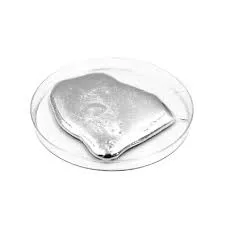
Galinstan refers to an alloy of gallium, indium and tin that is liquid at ordinary room temperatures and freezes at -19ºC.
Here’s some additional information about it:
Composition:
- This mixture of metals is called Galinstan because it becomes liquid at a temperature less than that required for any of its components to melt on their own. The main elements in it are gallium (Ga), indium (In) and tin (Sn).
- The liquid is neither solid nor gas when exposed to room temperature.
- Since Galinstan consists of specific metals, it keeps a liquid state at normal temperatures, meaning it is useful where mercury was once used.
Properties:
It is worth noting that this material has features such as high electrical conductivity, low vapor pressure and decent thermal conductivity.
Applications:
- Electronics: Galinstan is appropriate for touch sensors and is also used to replace mercury in liquid metallic contact points.
- Heat Transfer: It works well for heat transfer tasks such as in oscillating heat pipes.
- Microfluidics: Galinstan can be incorporated into devices that allow very precise control over small amounts of liquids.
- Galinstan is also sometimes chosen for use in thermometers in place of mercury and in experiments displaying the properties of liquid metals.
Safety:
Since galinstan does not contain mercury, it is seen as safer to utilize in various contexts.
Toxicity:
Though Galinstan is not toxic, it may cause irritation if someone comes into direct contact with the liquid.
Oxidation:
Any air exposure leads to Galinstan forming a layer of gallium oxide that protects it.