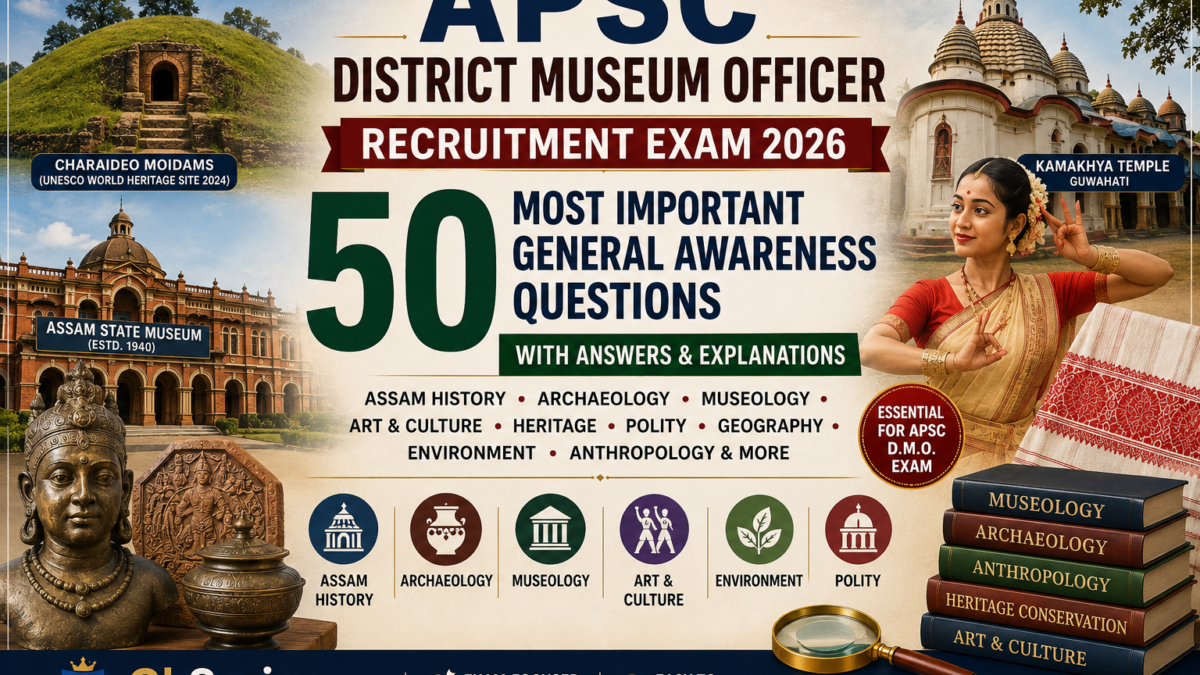
APSC District Museum Officer Recruitment Exam 2026: 50 Most Important General Awareness Questions with Answers & Explanations
Are you preparing for the upcoming APSC District Museum Officer Recruitment Examination? If yes, your preparation should go beyond conventional General Studies. The District Museum Officer examination requires a balanced understanding of Assam history, archaeology, museology, anthropology, art and culture, heritage conservation, Indian polity, geography, environment and general awareness.
For aspirants, the most effective strategy is to identify recurring themes from APSC and other State PSC examinations and combine them with the specialized requirements of museum administration.
This article presents 50 highly important General Awareness questions with answers and detailed explanations, specially selected for candidates preparing for the APSC District Museum Officer examination.
Why General Awareness Is Important for the APSC District Museum Officer Exam
A District Museum Officer is expected to understand not only museum administration but also the historical and cultural context of the objects and traditions under preservation.
Therefore, candidates should pay special attention to:
- Ancient and medieval history of Assam
- Ahom history and architecture
- Archaeological sites of Assam
- Assam’s traditional art and culture
- Satras and Neo-Vaishnavism
- Museums and museology
- Archaeological methods
- Conservation and preservation
- Anthropology and ethnography
- UNESCO World Heritage Sites
- Assam’s national parks and wetlands
- Indian Constitution and Assam-specific constitutional provisions
- Heritage legislation
- Modern Assam history and the freedom movement
50 Most Important General Awareness Questions for APSC District Museum Officer
1. What was the ancient name of Assam associated with the Kamarupa region?
Answer: Pragjyotisha
Headline: Pragjyotisha and Kamarupa
Core Summary
- Pragjyotisha is an ancient name associated with the Assam region.
- Kamarupa subsequently emerged as an important ancient kingdom.
- Assam’s ancient history is reconstructed through inscriptions, literary sources and archaeology.
- Knowledge of ancient geographical names is important for APSC examinations.
Key Facts & Data
- Ancient name: Pragjyotisha
- Major ancient kingdom: Kamarupa
- Important source: Allahabad Pillar inscription
- Gupta ruler associated with the inscription: Samudragupta
Background Context
Ancient Assam occupied an important position in northeastern India. Kamarupa became a significant political formation and maintained connections with other parts of the Indian subcontinent.
Exam Relevance
Subjects: Ancient History, Assam History, Archaeology.
Practice MCQ 1: Kamarupa was primarily associated with which region?
A. Assam and adjoining Northeast
B. Rajasthan
C. Kerala
D. Punjab
Answer: A
Practice MCQ 2: The Allahabad Pillar inscription is associated with:
A. Ashoka
B. Samudragupta
C. Harsha
D. Chandragupta Maurya
Answer: B
2. Who founded the Ahom Kingdom?
Answer: Sukaphaa
Headline: Sukaphaa and the Ahom Kingdom
Core Summary
- Sukaphaa established the Ahom kingdom in Assam.
- He entered the Brahmaputra Valley in 1228 CE.
- The Ahom dynasty eventually ruled large parts of Assam for nearly six centuries.
- Ahom history is one of the most important areas for Assam-focused examinations.
Key Facts & Data
- Founder: Sukaphaa
- Traditional date: 1228 CE
- First capital: Charaideo
- Dynasty: Ahom
Background Context
The Ahoms originated from the Tai-speaking region and gradually established political authority in the Brahmaputra Valley.
Exam Relevance
Subjects: Assam History, Archaeology, Heritage.
Practice MCQ 1: Who founded the Ahom Kingdom?
A. Lachit Borphukan
B. Sukaphaa
C. Rudra Singha
D. Suhungmung
Answer: B
Practice MCQ 2: The Ahoms entered Assam traditionally in:
A. 1206 CE
B. 1228 CE
C. 1325 CE
D. 1498 CE
Answer: B
3. What are the Charaideo Moidams?
Answer: Royal burial mounds of the Ahom dynasty
Headline: Charaideo Moidams and Ahom Heritage
Core Summary
- Moidams are monumental burial mounds associated with Ahom royalty.
- Charaideo was the first major capital of the Ahom kingdom.
- They provide evidence of Ahom funerary traditions and architecture.
- The Charaideo Moidams were inscribed as a UNESCO World Heritage Site in 2024.
Key Facts & Data
- Location: Charaideo, Assam
- Associated dynasty: Ahom
- Function: Royal burial grounds
- UNESCO inscription: 2024
Background Context
The Moidams combine architecture, funerary traditions, sacred landscapes and material culture, making them highly important to archaeological and museum studies.
Exam Relevance
Subjects: Archaeology, Museology, Heritage, Assam Culture.
Practice MCQ 1: Moidams are associated with:
A. Ahoms
B. Mughals
C. Cholas
D. Mauryas
Answer: A
Practice MCQ 2: Charaideo Moidams became a UNESCO World Heritage Site in:
A. 2022
B. 2023
C. 2024
D. 2025
Answer: C
4. Who commanded the Ahom forces during the Battle of Saraighat?
Answer: Lachit Borphukan
Headline: Battle of Saraighat
Core Summary
- The Battle of Saraighat took place in 1671.
- Lachit Borphukan commanded the Ahom forces.
- Mughal forces were commanded by Raja Ram Singh I.
- The Ahom victory prevented further Mughal expansion into the Brahmaputra Valley.
Key Facts & Data
- Year: 1671
- Ahom commander: Lachit Borphukan
- Mughal commander: Ram Singh I
- Location: Brahmaputra near Guwahati
Background Context
The battle was part of the long Ahom-Mughal conflict over control of Assam.
Exam Relevance
Subjects: Medieval Assam History, Military History.
Practice MCQ 1: Battle of Saraighat took place in:
A. 1526
B. 1671
C. 1757
D. 1826
Answer: B
Practice MCQ 2: Lachit Borphukan commanded:
A. Mughal forces
B. Ahom forces
C. British forces
D. Burmese forces
Answer: B
5. What was the Treaty of Yandabo?
Headline: Treaty of Yandabo and British Expansion into Assam
Core Summary
- The Treaty of Yandabo was signed in 1826.
- It ended the First Anglo-Burmese War.
- It marked a major turning point in Assam’s modern history.
- Assam subsequently came under British political control.
Key Facts & Data
- Year: 1826
- Date: 24 February 1826
- War ended: First Anglo-Burmese War
- Major consequence: British control over Assam
Background Context
Burmese invasions had caused considerable political instability in Assam. British victory in the Anglo-Burmese conflict resulted in major changes in Assam’s political administration.
Exam Relevance
Subjects: Modern History, Assam History.
Practice MCQ 1: Treaty of Yandabo was signed in:
A. 1757
B. 1826
C. 1857
D. 1905
Answer: B
Practice MCQ 2: The Treaty of Yandabo ended the:
A. First Anglo-Maratha War
B. First Anglo-Burmese War
C. First Anglo-Sikh War
D. Carnatic War
Answer: B
6. What are Buranjis?
Headline: Buranjis – Historical Chronicles of Assam
Core Summary
- Buranjis are historical chronicles associated particularly with the Ahom period.
- They provide information about rulers, administration, diplomacy and warfare.
- They are important primary sources for Assam history.
- They are extremely relevant to museum and archaeological studies.
Key Facts & Data
- Nature: Historical chronicles
- Major period: Ahom period
- Languages: Tai-Ahom and Assamese
- Importance: Historical source material
Background Context
Buranjis are particularly valuable because they preserve detailed information about political and social developments in Assam.
Exam Relevance
Subjects: History, Archaeology, Documentation.
Practice MCQ 1: Buranjis are mainly associated with:
A. Ahom history
B. Mughal painting
C. Buddhist philosophy
D. British architecture
Answer: A
Practice MCQ 2: Buranjis are best described as:
A. Historical chronicles
B. Temple sculptures
C. Coins
D. Dance forms
Answer: A
7. What is Sattriya?
Headline: Sattriya – Assam’s Classical Dance Tradition
Core Summary
- Sattriya developed within Assam’s Satras.
- It is closely associated with Srimanta Sankardeva.
- It developed as part of the Neo-Vaishnavite cultural tradition.
- Sattriya was recognized as a classical dance form in 2000.
Key Facts & Data
- State: Assam
- Associated with: Srimanta Sankardeva
- Institution: Satras
- Classical recognition: 2000
Background Context
Sankardeva used music, dance, drama and literature to communicate religious and social ideas.
Exam Relevance
Subjects: Art & Culture, Anthropology, Heritage.
Practice MCQ 1: Sattriya originated in:
A. Assam
B. Odisha
C. Kerala
D. Tamil Nadu
Answer: A
Practice MCQ 2: Sattriya is closely associated with:
A. Neo-Vaishnavism
B. Buddhism
C. Jainism
D. Sufism
Answer: A
8. Who was Srimanta Sankardeva?
Headline: Srimanta Sankardeva and Neo-Vaishnavism
Core Summary
- Sankardeva was a major religious and cultural reformer of Assam.
- He propagated Ekasarana Nama Dharma.
- He contributed significantly to Assamese literature, music, drama and dance.
- Satras and Namghars became important institutions of his movement.
Key Facts & Data
- Movement: Ekasarana Nama Dharma
- Institution: Satras and Namghars
- Major literary work: Kirtana-ghosha
- Dramatic tradition: Ankiya Naat
Background Context
The Neo-Vaishnavite movement profoundly influenced Assamese society, literature, performing arts and community life.
Exam Relevance
Subjects: Culture, Literature, Anthropology.
Practice MCQ 1: Sankardeva’s religious movement is associated with:
A. Ekasarana Dharma
B. Sikhism
C. Jainism
D. Buddhism
Answer: A
Practice MCQ 2: Namghars are particularly associated with:
A. Assam’s Vaishnavite tradition
B. Mughal administration
C. British administration
D. Buddhist monasticism
Answer: A
9. Where is Kamakhya Temple located?
Headline: Kamakhya Temple and Shakti Tradition
Core Summary
- Kamakhya Temple is situated on Nilachal Hill in Guwahati.
- It is one of India’s important Shakti Peethas.
- The temple is associated with Shaktism.
- The annual Ambubachi Mela is one of its major festivals.
Key Facts & Data
- Location: Guwahati
- Hill: Nilachal
- Religious tradition: Shaktism
- Festival: Ambubachi Mela
Background Context
The temple represents an important aspect of Assam’s religious, architectural and cultural heritage.
Exam Relevance
Subjects: Art, Architecture, Religion, Culture.
Practice MCQ 1: Kamakhya Temple is situated on:
A. Nilachal Hill
B. Khasi Hills
C. Garo Hills
D. Patkai Hills
Answer: A
Practice MCQ 2: Ambubachi Mela is associated with:
A. Kamakhya Temple
B. Rang Ghar
C. Talatal Ghar
D. Sivasagar Sivadol
Answer: A
10. When was the Assam State Museum established?
Answer: 1940
Headline: Assam State Museum
Core Summary
- Assam State Museum is located in Guwahati.
- It preserves archaeological, historical, ethnographic and cultural collections.
- It is an important institution for Assam’s material heritage.
- Understanding its role is particularly useful for District Museum Officer aspirants.
Key Facts & Data
- Location: Guwahati
- Established: 1940
- Major areas: Archaeology, ethnography, history and culture
Background Context
State museums preserve regional collections and provide facilities for education, research, conservation and public interpretation.
Exam Relevance
Subjects: Museology, Assam Heritage.
Practice MCQ 1: Assam State Museum is located in:
A. Guwahati
B. Sivasagar
C. Jorhat
D. Tezpur
Answer: A
Practice MCQ 2: Assam State Museum was established in:
A. 1920
B. 1935
C. 1940
D. 1950
Answer: C
11. What is Archaeology?
Headline: Archaeology and Material Culture
Core Summary
- Archaeology studies past human societies through material remains.
- Sources include pottery, coins, tools, structures, burials and inscriptions.
- Archaeological evidence complements written historical sources.
- It is a core subject for Museum Officer examinations.
Key Facts & Data
Important archaeological sources:
- Pottery
- Coins
- Tools
- Buildings
- Burials
- Inscriptions
Background Context
Archaeology is especially important for understanding societies for which written records are limited.
Exam Relevance
Subjects: Archaeology, Museum Studies.
Practice MCQ 1: Archaeology primarily studies:
A. Material remains of past societies
B. Modern elections
C. Weather
D. Financial markets
Answer: A
Practice MCQ 2: Which is an archaeological source?
A. Pottery
B. Television programme
C. Modern advertisement
D. Election manifesto
Answer: A
12. What is archaeological stratigraphy?
Headline: Stratigraphy and Archaeological Chronology
Core Summary
- Stratigraphy studies the sequence of archaeological layers.
- In an undisturbed site, lower layers are generally older.
- It helps establish relative chronology.
- It is an essential archaeological excavation principle.
Key Facts & Data
- Lower layer → generally older
- Upper layer → generally newer
- Disturbance → may complicate interpretation
Background Context
Archaeological settlements often contain layers created by successive occupations.
Exam Relevance
Subjects: Archaeology, Scientific Methods.
Practice MCQ 1: Stratigraphy is primarily used for determining:
A. Relative sequence
B. Currency values
C. Population growth
D. Political boundaries
Answer: A
Practice MCQ 2: In an undisturbed site, the lower layer is normally:
A. Older
B. Newer
C. Modern
D. Contemporary with the upper layer
Answer: A
13. Which isotope is used in radiocarbon dating?
Headline: Carbon-14 Dating
Core Summary
- Radiocarbon dating is based on radioactive decay of Carbon-14.
- It is primarily used for organic material.
- It is an important archaeological dating technique.
- It helps establish chronological sequences.
Key Facts & Data
- Isotope: Carbon-14
- Material: Organic remains
- Principle: Radioactive decay
Background Context
Carbon-14 is incorporated into living organisms. After death, its quantity gradually decreases through radioactive decay.
Exam Relevance
Subjects: Archaeology, Science.
Practice MCQ 1: Radiocarbon dating uses:
A. Carbon-14
B. Uranium-238
C. Oxygen-16
D. Hydrogen-1
Answer: A
Practice MCQ 2: It is most suitable for dating:
A. Organic remains
B. Granite
C. Steel
D. Glass
Answer: A
14. What is Museology?
Headline: Museology – The Science and Study of Museums
Core Summary
- Museology is the systematic study of museums.
- It includes collection management, documentation, conservation and exhibition.
- Museums also perform educational and research functions.
- Museology is one of the most important subjects for the District Museum Officer examination.
Key Facts & Data
Major museum functions:
- Collection
- Documentation
- Conservation
- Research
- Exhibition
- Education
Background Context
Modern museums have moved beyond simply storing objects and increasingly emphasize interpretation, education and public participation.
Exam Relevance
Subjects: Museology.
Practice MCQ 1: Museology primarily deals with:
A. Museums
B. Astronomy
C. Meteorology
D. Geology
Answer: A
Practice MCQ 2: Which is a major museum function?
A. Conservation
B. Currency printing
C. Election management
D. Tax collection
Answer: A
15. What is preventive conservation?
Headline: Preventive Conservation in Museums
Core Summary
- Preventive conservation seeks to prevent or minimize deterioration.
- It includes controlling humidity, temperature, light, pests and pollution.
- Proper storage and handling are essential.
- It reduces the need for invasive restoration.
Key Facts & Data
Major risks to collections:
- Humidity
- Temperature fluctuation
- Light
- Pests
- Pollution
- Fire
- Water
- Improper handling
Background Context
Museum objects may deteriorate because of environmental, biological, chemical and physical factors.
Exam Relevance
Subjects: Conservation, Museology.
Practice MCQ 1: Preventive conservation aims to:
A. Prevent deterioration
B. Sell objects
C. Destroy damaged objects
D. Replace original artefacts
Answer: A
Practice MCQ 2: Excessive light can cause damage especially to:
A. Organic and coloured materials
B. Granite only
C. Gold only
D. Stone foundations only
Answer: A
16. What is accessioning?
Headline: Museum Accessioning and Collection Management
Core Summary
- Accessioning is the formal process of adding an object to a museum collection.
- An accession number is assigned to identify the object.
- Proper documentation establishes accountability.
- Accession records support future research and collection management.
Key Facts & Data
Important accession information may include:
- Accession number
- Object description
- Acquisition date
- Source
- Provenance
- Condition
Background Context
Proper documentation is essential because museum objects can lose their historical context if records are inadequate.
Exam Relevance
Subjects: Museology, Collection Management.
Practice MCQ 1: Accessioning involves:
A. Registering an object into a museum collection
B. Destroying an object
C. Selling an object
D. Advertising an exhibition
Answer: A
Practice MCQ 2: Accession number is primarily used for:
A. Object identification
B. Ticket pricing
C. Tax calculation
D. Building construction
Answer: A
17. What is provenance?
Headline: Provenance and Museum Ethics
Core Summary
- Provenance refers to the history of ownership and origin of an object.
- It is particularly important for archaeological and art collections.
- Provenance research can help identify illegally acquired objects.
- It supports ethical museum acquisition.
Key Facts & Data
Provenance research may examine:
- Previous owners
- Acquisition records
- Discovery location
- Publication history
- Ownership transfers
Background Context
Museums must ensure that objects have legitimate ownership histories and were not illegally excavated or trafficked.
Exam Relevance
Subjects: Museology, Museum Ethics, Heritage Law.
Practice MCQ 1: Provenance refers primarily to:
A. Ownership and history of an object
B. Weight
C. Colour
D. Temperature
Answer: A
Practice MCQ 2: Provenance research can help combat:
A. Cultural-property trafficking
B. Floods
C. Inflation
D. Deforestation
Answer: A
18. What is the Archaeological Survey of India?
Headline: Archaeological Survey of India and Heritage Conservation
Core Summary
- ASI is India’s principal organization for archaeological research and conservation of centrally protected monuments.
- It works under the Ministry of Culture.
- It undertakes excavation, conservation and preservation.
- It plays a major role in protecting India’s tangible cultural heritage.
Key Facts & Data
- Established: 1861
- Founder associated with establishment: Alexander Cunningham
- Ministry: Ministry of Culture
Background Context
ASI has played a central role in archaeological exploration, excavation and monument conservation since the nineteenth century.
Exam Relevance
Subjects: Archaeology, Heritage Administration.
Practice MCQ 1: ASI functions under:
A. Ministry of Culture
B. Ministry of Tourism
C. Ministry of Education
D. Ministry of Home Affairs
Answer: A
Practice MCQ 2: ASI was established in:
A. 1757
B. 1857
C. 1861
D. 1905
Answer: C
19. When was the Antiquities and Art Treasures Act enacted?
Answer: 1972
Headline: Antiquities and Art Treasures Act, 1972
Core Summary
- The Act regulates antiquities and art treasures.
- It seeks to control illegal export and trafficking.
- Registration provisions apply to specified antiquities.
- The law is important for museum administration and heritage protection.
Key Facts & Data
- Act: Antiquities and Art Treasures Act
- Year: 1972
- Major purpose: Protection and regulation of antiquities and art treasures
Background Context
India has experienced illicit excavation, trafficking and unauthorized export of cultural objects. Legal regulation is therefore essential.
Exam Relevance
Subjects: Museum Law, Heritage Protection.
Practice MCQ 1: The Antiquities and Art Treasures Act was enacted in:
A. 1950
B. 1962
C. 1972
D. 1986
Answer: C
Practice MCQ 2: The Act primarily concerns:
A. Antiquities and art treasures
B. Forests
C. Wildlife
D. Land revenue
Answer: A
20. Which organization administers the World Heritage Convention?
Headline: UNESCO and World Heritage
Core Summary
- UNESCO is responsible for the World Heritage framework.
- The World Heritage Convention was adopted in 1972.
- World Heritage properties may be cultural, natural or mixed.
- Assam has important World Heritage properties.
Key Facts & Data
- UNESCO headquarters: Paris
- World Heritage Convention: 1972
- Categories: Cultural, Natural, Mixed
Background Context
The World Heritage system promotes international cooperation for protecting cultural and natural heritage of outstanding universal value.
Exam Relevance
Subjects: International Organizations, Heritage.
Practice MCQ 1: UNESCO headquarters is located in:
A. Geneva
B. Paris
C. London
D. Rome
Answer: B
Practice MCQ 2: World Heritage Convention was adopted in:
A. 1945
B. 1965
C. 1972
D. 1985
Answer: C
21–50: Rapid Revision Questions
For the remaining high-priority areas, aspirants should revise the following questions particularly carefully.
| No. | Question | Answer |
|---|---|---|
| 21 | Which Assam national park is famous for the one-horned rhinoceros? | Kaziranga National Park |
| 22 | Which Assam national park is a UNESCO World Heritage Site and tiger reserve? | Manas National Park |
| 23 | Which Ramsar wetland is located near Guwahati? | Deepor Beel |
| 24 | What is the Brahmaputra called in Tibet? | Yarlung Tsangpo |
| 25 | Which Bihu marks the Assamese New Year? | Bohag/Rongali Bihu |
| 26 | What is the Gamosa? | Traditional Assamese textile |
| 27 | Which place is famous for Assam’s silk weaving? | Sualkuchi |
| 28 | Which silk is known as Assam’s golden silk? | Muga silk |
| 29 | Which archaeological site is famous for temple ruins near Guwahati? | Madan Kamdev |
| 30 | Which Ahom structure served as a royal sports pavilion? | Rang Ghar |
| 31 | Where is Talatal Ghar located? | Sivasagar |
| 32 | Who was the young Assamese freedom fighter martyred at Gohpur in 1942? | Kanaklata Barua |
| 33 | Who was executed by the British in 1943 during the freedom struggle? | Kushal Konwar |
| 34 | When was the Assam Accord signed? | 15 August 1985 |
| 35 | Which Constitutional Schedule provides for Autonomous District Councils in specified northeastern tribal areas? | Sixth Schedule |
| 36 | Which constitutional provision is specifically associated with tribal areas of Assam? | Article 371B |
| 37 | Which river is the geographical backbone of Assam? | Brahmaputra |
| 38 | Majuli is situated in which river? | Brahmaputra |
| 39 | What does anthropology study? | Humans, societies and cultures |
| 40 | What is intangible cultural heritage? | Living traditions, practices, knowledge and expressions |
| 41 | Where is the National Museum located? | New Delhi |
| 42 | What is a major purpose of a museum exhibition? | Interpretation and public education |
| 43 | Harappa is associated with which civilization? | Indus Valley/Harappan Civilization |
| 44 | Harappan civilization is generally classified as which technological age? | Bronze Age |
| 45 | Sanchi is primarily associated with which religion? | Buddhism |
| 46 | Which Amendment added “Socialist” and “Secular” to the Preamble? | 42nd Amendment, 1976 |
| 47 | Under which Article are State Public Service Commissions established? | Article 315 |
| 48 | Which Schedule deals with allocation of Rajya Sabha seats? | Fourth Schedule |
| 49 | India’s State Emblem is based on which monument? | Lion Capital of Ashoka at Sarnath |
| 50 | Which ministry is primarily responsible for India’s central cultural heritage administration? | Ministry of Culture |
Top 15 Topics You Must Revise Before the APSC District Museum Officer Examination
If you have limited preparation time, prioritize these topics:
1. Charaideo Moidams
Know their history, architecture, funerary significance, Ahom connection and UNESCO status.
2. Ahom History
Prepare:
- Sukaphaa
- Ahom rulers
- Paik system
- Charaideo
- Rang Ghar
- Talatal Ghar
- Buranjis
- Saraighat
- Lachit Borphukan
3. Assam Archaeology
Focus on:
- Madan Kamdev
- Da-Parbatia
- Sivasagar monuments
- Charaideo
- Archaeological sources
- Excavation
- Stratigraphy
- Dating methods
4. Museology
Master the concepts of:
- Accessioning
- Cataloguing
- Documentation
- Provenance
- Collection management
- Museum storage
- Exhibition
- Interpretation
- Preventive conservation
- Restoration
5. Assam Art and Culture
Important areas:
- Sankardeva
- Madhavdeva
- Satras
- Namghars
- Sattriya
- Bihu
- Gamosa
- Mask-making
- Traditional textiles
- Muga, Pat and Eri silk
6. Heritage Legislation
Pay particular attention to:
- Antiquities and Art Treasures Act, 1972
- Ancient Monuments and Archaeological Sites and Remains Act
- UNESCO World Heritage Convention
- Intangible Cultural Heritage Convention
7. Assam’s World Heritage
Remember:
- Kaziranga
- Manas
- Charaideo Moidams
8. Assam Geography
Prepare:
- Brahmaputra
- Barak
- Tributaries
- Majuli
- Wetlands
- Floods
- Erosion
- National parks
- Wildlife sanctuaries
9. Anthropology
Study:
- Tribe
- Ethnography
- Material culture
- Folk traditions
- Social organization
- Cultural diversity
10. Indian Archaeology
Revise:
- Indus Valley Civilization
- Mauryan art
- Buddhist architecture
- Stupas
- Rock-cut architecture
- Gupta art
- Temple architecture
- Archaeological dating
11. Assam Freedom Movement
Important personalities:
- Kanaklata Barua
- Kushal Konwar
- Gopinath Bordoloi
- Tarun Ram Phookan
- Maniram Dewan
- Piyoli Barua
12. Assam Accord
Know:
- Assam Movement
- 1985 Accord
- 25 March 1971 cut-off
- Foreigners issue
- Constitutional and political implications
13. Northeast Constitutional Provisions
Particularly:
- Sixth Schedule
- Article 371B
- Autonomous District Councils
- Tribal administration
14. Museum Administration
Understand the museum lifecycle:
Acquisition → Accession → Documentation → Storage → Conservation → Research → Exhibition → Interpretation → Education
15. Current Affairs
For the final stage of preparation, revise the last 12–18 months of:
- UNESCO heritage additions
- Archaeological discoveries
- Assam government cultural initiatives
- Museum developments
- GI tags
- Important archaeological excavations
- National awards in art and culture
- Environmental designations
- Important Assam appointments and schemes
How to Prepare for APSC District Museum Officer General Awareness
The biggest mistake aspirants make is preparing General Awareness as if the examination were only a conventional APSC CCE/SSC-type General Studies paper.
For District Museum Officer, preparation should be integrated.
A useful approach is:
Assam History + Archaeology + Museology + Anthropology + Art & Culture + Heritage + General Studies
For example, if you study Charaideo, don’t memorize only that it is an Ahom site. Also study:
- Who founded the Ahom kingdom?
- Why was Charaideo important?
- What are Moidams?
- What do they tell us about Ahom funerary practices?
- What archaeological evidence exists?
- What is their architectural significance?
- When did UNESCO recognize them?
- What is the role of museums in preserving related material culture?
This integrated approach is much more suitable for a District Museum Officer examination.
Final Revision Strategy
Phase 1 – Assam Heritage
Complete:
Ahom History → Charaideo → Buranjis → Saraighat → Sankardeva → Satras → Sattriya → Assam Architecture
Phase 2 – Core Museology
Complete:
Museology → Accessioning → Documentation → Provenance → Conservation → Exhibition → Interpretation
Phase 3 – Archaeology
Complete:
Archaeological Sources → Excavation → Stratigraphy → Dating → Harappan Civilization → Buddhist Archaeology → Indian Art
Phase 4 – General Studies
Complete:
Indian Polity → Geography → Environment → Economy → Modern History → Science → Current Affairs
Phase 5 – APSC-Style Practice
Finally, solve questions using:
- Statement-based MCQs
- Match-the-following
- Chronology questions
- Assertion-reason questions
- Multiple-statement questions
- Assam-specific factual questions
- Conceptual museology questions
The APSC District Museum Officer Recruitment Examination requires a specialized preparation strategy. Candidates should not depend solely on conventional General Knowledge books. A strong candidate should be able to connect Assam’s history and archaeology with museum documentation, conservation, anthropology, art, architecture and heritage management.
The 50 questions covered above should therefore be treated as a high-priority revision framework rather than merely a question bank.