Gkseries.com


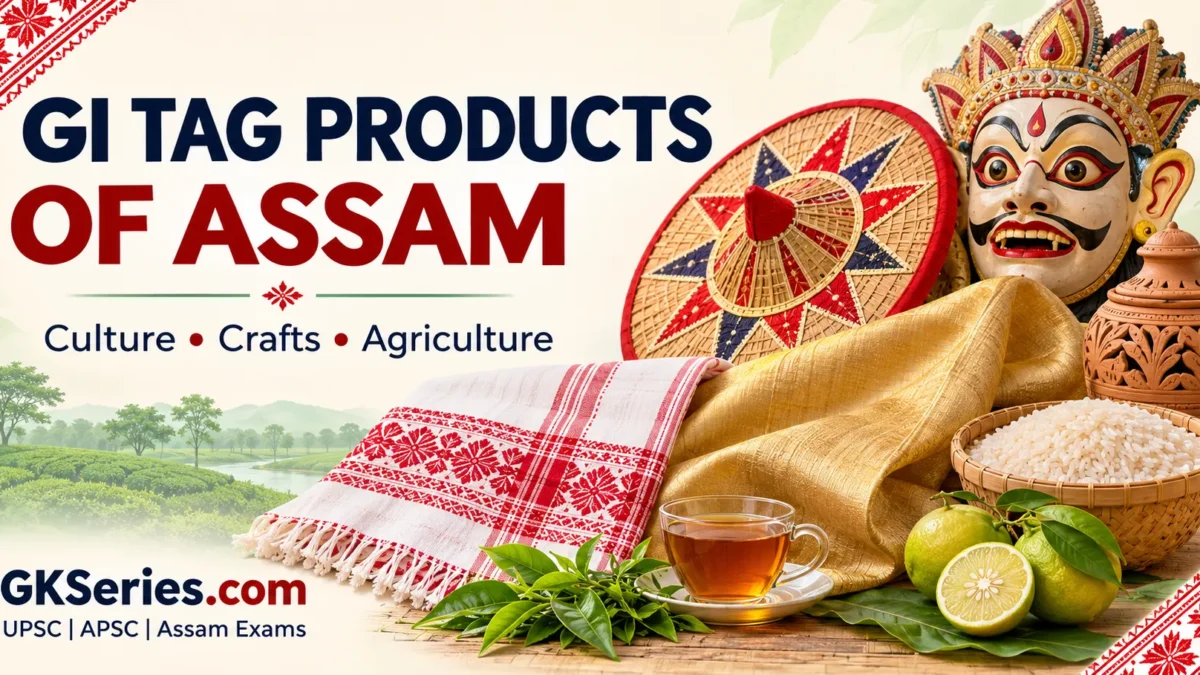
GI Tag Products of Assam: List, Importance and Key Facts for UPSC and APSC
Assam has a rich tradition of tea production, silk weaving, farming, craftwork and food preparation. Many products from the state have a distinctive identity shaped by their geographical origin and the knowledge of local communities.
A Geographical Indication, or GI tag, helps protect this connection between a product and its place of origin. Important examples from Assam include Muga Silk of Assam, Assam Orthodox tea, Gamosa of Assam, Joha Rice of Assam, Kaji Nemu, Majuli masks and Assamese Jewellery.
For students preparing for UPSC, APSC, ADRE, Assam Police and other competitive examinations, Assam’s GI products are important for questions on culture, agriculture, intellectual property rights and rural development.
Coverage note: This article follows the supplied reference list, whose consolidated registration data is dated 31 December 2025. It does not claim to be an exhaustive list of registrations through November 2026.
Overview: GI Tag Products of Assam
GI-tagged products of Assam are goods whose quality, reputation or other characteristics are linked to their geographical origin. These include agricultural products, silk, traditional textiles, crafts, musical instruments, food products and beverages.
India protects geographical indications under the Geographical Indications of Goods (Registration and Protection) Act, 1999. The Act came into force on 15 September 2003. GI registration is valid for 10 years and can be renewed.
GI recognition can help protect traditional identity and improve market recognition. Its economic benefits depend on producer participation, quality standards, authenticity checks and access to buyers.
What Is a GI Tag?
A geographical indication identifies goods that have a special connection with a particular place. Their quality or reputation may arise from natural conditions, human skills or a combination of both.
This connection may involve:
- Local climate, soil and natural resources.
- Traditional production and processing methods.
- Weaving, painting or craft skills.
- Knowledge passed down through generations.
A GI protects the geographical identity associated with goods. A patent, by comparison, protects an invention.
GI Products of Assam at a Glance
| Particular | Key information |
|---|---|
| Full form of GI | Geographical Indication |
| Principal Indian law | Geographical Indications of Goods (Registration and Protection) Act, 1999 |
| Date of commencement | 15 September 2003 |
| Registration validity | 10 years, renewable |
| Main product groups | Agriculture, textiles, crafts, musical instruments, traditional foods and beverages |
| Examination relevance | Assam culture, intellectual property rights, agriculture and rural economy |
Consolidated List of GI Products of Assam
The following table brings all the product names from the supplied reference together in one place.
| No. | GI product |
|---|---|
| 1 | Assam (Orthodox) |
| 2 | Assam Karbi Anglong Ginger |
| 3 | Tezpur Litchi |
| 4 | Joha Rice of Assam |
| 5 | Boka Chaul |
| 6 | Chokuwa Rice of Assam |
| 7 | Kaji Nemu |
| 8 | Muga Silk of Assam |
| 9 | Gamosa of Assam |
| 10 | Bodo Aronai |
| 11 | Bodo Dokhona |
| 12 | Bodo Eri Silk |
| 13 | Bodo Jwmgra |
| 14 | Bodo Gamsa |
| 15 | Majuli Mask of Assam |
| 16 | Assam Majuli Manuscript Painting |
| 17 | Bodo Thorkha |
| 18 | Bodo Kham |
| 19 | Bodo Serja |
| 20 | Bodo Sifung |
| 21 | Bodo Gongona |
| 22 | Bodo Jotha |
| 23 | Assam Jaapi |
| 24 | Assam Asharikandi Terracotta Craft |
| 25 | Assam Bihu Dhol |
| 26 | Assam Pani Meteka Craft |
| 27 | Sarthebari Metal Craft |
| 28 | Axomiya Gohona (Assamese Jewellery) |
| 29 | Bodo Keradapini |
| 30 | Bodo Gongar Dunjia |
| 31 | Bodo Khardwi |
| 32 | Bodo Narzi |
| 33 | Bodo Napham – Fermented Fish |
| 34 | Bodo Ondla |
| 35 | Bodo Gwkha – Gwkhwi |
| 36 | Judima |
| 37 | Bodo Jou Gwran |
| 38 | Bodo Jou Gishi |
| 39 | Bodo Maibra Jou Bidwi |
| 40 | Assam Mishing Handloom Products* |
| 41 | Arunachal Pradesh Singpho Phalap (Singpho Tea)* |

The last two products are additional Assam-linked entries. The supplied reference identifies differences between consolidated and individual records concerning their geographical coverage. Their approved specifications should be checked before making a precise territorial claim.
Separate logo registration: Muga Silk of Assam (Logo) is also listed in the reference material. It represents a registered logo associated with Muga silk rather than another physical product.
Why Do Different Sources Give Different GI Totals?
Different totals may arise because sources use different dates or counting methods. Some include separately registered logos, while others count only product names. Shared geographical coverage can also affect state-wise totals.
The table above contains 41 product names, including the two Assam-linked entries marked with a note. The separate Muga silk logo is listed outside the table.
This presentation should not be interpreted as an exhaustive current total for Assam.
Cultural Importance of Assam’s GI Products
Recognition of Traditional Knowledge
Assam’s GI products show how communities preserve knowledge through everyday production. Weaving, craftwork, food preparation and agricultural practices often depend on skills developed over generations.
GI recognition can help give these traditions a clearer public identity. Community participation remains essential in deciding how that identity is represented and protected.
Preservation of Regional Diversity
Assam’s heritage includes the traditions of many communities. Its GI portfolio reflects this diversity through agricultural products, textiles, instruments, crafts and foods.
Studying these products helps students understand that cultural heritage includes productive skills and living traditions alongside monuments and historical sites.
Recognition of Artisans and Producers
Farmers, weavers and artisans maintain the practices behind GI goods. Protecting a geographical name can support recognition of their work.
For meaningful benefits, producers need access to the GI system, clear information and opportunities to participate in marketing decisions.
Economic Importance of GI Tags for Assam
Stronger Product Identity
A GI can help distinguish goods associated with a particular place from misleading substitutes. This gives producers a way to communicate their products’ recognised geographical identity.
Clear branding and reliable information can also help consumers make informed purchases.
Opportunities for Rural Livelihoods
GI products can support employment in farming, weaving, craft production, processing, packaging and retail.
However, registration alone does not guarantee better income. Producers also need suitable infrastructure, fair prices and dependable market connections.
Value Addition in Agriculture
A recognised local identity can help agricultural goods stand out in competitive markets. Packaging, storage and marketing can strengthen this advantage.
Producer groups can play an important role by coordinating quality and negotiating with buyers.
Connections with Tourism
Craft demonstrations, weaving visits and local food experiences can connect cultural tourism with producer sales.
Tourism initiatives should respect community choices and ensure that local producers receive fair benefits.
Major Challenges Facing GI Products
Limited Awareness
Some eligible producers may not fully understand GI protection or the process of becoming authorised users. Accessible guidance in local languages can improve participation.
Misleading Sales
Product labels and online listings may make claims that buyers cannot easily verify. Effective inspection and traceability help protect the credibility of GI goods.
Unequal Distribution of Benefits
Traders and retailers may capture a large share of a product’s final value. Strong producer organisations and transparent pricing can improve producers’ bargaining power.
Infrastructure Gaps
Agricultural goods may require better storage, transport and packaging. Craft producers may need shared facilities, suitable equipment and design support.
Maintaining Authenticity and Diversity
Quality standards should protect a product’s identity while recognising legitimate variations within its tradition. Producers should have a meaningful role in developing and applying these standards.
How Can Assam Strengthen Its GI Products?
Assam can improve the practical benefits of GI recognition through the following measures:
- Support authorised users: Help eligible producers complete documentation and understand their rights.
- Strengthen producer organisations: Support cooperatives and community groups in marketing and negotiation.
- Improve traceability: Make producer and registration information easier for buyers to check.
- Develop suitable infrastructure: Provide storage, packaging and common production facilities where needed.
- Address misleading claims: Help producer bodies report misuse in physical and online markets.
- Measure local benefits: Track producer participation, income and the share of value retained within communities.
The success of GI protection should be assessed through its benefits to producers as well as the recognition it brings.
Important One-Liner Points for Competitive Examinations
- GI stands for Geographical Indication.
- A GI links goods with a geographical origin and an associated quality, reputation or characteristic.
- India’s principal GI law was enacted in 1999.
- The GI Act came into force on 15 September 2003.
- GI registration remains valid for 10 years and can be renewed.
- A GI protects geographical identity, while a patent protects an invention.
- Assam’s GI portfolio includes agricultural products, textiles, crafts, instruments, foods and beverages.
- Gamosa of Assam and Bodo Gamsa are separate registered names.
- Axomiya Gohona and Assamese Jewellery refer to the same product entry in the supplied reference.
- The Muga silk logo is a separate registration associated with Muga silk.
- GI recognition does not automatically guarantee higher income or exports.
- GI registration alone does not establish environmental sustainability.
- Producer participation, authenticity and market access are central to effective GI protection.
UPSC and APSC Examination Relevance
| Examination area | Preparation focus |
|---|---|
| Prelims | Product–state matching, GI meaning, legal framework and registration validity |
| GS I | Regional culture, textiles, crafts and traditional knowledge |
| GS III | Intellectual property rights, agricultural marketing and rural enterprises |
| Assam recruitment examinations | Assam’s products, cultural heritage and geographical associations |
| Mains answer writing | Producer welfare, authenticity, market access and inclusive development |
For Mains preparation, use Assam’s GI products as examples when discussing how intellectual property protection can support cultural preservation and rural livelihoods.
A balanced answer should explain that legal recognition creates an opportunity, while economic results depend on implementation.
Frequently Asked Questions
What are GI tag products of Assam?
They are goods associated with Assam whose quality, reputation or other characteristics have a recognised geographical connection. Examples include Muga silk, Assam Orthodox tea, Gamosa, Joha rice and Majuli masks.
Which law protects GI products in India?
The Geographical Indications of Goods (Registration and Protection) Act, 1999 provides the principal legal framework.
How long is a GI registration valid?
GI registration is valid for 10 years and can be renewed.
Are Gamosa of Assam and Bodo Gamsa separate GI products?
Yes. They are separate registered names and should be studied separately.
Is the Muga silk logo another variety of silk?
The logo is a separately registered identity associated with Muga silk. It is not another silk variety.
Why do Assam GI product totals vary?
Totals may vary because of different reporting dates, separate logo registrations, shared geographical coverage and different counting methods.
Does a GI tag guarantee higher prices?
A GI can support product recognition and marketing, but higher prices depend on demand, quality, market access and other commercial factors.
Why are Assam’s GI products important for UPSC and APSC?
They connect regional culture with intellectual property rights, agriculture, traditional knowledge and rural development.
The GI tag products of Assam reflect the state’s agricultural diversity, cultural traditions and community skills. Their importance lies in both the goods themselves and the people who maintain the knowledge behind them.
GI recognition provides a legal foundation for protecting geographical identity. Lasting benefits require reliable standards, fair market opportunities and active producer participation.
Prepare for UPSC, APSC, ADRE and other competitive examinations with GKSeries.com by studying Assam’s GI products alongside their cultural significance and economic role.