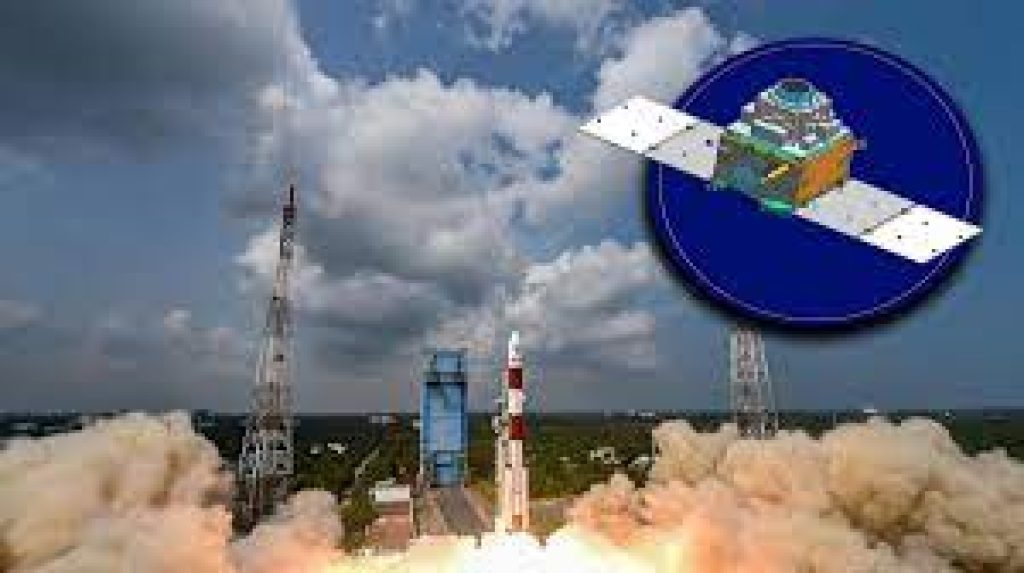
ISRO (Indian Space Research Organisation) has been making significant strides in space exploration, and the year 2024 is set to begin with yet another groundbreaking mission. Following the successes of the Chandrayaan-3 and Aditya-L1 missions, ISRO is gearing up for its latest venture – the XPoSat mission. Scheduled for launch on January 1, 2024, this mission marks India’s maiden foray into polarimetry, a field crucial for studying black holes and other celestial sources emitting X-rays.
Countdown to a New Year Launch
Ø As the world welcomes the dawn of 2024, ISRO scientists will orchestrate the launch of XPoSat at precisely 9:10 am.
Ø The mission’s trajectory involves placing XPoSat into a low earth orbit (LEO), a feat to be accomplished by India’s reliable Polar Satellite Launch Vehicle (PSLV).
Scientific Payloads on Board
Ø XPoSat carries two sophisticated scientific payloads designed to unravel the mysteries of cosmic phenomena.
Ø The primary payload, POLIX (Polarimeter Instrument in X-rays), is tasked with measuring polarimetry parameters – specifically, the degree and angle of polarization. This will be conducted within the medium X-ray energy range of 8-30 keV.
Ø The second payload, XSPECT (X-Ray Spectroscopy and Timing), will provide crucial spectroscopic information within the energy range of 0.8-15 keV.
Unraveling Cosmic Mysteries
Ø ISRO emphasizes the importance of understanding complex emission mechanisms from celestial sources like black holes, neutron stars, active galactic nuclei, and pulsar wind nebulae.
Ø Spectroscopic and timing data from various observatories offer valuable insights, but challenges persist in grasping the exact nature of these emissions.
Ø The XPoSat mission aims to address these challenges by introducing polarimetric measurements, offering additional dimensions in the form of the degree and angle of polarization.
ISRO’s Technological Contribution: FEAST Software Tool
Ø In parallel to its space exploration endeavors, ISRO has developed a cutting-edge analysis software tool named FEAST (Finite Element Analysis of Structures).
Ø This tool, born out of decades-long efforts by scientists and engineers at ISRO’s lead centre VSCC in Thiruvananthapuram, is designed for conducting Finite Element Analysis (FEA) of structures such as satellites, rockets, aircraft, and buildings.
Unveiling Polarimetry: Insights into Satellite Surface Reflection
Ø Polarimetry entails measuring the polarization degree of radiation reflected from a satellite’s surface.
Ø Polarimetry empowers astronomers to study and quantify features of celestial objects that may elude identification through alternative methods.
Ø Examples include determining the size, shape, and orientation of dust particles, such as those found around comets or within planet-forming discs encircling stars.