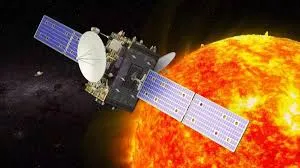
The Indian Space Research Organisation (ISRO) on June 2, announced that India’s inaugural solar mission has completed its halo orbit around the Sun-Earth L1 point on July 2. This significant breakthrough was achieved after a station keeper manoeuvre made its transition into the second halo orbit.
About Aditya-L1 Mission
TheAditya-L1 missionis an Indian solar observatory installed at theLagrangian point L1and was launched in September 2023. ISRO observed that the Aditya-L1 spacecraft completed circling theL1 pointin the halo orbit in178 days.The spacecraft was positioned into the intended halo orbit byISRO on January 6, 2024.
What are the objectives of Aditya-L1?
TheAditya-L1 mission aimsto study the Sun’s upper atmosphere, focusing on thechromosphere and corona. Its objectives include investigating heating mechanisms, ionised plasma physics, coronal mass ejections, and flares. It is sent to observe the particle and plasma environment, examinesolar corona physics,diagnose plasma properties, andstudy the development of coronal mass ejections(CMEs). The mission also aims toidentify processes leading to solar eruptions,measure magnetic fields in the corona, and investigate space weather drivers like the solar wind.
Aditya-L1 put into second orbit
TheIndian space agencysaid that to maintain this orbit, the Aditya-L1 spacecraft underwentthree station-keeping manoeuvres– onFebruary 22, June 7, and July 2,ensuring its transition into the second halo orbit. These manoeuvres counteract perturbing forces that could push the spacecraft off course, it added.
Difficulties in keeping Aditya-L1 in orbit
Aditya-L1’s journeyaround the Sun-Earth L1Lagrangian point requires careful planningand understanding of various forces that can push it off course. By studying these forces,ISROcould accurately plot the spacecraft’s path and plan necessary adjustments.