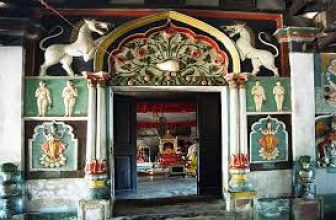
The Khajuraho complex is an unparalleled artistic achievement both for reasons of its very distinctive architecture and for its sculpted decoration of a surprising quality composed of a mythological repertory of many scenes of diversions, of which the not least known scenes, perhaps susceptible of sacred or profane interpretrations. Khajuraho is an important capital of the Chandella rulers, an empire of Rajput lineage which came to power at the very beginning of the 10th century, reached its apogee between 950 and 1050. Of the eighty-five temples which were built at Khajuraho during the Chandella period (and which were still resplendent when visited by the great traveller Ibn Battuta in 1335), there are 22 temples still standing and are dispersed around an area of about 6 km2. As monuments of two completely different religions, Brahmanism and Jainism, the temples of Khajuraho are nevertheless united in a common typology: they have an elevated substructure, above which rises a richly decorated building structure, the ‘jangha’, covered all over with multiple registers of sculptural panels, to which there are added open-work galleries. This is crowned by a series of bundled towers with curvilinear contour, the Sikharas. The most important group of monuments is under a fairly tight grouping in the western zone, within a short distance of the archaeological museum: Varaha, Lakshmana, Matangeshwara, Kandariya, Mahadeva Chitragupta, Chopra Tank, Parvati, Vishwanatha, and Nandi. However, the east and south groups also contain interesting complexes (Ghantai, Parshvanath, Adinath, Shantinath, Dulhadeo, Chaturbhuja temples).