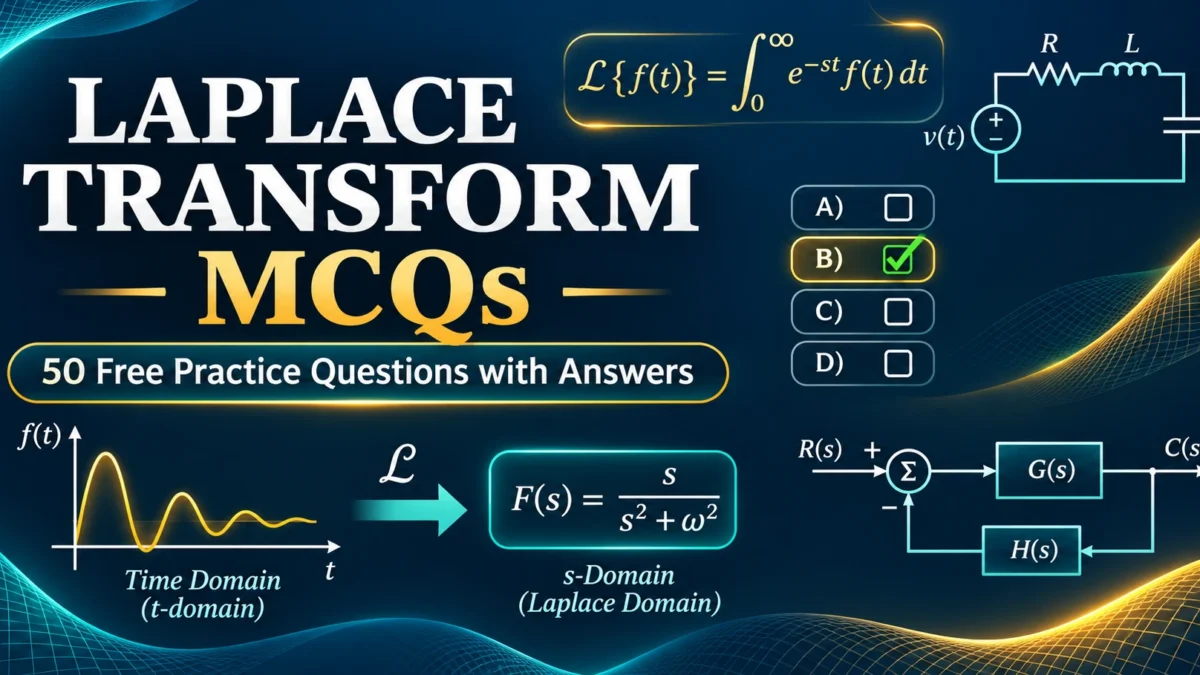
Laplace Transform MCQs with Answers: Free Practice Questions
The Laplace transform is an important topic in mathematics, electrical engineering, control systems and signal processing. Practising multiple-choice questions can help you understand its rules, recognise common patterns and prepare for competitive examinations.
This free Laplace transform MCQ set contains 50 questions with answers and explanations. It covers basic transforms, inverse transforms, the region of convergence, convolution, differential equations and system response. The questions are useful for students preparing for GATE, UPSC Engineering Services and state-level technical recruitment exams.
What Is the Laplace Transform?
For a function \(f(t)\) defined for \(t \geq 0\), its one-sided Laplace transform is\[ F(s)=\int_0^\infty e^{-st}f(t)\,dt \]
The transform changes a function of time into a function of the complex variable \(s\). This is useful because operations such as differentiation and convolution can often be handled more easily in the Laplace domain.
For example, the transform of \(t\) is \(1/s^2\), while the transform of \(t^2\) is \(2/s^3\). Knowing these standard results makes it easier to solve more involved questions.
Topics Covered in the Free MCQs
The practice questions cover several parts of Laplace transform theory:
- Standard transforms: Powers of \(t\), exponential functions, sine, cosine and hyperbolic functions.
- Transform properties: Time scaling, frequency shifting, multiplication by \(t\), integration and time delay.
- Inverse transforms: Partial fractions, repeated poles and causal signal reconstruction.
- Region of convergence: Conditions for convergence and how the ROC relates to poles and signal direction.
- Convolution: Using the convolution theorem for Laplace, Fourier and Z transforms.
- Differential equations and systems: Transfer functions, impulse response, initial and final value theorems, and responses to standard inputs.
This range helps you practise both direct formula questions and problems that require several steps.
How to Practise Effectively
Try each question before looking at its answer. When you make a mistake, identify the rule involved. For instance, multiplication by \(e^{at}\) shifts the transform from \(F(s)\) to \(F(s-a)\). A delay by \(a\) units introduces a factor of \(e^{-as}\). Mixing up these two rules is a common source of errors.
For inverse transforms, factor the denominator and use partial fractions before applying standard pairs. For region-of-convergence questions, check whether the signal is right-sided, left-sided or finite in duration. The poles alone do not always identify the time-domain signal; the ROC provides essential information.
System questions also benefit from a quick check of the assumptions. Transfer functions generally use zero initial conditions. The final-value theorem is valid only when the relevant poles meet its stability conditions, so verify those conditions before applying it.
Who Should Use These Questions?
These Laplace transform questions are suitable for engineering students and candidates preparing for technical recruitment examinations. They can be used for revision after studying the basic formulas or as a short self-test before an exam.
Work through the set in stages: begin with standard transforms, then attempt properties and inverse transforms, and finish with systems and ROC problems. Read the explanations after answering to reinforce the method, not just the final option.
Start Your Laplace Transform Practice
Regular practice can make Laplace transform problems easier to recognise and solve. Use these free MCQs to revise key formulas, test your understanding and find topics that need more attention. Keep a list of incorrect answers and revisit the related rule before trying similar questions again.
Related keywords: Laplace transform questions and answers, Laplace transform MCQs for GATE, inverse Laplace transform questions, Laplace transform practice questions