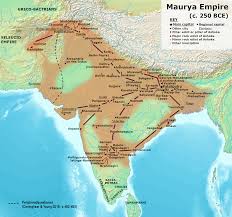
The Mauryan Empire was the first major empire in the history of India. Founded by Chandragupta Maurya in 322 BCE, it spanned from the Oxus Valley to the Kaveri delta. It is known for its more or less powerful centralized administration and is a benchmark in the ancient history of India. The Mauryan empire reached its peak at the time of Ashoka, who is even better known for his edicts and conversion to Buddhism.
Key points
- Chandragupta Maurya established the Mauryan Empire in 322 BCE by defeating the Nanda Dynasty, with help from his minister and advisor Kautilya (Chanakya).
- Chandragupta’s conquests and alliances were exceptionally effective, and he had established Mauryan rule over the northwestern subcontinent by 317 BCE.
- The Mauryan Empire was characterized by a strong, centralized administration, which was informed by Kautilya’s work on governance entitled Arthashastra.
Rulers:
- Chandragupta Maurya: the founder of the empire; noted for his military might as well as his ability to administer a vast empire.
- Bindusara: Chandragupta’s son; continued to expand the empire southward.
- Ashoka: the grandson of Chandragupta; well known for his acceptance of Buddhism; also his edicts, which enabled the promotion of dharma, and non-violence.
After Ashoka’s death, the empire went into decline and fragmentation, and was ultimately overthrown by a military commander.
The Mauryan Empire is remembered for its extent, centralized administration, and lasting impact on the history and cultures within India.