Let X1, X2 be two independent normal random variables with means µ1, µ2 and standard deviations s1, s2,

Let X1, X2 be two independent normal random variables with means µ1, µ2 and standard deviations s1, s2,

Q. Let X1, X2 be two independent normal random variables with means µ1, µ2 and standard deviations s1, s2, respectively. Consider Y = X1 – X2; µ1 = µ2 =1, s1 = 1, s2 = 2. Then, A. Y is normally distributed with mean 0 and variance 1 B. Y is normally distributed with mean […]
Let X1, X2 be two independent normal random variables with means µ1, µ2 and standard deviations s1, s2, Read More »

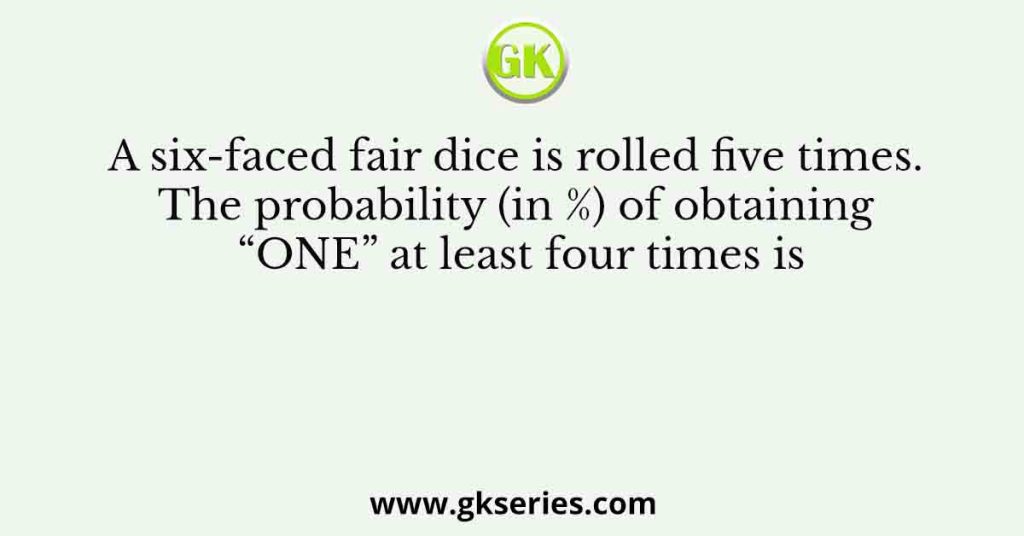
A six-faced fair dice is rolled five times. The probability (in %) of obtaining “ONE” at least four times is

A six-faced fair dice is rolled five times. The probability (in %) of obtaining “ONE” at least four times is

Q. A six-faced fair dice is rolled five times. The probability (in %) of obtaining “ONE” at least four times is (A) 33.3                      (B) 3.33                      (C) 0.33                     (D) 0.0033 Ans: 0.33

A six-faced fair dice is rolled five times. The probability (in %) of obtaining “ONE” at least four times is Read More »

The time series forecasting method that gives equal weightage to each of the m most recent observations is

The time series forecasting method that gives equal weightage to each of the m most recent observations is

Q. The time series forecasting method that gives equal weightage to each of the m most recent observations is (A) Moving average method                         (B) Exponential smoothing with linear trend (C) Triple Exponential smoothing                 (D) Kalman Filter Ans: Moving average Method

The time series forecasting method that gives equal weightage to each of the m most recent observations is Read More »

Scroll to Top