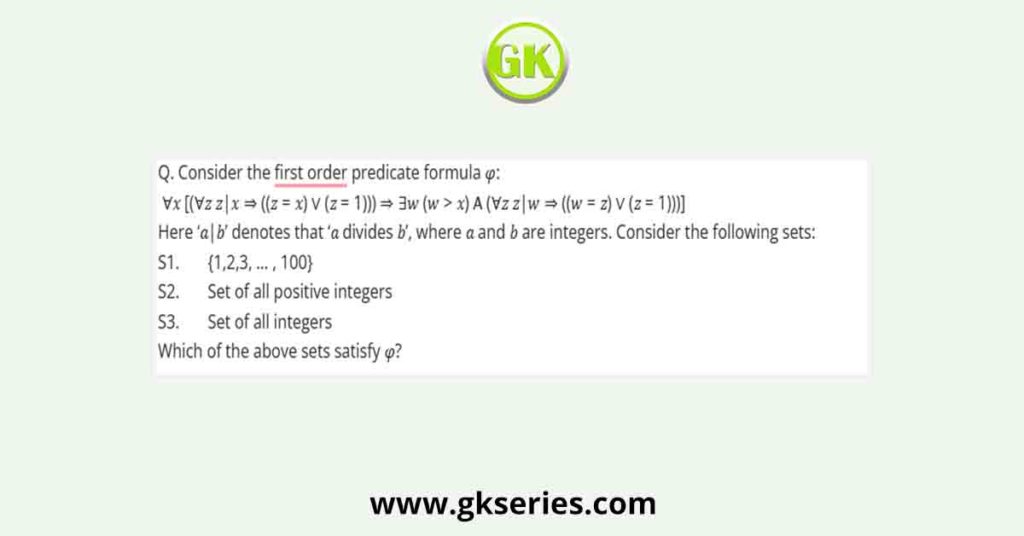
Consider the following sets. Set of all recursively enumerable languages over the alphabet {0,1}

Consider the following sets. Set of all recursively enumerable languages over the alphabet {0,1}

Q. Consider the following sets: S1.       Set of all recursively enumerable languages over the alphabet {0,1} S2.       Set of all syntactically valid C programs S3.        Set of all languages over the alphabet {0,1} S4.       Set of all non-regular languages over the alphabet {0,1} Which of the above sets are uncountable? (A) S1 and S2 (B) S3 […]

Consider the following sets. Set of all recursively enumerable languages over the alphabet {0,1} Read More »

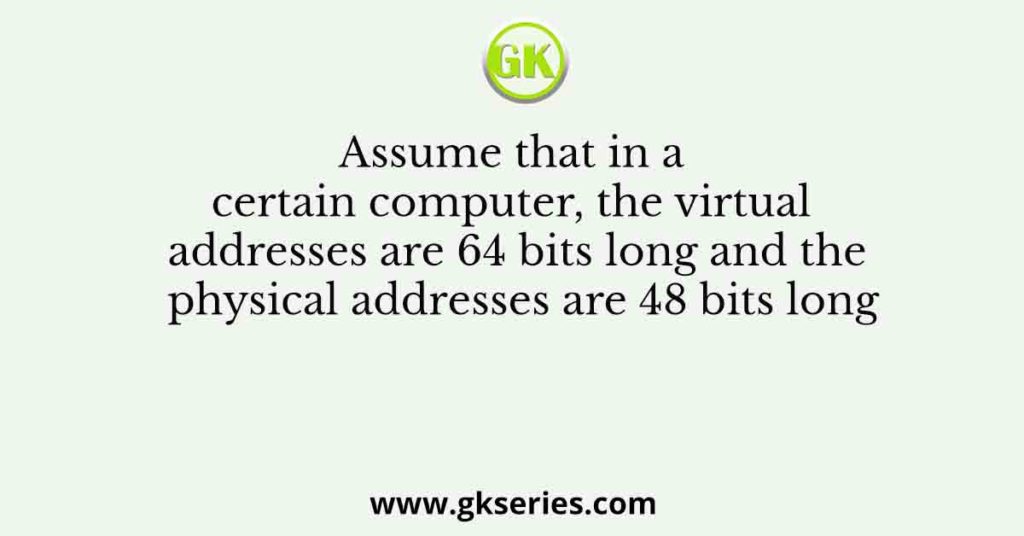
Assume that in a certain computer, the virtual addresses are 64 bits long and the physical addresses are 48 bits long

Assume that in a certain computer, the virtual addresses are 64 bits long and the physical addresses are 48 bits long

Q. Assume that in a certain computer, the virtual addresses are 64 bits long and the physical addresses are 48 bits long. The memory is word addressible. The page size is 8 kB and the word size is 4 bytes. The Translation Look-aside Buffer (TLB) in the address translation path has 128 valid entries. At

Assume that in a certain computer, the virtual addresses are 64 bits long and the physical addresses are 48 bits long Read More »

Let the set of functional dependencies F = {QR → S, R → P, S → Q} hold on a relation schema X = (PQRS).

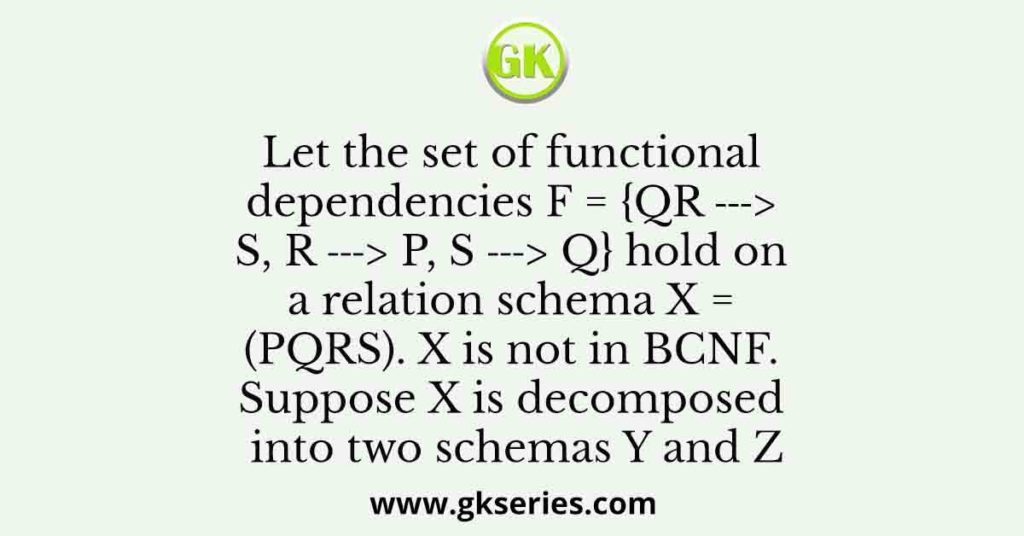
Let the set of functional dependencies F = {QR → S, R → P, S → Q} hold on a relation schema X = (PQRS). X is not in BCNF. Suppose X is decomposed into two schemas Y and Z

Q. Let the set of functional dependencies F = {QR → S, R → P, S → Q} hold on a relation schema X = (PQRS). X is not in BCNF. Suppose X is decomposed into two schemas Y and Z, where Y = (PR) and Z = (QRS). Consider the two statements given below.

Let the set of functional dependencies F = {QR → S, R → P, S → Q} hold on a relation schema X = (PQRS). X is not in BCNF. Suppose X is decomposed into two schemas Y and Z Read More »

Which one of the following languages over Σ = {𝑎, 𝑏} is NOT context-free?

Which one of the following languages over Σ = {𝑎, 𝑏} is NOT context-free?

Q. Which one of the following languages over Σ = {𝑎, 𝑏} is NOT context-free? (A) {𝑤𝑤𝑅 |𝑤 ∈ {𝑎, 𝑏}∗} (B) {𝑤𝑎𝑛𝑏𝑛𝑤𝑅 |𝑤 ∈ {𝑎, 𝑏}∗, 𝑛 ≥ 0} (C) {𝑤𝑎𝑛𝑤𝑅𝑏𝑛 |𝑤 ∈ {𝑎, 𝑏}∗, 𝑛 ≥ 0} (D) {𝑎𝑛𝑏𝑖 | 𝑖 ∈ {𝑛, 3𝑛, 5𝑛}, 𝑛 ≥ 0} Ans: {wanwRbn ⏐ w ∈ {a,

Which one of the following languages over Σ = {𝑎, 𝑏} is NOT context-free? Read More »

Suppose that in an IP-over-Ethernet network, a machine X wishes to find the MAC address of another machine Y in its subnet. Which one of the following techniques can be used for this?

Suppose that in an IP-over-Ethernet network, a machine X wishes to find the MAC address of another machine Y in its subnet. Which one of the following techniques can be used for this?

Q. Suppose that in an IP-over-Ethernet network, a machine X wishes to find the MAC address of another machine Y in its subnet. Which one of the following techniques can be used for this? A. X sends an ARP request packet to the local gateway’s IP address which then finds the MAC address of Y

Suppose that in an IP-over-Ethernet network, a machine X wishes to find the MAC address of another machine Y in its subnet. Which one of the following techniques can be used for this? Read More »

Consider three machines M, N, and P with IP addresses 100.10.5.2, 100.10.5.5, and 100.10.5.6 respectively.

Consider three machines M, N, and P with IP addresses 100.10.5.2, 100.10.5.5, and 100.10.5.6 respectively.

Q. Consider three machines M, N, and P with IP addresses 100.10.5.2, 100.10.5.5, and 100.10.5.6 respectively. The subnet mask is set to 255.255.255.252 for all the three machines. Which one of the following is true? (A) M, N, and P all belong to the same subnet (B) Only M and N belong to the same

Consider three machines M, N, and P with IP addresses 100.10.5.2, 100.10.5.5, and 100.10.5.6 respectively. Read More »

Two numbers are chosen independently and uniformly at random from the set {1, 2 , . . . , 13}. The probability (rounded off to 3 decimal places) that their 4-bit (unsigned) binary representations

Two numbers are chosen independently and uniformly at random from the set {1, 2 , . . . , 13}. The probability (rounded off to 3 decimal places) that their 4-bit (unsigned) binary representations

Q. Two numbers are chosen independently and uniformly at random from the set {1, 2 , . . . , 13}. The probability (rounded off to 3 decimal places) that their 4-bit (unsigned) binary representations have the same most significant bit is Solution: The 4-bit binary representation of numbers (1, 2, 3, 4………13): 0  –

Two numbers are chosen independently and uniformly at random from the set {1, 2 , . . . , 13}. The probability (rounded off to 3 decimal places) that their 4-bit (unsigned) binary representations Read More »

2 August 2023 Current Affairs

2 August 2023 Current Affairs – The Day’s Top News | GKSERIES

Current Affairs is the most important area in all competitive exams. But the difficulty level is very high. That’s why; many aspirants get confused, how to select Current Affairs for Preparation of Competitive Examination? In this Post, Daily Current Affairs 2 August 2023, we have tried to cover each and every point and also included all important facts from

2 August 2023 Current Affairs – The Day’s Top News | GKSERIES Read More »

Scroll to Top