For Ξ£ = {π‘Ž, 𝑏}, let us consider the regular language 𝐿 = { π‘₯ |π‘₯ = π‘Ž2+3π‘˜ or π‘₯ = 𝑏10+12π‘˜, π‘˜ β‰₯ 0}. Which one of the following

For Ξ£ = {π‘Ž, 𝑏}, let us consider the regular language 𝐿 = { π‘₯ |π‘₯ = π‘Ž2+3π‘˜ or π‘₯ = 𝑏10+12π‘˜, π‘˜ β‰₯ 0}. Which one of the following

Q. For Ξ£ = {π‘Ž, 𝑏}, let us consider the regular language 𝐿 = { π‘₯ |π‘₯ = π‘Ž2+3π‘˜ or π‘₯ = 𝑏10+12π‘˜, π‘˜ β‰₯ 0}. Which one of the following can be a pumping length (the constant guaranteed by the pumping lemma) for 𝐿 ? (A) 3 (B) 5 (C) 9 (D) 24 Ans: […]


For Ξ£ = {π‘Ž, 𝑏}, let us consider the regular language 𝐿 = { π‘₯ |π‘₯ = π‘Ž2+3π‘˜ or π‘₯ = 𝑏10+12π‘˜, π‘˜ β‰₯ 0}. Which one of the following Read More Β»

ISRO injects Chandrayaan-3 into translunar orbit

ISRO injects Chandrayaan-3 into translunar orbit

ISRO injects Chandrayaan-3 into translunar orbit: The Chandrayaan-3 spacecraft, India’s third lunar exploration mission, has made an important accomplishment by entering the moon’s sphere of influence. This successful entry was made possible through a TransLunar Injection (TLI) executed by the Indian Space Research Organisation (ISRO). The next critical stage is the August 5 Lunar Orbit

ISRO injects Chandrayaan-3 into translunar orbit Read More Β»

Which one of the following statements is NOT correct about the B+ tree data structure used for creating an index of a relational database table?

Which one of the following statements is NOT correct about the B+ tree data structure used for creating an index of a relational database table?

Q. Which one of the following statements is NOT correct about the B+ tree data structure used for creating an index of a relational database table? (A) B+ Tree is a height-balanced tree (B) Non-leaf nodes have pointers to data records (C) Key values in each node are kept in sorted order (D) Each leaf

Which one of the following statements is NOT correct about the B+ tree data structure used for creating an index of a relational database table? Read More Β»

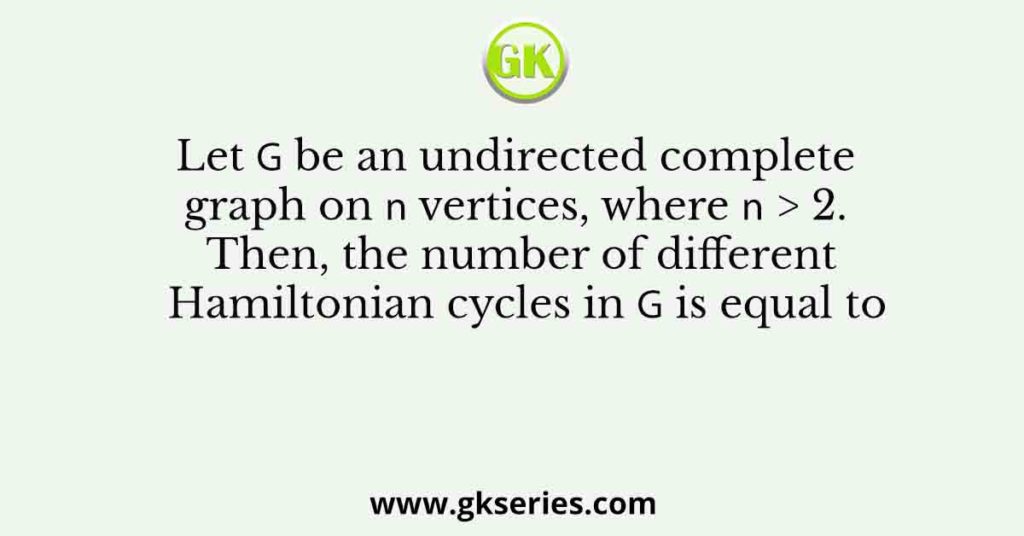
Let 𝐺 be an undirected complete graph on 𝑛 vertices, where 𝑛 > 2. Then, the number of different Hamiltonian cycles in 𝐺 is equal to

Let 𝐺 be an undirected complete graph on 𝑛 vertices, where 𝑛 > 2. Then, the number of different Hamiltonian cycles in 𝐺 is equal to

Q. Let 𝐺 be an undirected complete graph on 𝑛 vertices, where 𝑛 > 2. Then, the number of different Hamiltonian cycles in 𝐺 is equal to Ans: Option D Solution: A simple circuit in a graph G that passes through every vertex exactly once is called a Hamiltonian circuit. In Hamiltonian cycle is a

Let 𝐺 be an undirected complete graph on 𝑛 vertices, where 𝑛 > 2. Then, the number of different Hamiltonian cycles in 𝐺 is equal to Read More Β»

Let 𝐺 be an arbitrary group. Consider the following relations on 𝐺

Let 𝐺 be an arbitrary group. Consider the following relations on 𝐺

Q. Let 𝐺 be an arbitrary group. Consider the following relations on 𝐺: 𝑅1: βˆ€π‘Ž, 𝑏 ∈ 𝐺, π‘Ž 𝑅1𝑏 if and only if βˆƒπ‘” ∈ 𝐺 such that π‘Ž = π‘”βˆ’1𝑏𝑔 𝑅2: βˆ€π‘Ž, 𝑏 ∈ 𝐺, π‘Ž 𝑅2𝑏 if and only if π‘Ž = π‘βˆ’1 Which of the above is/are equivalence relation/relations? (A) 𝑅1

Let 𝐺 be an arbitrary group. Consider the following relations on 𝐺 Read More »

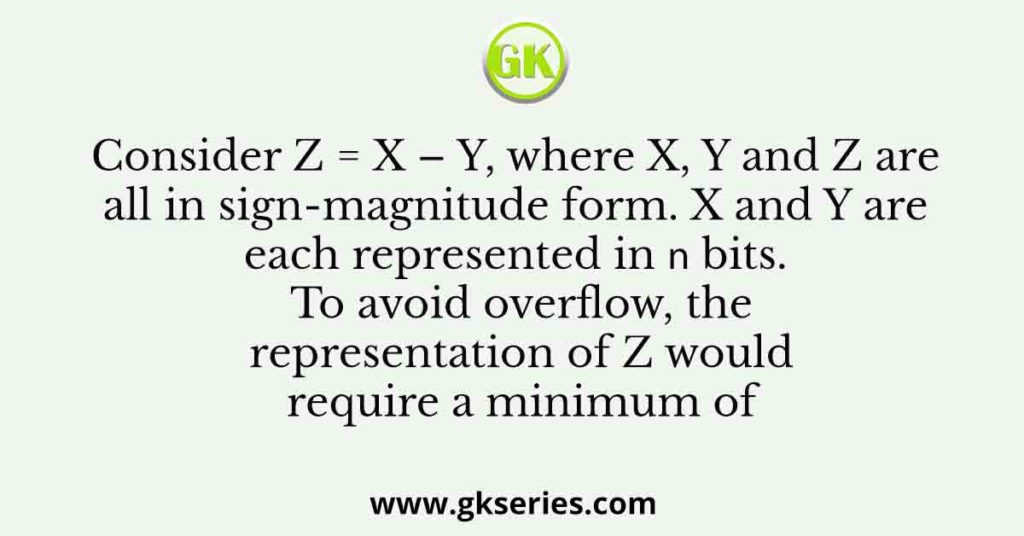
Consider Z = X – Y, where X, Y and Z are all in sign-magnitude form. X and Y are each represented in 𝑛 bits. To avoid overflow, the representation of Z would require a minimum of

Consider Z = X – Y, where X, Y and Z are all in sign-magnitude form. X and Y are each represented in 𝑛 bits. To avoid overflow, the representation of Z would require a minimum of

Q. Consider Z = X – Y, where X, Y and Z are all in sign-magnitude form. X and Y are each represented in 𝑛 bits. To avoid overflow, the representation of Z would require a minimum of: (A) 𝑛 bits (B) 𝑛 βˆ’ 1 bits (C) 𝑛 + 1 bits (D) 𝑛 + 2

Consider Z = X – Y, where X, Y and Z are all in sign-magnitude form. X and Y are each represented in 𝑛 bits. To avoid overflow, the representation of Z would require a minimum of Read More Β»

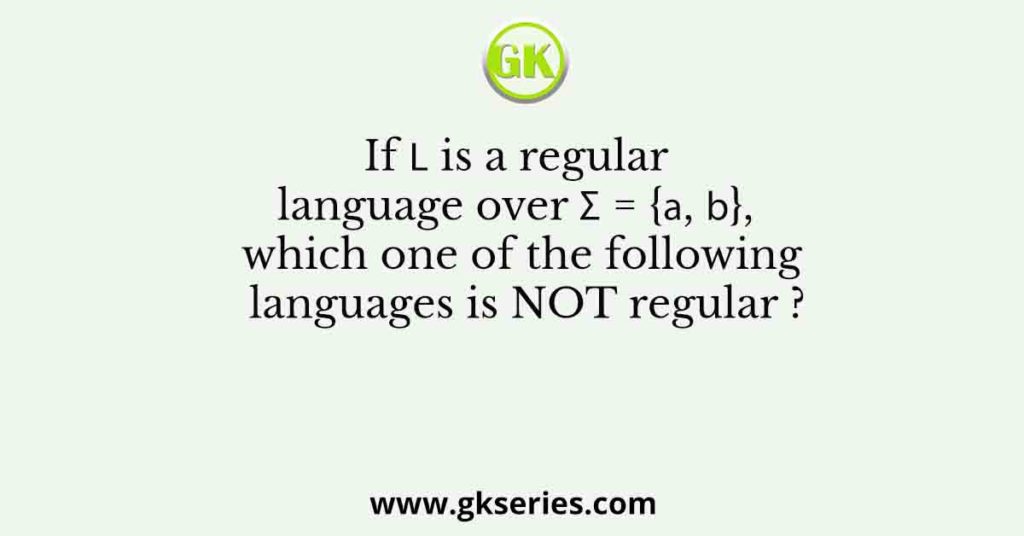
If 𝐿 is a regular language over Ξ£ = {π‘Ž, 𝑏}, which one of the following languages is NOT regular ?

If 𝐿 is a regular language over Ξ£ = {π‘Ž, 𝑏}, which one of the following languages is NOT regular ?

Q. If 𝐿 is a regular language over Ξ£ = {π‘Ž, 𝑏}, which one of the following languages is NOT regular ? (A) 𝐿 β‹… 𝐿𝑅 = {π‘₯𝑦 | π‘₯ ∈ 𝐿, 𝑦𝑅 ∈ 𝐿} (B) {𝑀𝑀𝑅 | 𝑀 ∈ 𝐿} (C) Prefix (𝐿) = {π‘₯ ∈ π›΄βˆ—|βˆƒπ‘¦ ∈ π›΄βˆ— such that π‘₯𝑦 ∈ 𝐿}

If 𝐿 is a regular language over Ξ£ = {π‘Ž, 𝑏}, which one of the following languages is NOT regular ? Read More Β»

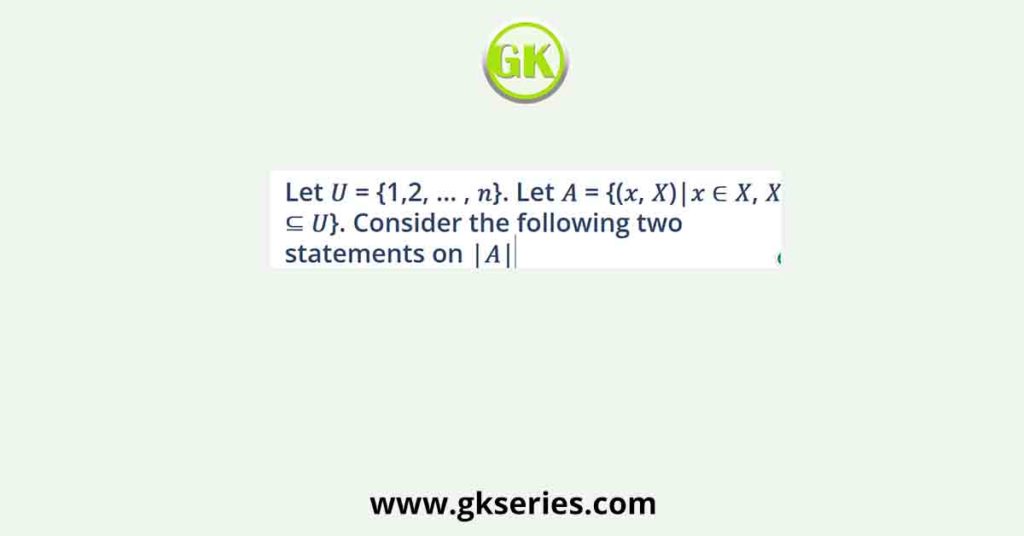
Let π‘ˆ = {1,2, … , 𝑛}. Let 𝐴 = {(π‘₯, 𝑋)|π‘₯ ∈ 𝑋, 𝑋 βŠ† π‘ˆ}. Consider the following two statements on |𝐴|.

Let π‘ˆ = {1,2, … , 𝑛}. Let 𝐴 = {(π‘₯, 𝑋)|π‘₯ ∈ 𝑋, 𝑋 βŠ† π‘ˆ}. Consider the following two statements on |𝐴|

Q. Let π‘ˆ = {1,2, … , 𝑛}. Let 𝐴 = {(π‘₯, 𝑋)|π‘₯ ∈ 𝑋, 𝑋 βŠ† π‘ˆ}. Consider the following two statements on |𝐴|. I.Β Β Β Β Β Β Β Β Β Β  |𝐴| = 𝑛2π‘›βˆ’1 II.Β Β Β Β Β Β Β Β  |𝐴| = βˆ‘π‘›π‘˜=1Β Β Β Β  π‘˜(𝑛) Β Β Β Β Β Β Β Β Β Β  Which of the above statements is/are TRUE?   (A) Only I (B) Only II   (C) Both I and II

Let π‘ˆ = {1,2, … , 𝑛}. Let 𝐴 = {(π‘₯, 𝑋)|π‘₯ ∈ 𝑋, 𝑋 βŠ† π‘ˆ}. Consider the following two statements on |𝐴| Read More Β»

Scroll to Top