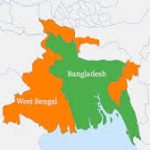
The Partition of Bengal in 1905 was a significant move by the British Raj, aimed at splitting Bengal into two separate provinces: Eastern Bengal and Assam, and West Bengal. This decision was made public in July 1905 and officially came into effect on October 16, 1905.
How it happened
- The British cited administrative convenience as the reason for the partition.
- The partition separated the largely Muslim eastern areas from the largely Hindu western areas.
- The partition was met with widespread resistance from Indian nationalists.
Detailed Breakdown:
Background & the Partition
- Since 1765, after the Battle of Buxar, the vast province of Bengal—which includes what we now know as West Bengal, Bihar, Odisha, Bangladesh, and Assam—came under British control.
- By the early 20th century, this area had grown to a staggering population of nearly 80 million, with Calcutta serving as both the provincial and British India’s capital.
- There were difficulties in administering such a large area. The eastern part, especially in rural areas were neglected.
- This part of Bengal struggled with a lack of industry, education, and job opportunities, with most industrial activity concentrated in Calcutta.
- Even before Lord Curzon arrived in India, there were discussions about partitioning the province for better administration.
- In 1874, Assam was separated from Bengal and placed under a Chief Commissioner.
- Initially, Curzon suggested partitioning the province purely for administrative reasons. In 1904, he toured eastern Bengal to assess the situation.
- It was later that the idea emerged to use the partition as a political strategy to weaken the rising nationalism in Bengal and across India.
- According to Curzon, the partition would create two provinces: Bengal (which would include modern-day West Bengal, Odisha, and Bihar) and Eastern Bengal and Assam.
- Bengal would lose five Hindi-speaking states to the Central Provinces but would gain Odia-speaking regions from there.
- Eastern Bengal would comprise the Hill Tripura, Chittagong, Rajshahi, and Dhaka divisions, with Dhaka as its capital.
- Bengal would have a Hindu majority and Eastern Bengal and Assam would have a Muslim majority population. Its capital would remain Calcutta.
Reaction to the partition of Bengal
- There was an outburst of political unrest within the province when Curzon announced the partition.
- Most people of Bengal considered this partition to be an affront to their motherland. There was a vast outcry for Bengal’s unification. Rabindranath Tagore wrote the popular song ‘Amar Sonar Bangla’ which came to be used as the national anthem of Bangladesh.
- The Indian National Congress opposed this action to divide the province on communal grounds.
- Most of the Bengalis in the western part protested against this step which would also make them a linguistic minority in their own province. There would be more Odia and Hindi speaking people than Bengalis.
- Many Muslims from the Bengali Muslim community welcomed this move since they thought that it would advance their educational, economic and political interests if they became the majority in the new province.
- Lord Curzon also pledged to establish a university in Dhaka. This too was considered a chance for Muslims to progress in education and raise their standard of living.
- The general protest in the rest of the country was against this partition. The people saw through the ‘divide and rule’ policy of the British authorities.
- The chief aim of such a partition was only to create a rift between the two communities and hampering the unity and nationalism in the country.
- The protest had begun long before the partition date itself. On the partition date, all people spent a day in mourning. Hindus and Muslims were requested by Tagore to tie rakhis on their wrists as a gesture of protest.
- There were some Muslims who also opposed the partition.
- Swadeshi and Boycott movements during the national struggle began due to this partition.
- Individuals began boycotting British products that had inundated the Indian market and had struck a blow to the native industry.
- The partition did succeed in creating a communal rift in the country and even contributed to the birth of the Muslim League in 1906.
Partition annulled
- Owing to mass political protests, the partition was annulled in 1911.
- New provinces were created based on linguistic lines rather than religious lines. Bihar and Orissa Province was carved out of Bengal. (Bihar and Orissa became separate provinces in 1936).
- A separate Assam province was created.
- The capital of British India was moved to Delhi from Calcutta in 1911.
- Despite the annulment, the partition did create a communal divide among the Hindus and Muslims of Bengal.