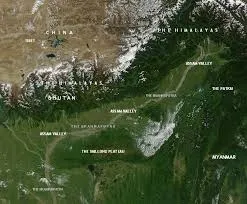
Assam’s physiography is made up of three distinct regions: Brahmaputra Valley (north of the Brahmaputra River), the Karbi-Anglong and North Cachar Hills, and the Barak Valley (south of the Brahmaputra River). The Brahmaputra Valley, which serves as a vast plain consisting of sedimentary material from the Brahmaputra River, is the largest of the three regions. The hills of central Assam and Barak Valley are comparatively smaller.
For a more detailed view:
- Brahmaputra Valley: The fertile plain is an eastern extension of the Indo-Gangetic Plain. The Brahmaputra River, which runs from east to west and contributes toward a major part of Assam’s agriculture, is also a major feature of this valley.
- Karbi Anglong and North Cachar Hills: Hilly remnants of the South Indian Plateau system, tested by erosion and erosion also through river dissection, which separate the Brahmaputra Valley from the Barak Valley, while hosting diverse flora and fauna.
- Barak Valley: The Barak Valley is situated in southern Assam, it is smaller than the Brahmaputra Valley to its north and separated from it in the center by some hills. The Barak River flows southwest through this valley and enters Bangladesh, where it joins the Brahmaputra.