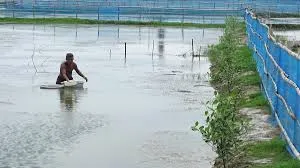
In a prestigious endorsement of India’s green innovation, the Sustainable Aquaculture in Mangrove Ecosystems (SAIME) model—developed by the Nature Environment and Wildlife Society (NEWS)—has received Global Technical Recognition from the Food and Agriculture Organization (FAO) of the United Nations. This award places the Sundarbans region on the global map for pioneering a climate-adaptive, conservation-linked aquaculture model that balances ecological preservation with rural livelihoods, particularly through the cultivation of native black tiger shrimp.
What is the SAIME Model?
The SAIME initiative is a multi-stakeholder partnership (MSP) that transforms shrimp aquaculture in mangrove-rich regions of South Asia. It aims to create an ecosystem-based standard that protects mangroves while enhancing farmer incomes through sustainable shrimp farming.
Key Features
- Focus Species: Integrates native black tiger shrimp in brackish water aquaculture.
- Approach:Ecosystem-based, climate-resilient, and conservation-driven.
Objectives
- Strengthen rural livelihoods in mangrove zones
- Reduce blue carbon emissions by integrating mangroves as natural carbon sinks
- Improve market access through branding, certification, and farmer institutions
- Encourage low-input aquaculture through Integrated Mangrove Aquaculture (IMA)