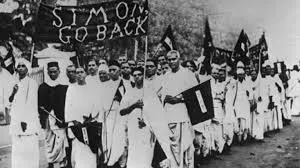
The Simon Commission, created by the British Government in 1927 to assess the 1919 Government of India Act for constitutional progress in India, was completely British, which led to widespread protests and illustrated India’s great opposition to colonialism that decided their future without Indian presence or voice in the matter. This article will study the background, formation, and implications of the Simon Commission as well as the protests that were the hallmark of this important event in India’s fight for independence.
About Simon Commission 1927
- The Simon Commission, or formally the Indian Statutory Commission, was created in 1927 by the British Government to examine the 1919 Government of India Act.
- The Simon Commission, was led by Sir John Simon, was created to survey constitutional reforms in India, but it was 100 percent British and had no Indian representation, and outraged people throughout the country.
- It embodies an insult to Indian autonomy. Its arrival also initiated one of the biggest protests in organized, national history.
Formation of Simon Commission 1927 - The Government of India Act, 1919 was known as the Montagu-Chelmsford Reforms and they promised to review the Government of India Act after ten years.
- The British Government was now under extreme pressure to respond to the desires of Indians to achieve greater autonomy, so they set the Simon Commission up two years ahead of schedule in 1927.
- Although the commission’s purpose was evaluating India’s constitutional progress, the commission only had British members, it expressed complete indifference to Indian opinion, and which only produced further dissatisfaction among nationalists.
Recommendations of Simon Commission 1927
- The Simon Commission, formed in 1927 by the British government, was tasked with evaluating the constitutional framework in India.
- Its key recommendations included the abolition of dyarchy at the provincial level and introducing a system of responsible government in provinces, where ministers would be accountable to the legislature.
- It also suggested the separation of Burma from India and emphasised the need for safeguards to protect minority communities.
- However, the Commission faced widespread opposition in India due to its exclusion of Indian members, leading to protests and the popular slogan, “Simon Go Back.”
Nationwide Boycott of Simon Commission
- The Simon Commission was unanimously condemned by all Indian political factions, including Congress, the Muslim League, and many regional political groups.
- Indians all across the country protested under the slogan “Simon Go Back!” and refused to recognize the authority of the all-white commission deciding India’s future.
- When the commission came to Bombay (now Mumbai) on February 3, 1928, it was met by thousands who protested with black flags and banners saying Simon Go Back! and other slogans condemning the commission.
Political Unity Against the Simon Commission - The Simon Commission brought different political groups and regional factions together, being among the rare occasions of unity across ideological lines of dissent.
- The Central Legislative Assembly refused to work with the commission by refusing to put together a joint committee with it.
- This formulation of rejection clearly stated the strong attitude of Indian leaders against any legitimacy of the commission.
- Many well-known leaders, including Mahatma Gandhi, Jawaharlal Nehru, and Subhas Chandra Bose supported the protests and this immediately transformed the boycott into a strong sense of movement.
Impact of Simon Commission
• Later recommendations, after the Simon Commission, were largely ignored by Indian leaders.
• In addition, the commission’s rejection of Indian aspirations, demonstrated the refusal of the British government to recognize Indian demands for self government, was damaging to its acceptance.
• The response to the Simon Commission from Indians was a united front, but it also paved the way for later protests and movements including Mahatma Gandhi’s Civil Disobedience Movement.
• The protests against the Simon Commission also impacted the Nehru Report of 1928, which proposed a constitution for India, and echoed the Indian aspirations for Dominion Status in the Caribbean.