gate questions

It takes two hours for a person X to mow the lawn. Y can mow the same lawn in four hours. How long (in minutes) will it take X and Y

It takes two hours for a person X to mow the lawn. Y can mow the same lawn in four hours. How long (in minutes) will it take X and Y

Q. It takes two hours for a person X to mow the lawn. Y can mow the same lawn in four hours. How long (in minutes) will it take X and Y, if they work together to mow the lawn? (A) 60 (B) 80 (C) 90 (D) 120 Ans: 80 Solution: Work done by X […]
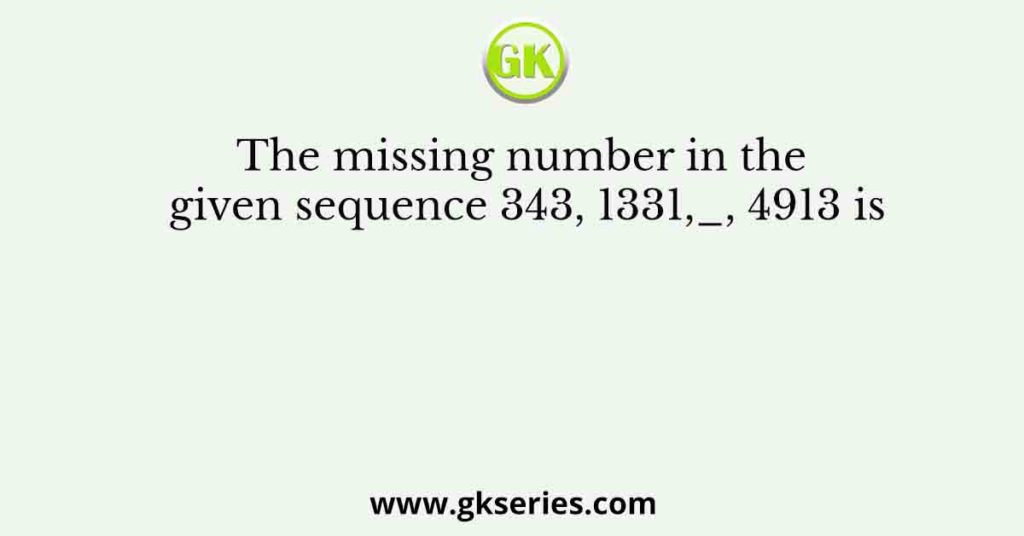

It takes two hours for a person X to mow the lawn. Y can mow the same lawn in four hours. How long (in minutes) will it take X and Y Read More »

In the circuit shown, the breakdown voltage and the maximum current of the Zener diode are 20 V and 60 mA, respectively

In the circuit shown, the breakdown voltage and the maximum current of the Zener diode are 20 V and 60 mA, respectively

Q. In the circuit shown, the breakdown voltage and the maximum current of the Zener diode are 20 V and 60 mA, respectively. The values of 𝑅1 and 𝑅𝐿 are 200 Ω and 1 kΩ, respectively. What is the range of Vi that will maintain the Zener diode in the ‘on’ state? Ans: 24 V

In the circuit shown, the breakdown voltage and the maximum current of the Zener diode are 20 V and 60 mA, respectively Read More »

Two identical copper wires W1 and W2, placed in parallel as shown in the figure, carry currents I and 2I, respectively, in opposite directions

Two identical copper wires W1 and W2, placed in parallel as shown in the figure, carry currents I and 2I, respectively, in opposite directions

Q. Two identical copper wires W1 and W2, placed in parallel as shown in the figure, carry currents I and 2I, respectively, in opposite directions. If the two wires are separated by a distance of 4r, then the magnitude of the magnetic field ⃗B→ between the wires at a distance r from W1 is Solution:

Two identical copper wires W1 and W2, placed in parallel as shown in the figure, carry currents I and 2I, respectively, in opposite directions Read More »

A single bit, equally likely to be 0 and 1, is to be sent across an additive white Gaussian noise (AWGN) channel with power spectral density 𝑁0/2.

A single bit, equally likely to be 0 and 1, is to be sent across an additive white Gaussian noise (AWGN) channel with power spectral density 𝑁0/2.

Q. A single bit, equally likely to be 0 and 1, is to be sent across an additive white Gaussian noise (AWGN) channel with power spectral density 𝑁0/2. Binary signaling, with 0 ↦ 𝑝(𝑡) and 1 ↦ 𝑞(𝑡), is used for the transmission, along with an optimal receiver that minimizes the bit-error probability. Let 𝜑1(𝑡),

A single bit, equally likely to be 0 and 1, is to be sent across an additive white Gaussian noise (AWGN) channel with power spectral density 𝑁0/2. Read More »

. In the circuit shown, if 𝑣(𝑡) = 2 sin(1000 𝑡) volts, 𝑅 = 1 kΩ and 𝐶 = 1 𝜇F, then the steady-state current 𝑖(𝑡), in milliamperes (mA), is

In the circuit shown, if 𝑣(𝑡) = 2 sin(1000 𝑡) volts, 𝑅 = 1 kΩ and 𝐶 = 1 𝜇F, then the steady-state current 𝑖(𝑡), in milliamperes (mA), is

Q. In the circuit shown, if 𝑣(𝑡) = 2 sin(1000 𝑡) volts, 𝑅 = 1 kΩ and 𝐶 = 1 𝜇F, then the steady-state current 𝑖(𝑡), in milliamperes (mA), is (A) sin(1000 𝑡) +   cos(1000 𝑡) (B) 2 sin(1000 𝑡) + 2 cos(1000 𝑡) (C) 3 sin(1000 𝑡) + cos(1000 𝑡) (D) sin(1000 𝑡) +

In the circuit shown, if 𝑣(𝑡) = 2 sin(1000 𝑡) volts, 𝑅 = 1 kΩ and 𝐶 = 1 𝜇F, then the steady-state current 𝑖(𝑡), in milliamperes (mA), is Read More »

Consider the line integral

Consider the line integral

Q. Consider the line integral ∫(𝑥𝑑𝑦 − 𝑦𝑑𝑥) 𝐶 the integral being taken in a counterclockwise direction over the closed curve 𝐶 that forms the boundary of the region 𝑅 shown in the figure below. The region 𝑅 is the area enclosed by the union of a 2 × 3 rectangle and a semi-circle of

Consider the line integral Read More »

Scroll to Top