gate questions

Gas phase bond length and dipole moment of a compound (MX) is 3 Å and 10.8 D, respectively. The ionic character in gas phase MX is

Gas phase bond length and dipole moment of a compound (MX) is 3 Å and 10.8 D, respectively. The ionic character in gas phase MX is

Q. Gas phase bond length and dipole moment of a compound (MX) is 3 Å and 10.8 D, respectively. The ionic character in gas phase MX is _________________%. (Round off to one decimal place) (1D = 3.336 × 10⁻³⁰ C m) Solution: To determine the Ionic character of a given compound, Dipole moment is necessary to […]

Gas phase bond length and dipole moment of a compound (MX) is 3 Å and 10.8 D, respectively. The ionic character in gas phase MX is Read More »

In a 400 MHz 1H NMR spectrometer, a proton resonates at 1560 Hz higher than that of tetramethylsilane. The chemical shift value of this proton

In a 400 MHz 1H NMR spectrometer, a proton resonates at 1560 Hz higher than that of tetramethylsilane. The chemical shift value of this proton

Q. In a 400 MHz 1H NMR spectrometer, a proton resonates at 1560 Hz higher than that of tetramethylsilane. The chemical shift value of this proton is___________ppm. (Round off to one decimal place) (Chemical shift of tetramethylsilane is fixed at zero ppm) Solution: The chemical shift of Nuclear Magnetic Resonance Spectroscopy is the relative resonant

In a 400 MHz 1H NMR spectrometer, a proton resonates at 1560 Hz higher than that of tetramethylsilane. The chemical shift value of this proton Read More »

Consider a system of three identical and distinguishable non-interacting particles and three available nondegenerate single particle energy levels having energies

Consider a system of three identical and distinguishable non-interacting particles and three available nondegenerate single particle energy levels having energies

Q. Consider a system of three identical and distinguishable non-interacting particles and three available nondegenerate single particle energy levels having energies 0, e and 2e. The system is in contact with a heat bath of temperature T K. A total energy of 2ɛ is shared by these three particles. The number of ways the particles

Consider a system of three identical and distinguishable non-interacting particles and three available nondegenerate single particle energy levels having energies Read More »

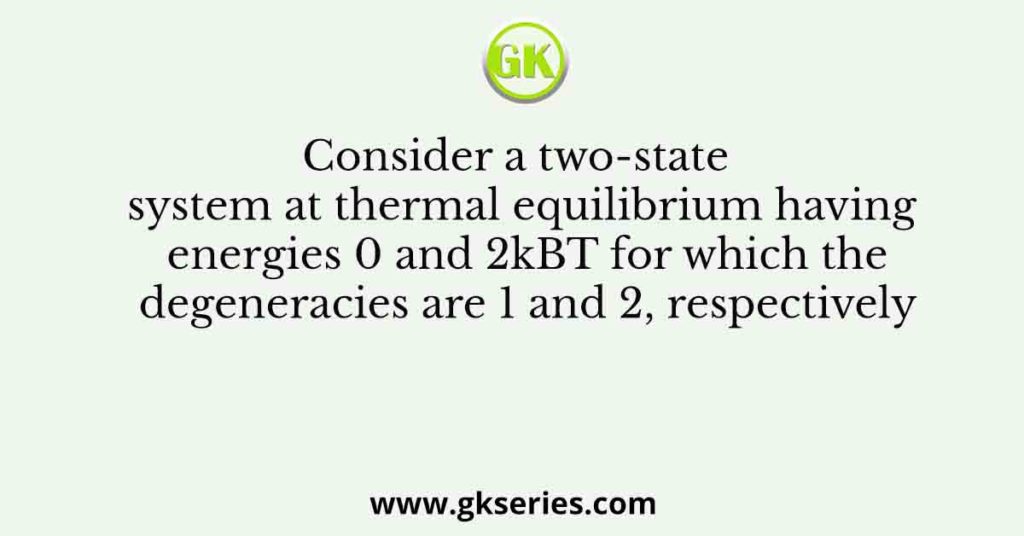
Consider a two-state system at thermal equilibrium having energies 0 and 2kBT for which the degeneracies are 1 and 2, respectively

Consider a two-state system at thermal equilibrium having energies 0 and 2kBT for which the degeneracies are 1 and 2, respectively

Q. Consider a two-state system at thermal equilibrium having energies 0 and 2kBT for which the degeneracies are 1 and 2, respectively. The value of the partition function at the same absolute temperature T is ______.  (Round off to two decimal places) (kB is the Boltzmann constant) Solution: General formula is q = Ʃ gi e-Ei / KT, For

Consider a two-state system at thermal equilibrium having energies 0 and 2kBT for which the degeneracies are 1 and 2, respectively Read More »

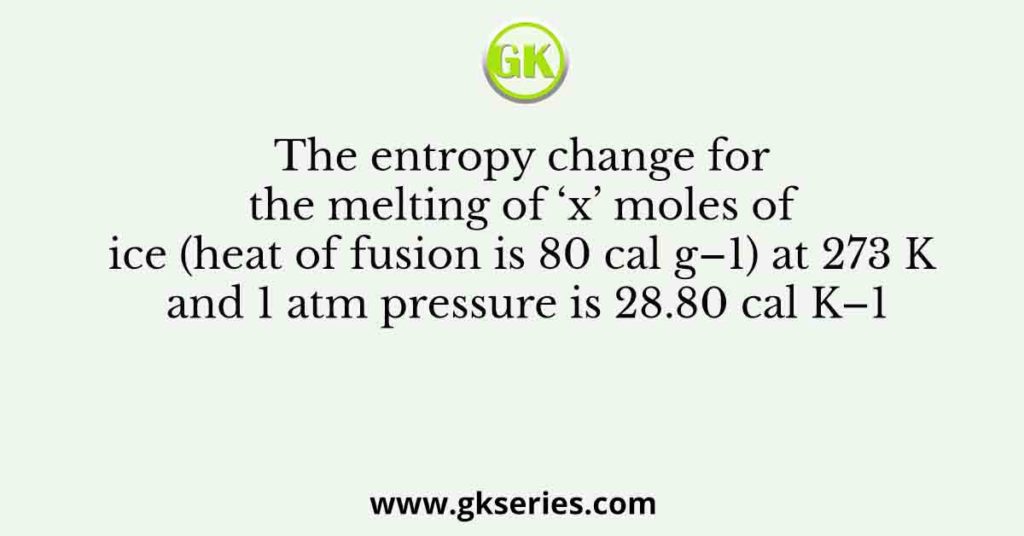
The entropy change for the melting of ‘x’ moles of ice (heat of fusion is 80 cal g–1) at 273 K and 1 atm pressure is 28.80 cal K–1

The entropy change for the melting of ‘x’ moles of ice (heat of fusion is 80 cal g–1) at 273 K and 1 atm pressure is 28.80 cal K–1

Q. The entropy change for the melting of ‘x’ moles of ice (heat of fusion is 80 cal g–1) at 273 K and 1 atm pressure is 28.80 cal K–1. The value of ‘x’ is___________. (Round off to two decimal places) (Molecular weight of water =18 g/mol) Solution: Δ S = Δ H/ T , OR  Δ

The entropy change for the melting of ‘x’ moles of ice (heat of fusion is 80 cal g–1) at 273 K and 1 atm pressure is 28.80 cal K–1 Read More »

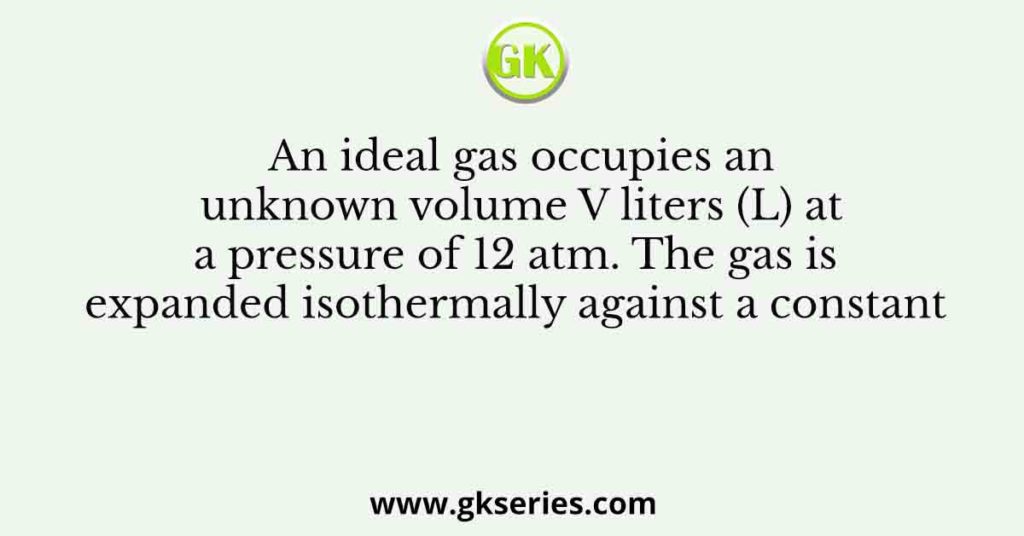
An ideal gas occupies an unknown volume V liters (L) at a pressure of 12 atm. The gas is expanded isothermally against a constant

An ideal gas occupies an unknown volume V liters (L) at a pressure of 12 atm. The gas is expanded isothermally against a constant

Q. An ideal gas occupies an unknown volume V liters (L) at a pressure of 12 atm. The gas is expanded isothermally against a constant external pressure of 2 atm so that its final volume becomes 3 L. The work involved for this expansion process is______cal. (Round off to two decimal places) (Gas constant R

An ideal gas occupies an unknown volume V liters (L) at a pressure of 12 atm. The gas is expanded isothermally against a constant Read More »

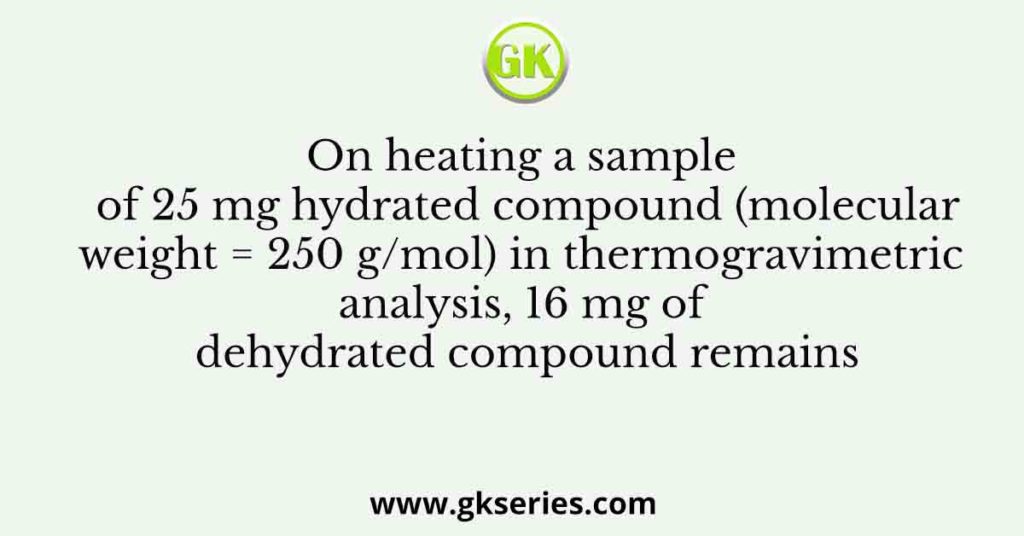
On heating a sample of 25 mg hydrated compound (molecular weight = 250 g/mol) in thermogravimetric analysis, 16 mg of dehydrated compound remains

On heating a sample of 25 mg hydrated compound (molecular weight = 250 g/mol) in thermogravimetric analysis, 16 mg of dehydrated compound remains

Q. On heating a sample of 25 mg hydrated compound (molecular weight = 250 g/mol) in thermogravimetric analysis, 16 mg of dehydrated compound remains. The number of water molecules lost per molecule of hydrated compound is                                                                             . (Molecular weight of water = 18 g/mol) Solution: 25 mg Compound contains (25-16) g of Water = 9

On heating a sample of 25 mg hydrated compound (molecular weight = 250 g/mol) in thermogravimetric analysis, 16 mg of dehydrated compound remains Read More »

The number of following diene(s) that undergo Diels-Alder reaction with methyl acrylate is

The number of following diene(s) that undergo Diels-Alder reaction with methyl acrylate is

Q. The number of following diene(s) that undergo Diels-Alder reaction with methyl acrylate is Ans: The number of following diene(s) that undergo Diels-Alder reaction with methyl acrylate is 5 Solution: Diels- Alder Reaction is a  pericyclic chemical reaction between substituted alkenes or Dienophiles and conjugated dienes.  Here, all the cis structures will undergo Diels- Alder Reaction

The number of following diene(s) that undergo Diels-Alder reaction with methyl acrylate is Read More »

Scroll to Top