

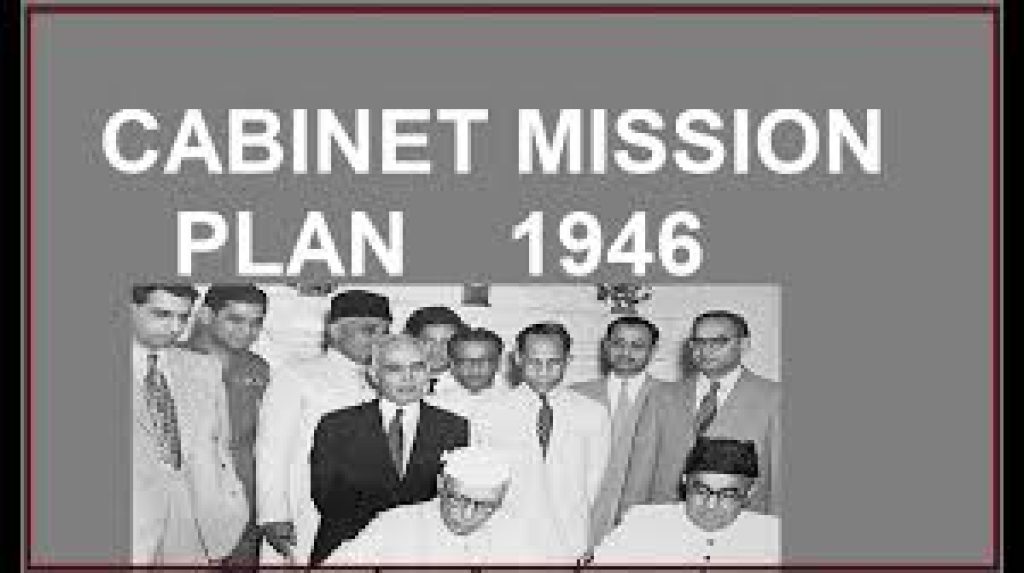
The Atlee Government (head of Britain) sent the Cabinet Mission to India in February, 1946 as a high-powered team. Pethick Lawrence, Stafford Cripps, and A.V. Alexander were the three members of the British cabinet participating in the mission. The Cabinet Mission aimed to discuss the transfer of power from British to Indian leadership.
What did the Cabinet Mission aim to do and who were the members?
Clement Atlee, who was British Prime Minister, sent a delegation to India to assist in handing over power from the British Indian government to Indian overseers.
| Cabinet Mission Members | Cabinet Mission Members – Designation |
| Pethick Lawrence | Secretary of State for India |
| Stafford Cripps | President of the Board of Trade |
| A.V. Alexander | First Lord of Admiralty |
Objectives of Cabinet Mission
- To reach an agreement with Indian leaders about how the constitution for India should be formed.
- To build an assembly whose role is to write the constitution (the Constituent Assembly of India).
- To set up an Executive Council with backing from the main political parties in India.
What reasons did the failure of the Cabinet Mission rest on?
The main reasons for the failure of the Cabinet Mission are given below:
- The Congress Party believed in giving most of the power to the centre, with only a small amount left to the provinces.
- The Muslim League required strong measures to assure that the Muslims could have equal political representation in government bodies.
- Since there were many differences in beliefs, the mission group came up with its own proposals in May 1946.
Cabinet Mission Proposals:
There would be no partition, and the Dominion of India would be allowed independence.
Provinces would be assigned to one of three groups/sections.
- Group A: The cities included were Madras, Central Provinces, UP, Bihar, Bombay and Orissa.
- Group B: Punjab, Sindh, NWFP and Baluchistan
- Group C: Bengal and Assam
- The Muslim-majority provinces were grouped into two groups and the remaining Hindu-majority in one of the groups.
- The central government at Delhi would have powers over the defence, foreign affairs, communications and currency. The rest of the powers would be vested with the provinces.
- A constituent assembly would be set up for writing a new constitution for the country. An interim government would be established until a new government was formed on the basis of the constitution written by the constituent assembly.
- The Congress leaders did not support forming groups based on whether a province was majority Hindu or majority Muslim and trying to control the central government. Similarly, it challenged the idea of having a weak federal government. The Muslim League wished to keep everything in the proposals unchanged.
- Because the first plan was not chosen, a new plan was introduced by the mission in June 1946. The plan mentioned dividing India between a Hindu-dominated India and a Muslim-dominated India that would be renamed Pakistan. A list of princely states was also created, and they were allowed to decide if they would become part of the union or remain on their own.
- Under Nehru’s leadership, the Congress Party refused to support the second plan. However, it chose to participate in the constituent assembly.
- The Viceroy chose 14 men to act as the interim government. The Congress sent 5 members, the League also sent 5, and another 1 member represented the Sikh, Parsee, Indian Christian, and scheduled caste communities.
- Both the League and the Congress were allowed to pick 5 members for the Viceroy’s interim council. Zakir Hussain was chosen by Congress for the Legislative Assembly, but the League responded by claiming it was the sole representative for Indian Muslims and no one else had that right. The party called the Muslim League did not participate in the election.
- Nehru headed the interim government because Congress leaders joined the viceroy’s interim council. It was the new government’s task to organize and write a constitution for the country.
- The region called the NWFP was included among the provinces where Congress-led governments emerged. The League took control of the governments in Bengal and Sind.
- Jinnah and the League opposed the formation of the new central government. He set out to demand Pakistan and convinced Muslims to make their request in any way they could. On 16 August 1946, he decided to organize ‘Direct Action Day’.
- This call led to widespread communal rioting in the country with thousands of people being killed on the first day in Calcutta. Communal riots spread to many other areas notably Noakhali and Bihar.
- There was a call for the partitioning of the country on account of the riots. Sardar Vallabhbhai Patel was one of the first Congress leaders to acknowledge the inevitability of the partition as a means to stop the brutal violence.