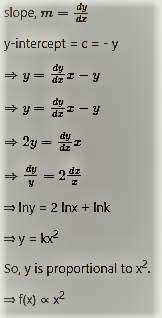
Q. The curve y = f (x) is such that the tangent to the curve at every point (𝑥, 𝑦) has a 𝑌-axis intercept 𝑐, given by 𝑐 = −𝑦. Then, f (x) is proportional to
(A) x–1
(B) x2
(C) x3
(D) x4
Ans: x2
Sol:
Let the equation of tangent is,
y = mx + c

Q. The curve y = f (x) is such that the tangent to the curve at every point (𝑥, 𝑦) has a 𝑌-axis intercept 𝑐, given by 𝑐 = −𝑦. Then, f (x) is proportional to
(A) x–1
(B) x2
(C) x3
(D) x4
Ans: x2
Sol:
Let the equation of tangent is,
y = mx + c