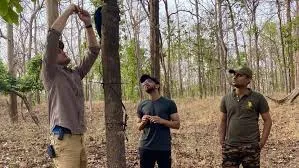
Artificial Intelligence (AI) has made a significant impact on wildlife conservation, particularly in enhancing anti-poaching strategies and leading to a considerable decline in poaching incidents. A key innovation in this field is TrailGuard AI, an advanced surveillance system that aims to detect and prevent poaching activities. A prime example of its successful deployment is the Similipal Tiger Reserve in Odisha, where officials have reported a notable improvement in wildlife protection and conservation efforts. This article discusses the significance of the Similipal Tiger Reserve, the function of TrailGuard AI in combating poaching, its operational methods, community effects, and future possibilities.
Similipal Tiger Reserve: A Biodiversity Hotspot
Location & Geography
Located in the Mayurbhanj District of Odisha, the Similipal Tiger Reserve is in the northernmost part of the state. It covers a large area of 2,750 square kilometers, ranking it among India’s largest tiger reserves.
- The reserve is famous for itspicturesque waterfalls, includingJoranda and Barehipani.
- It forms a critical part of theMayurbhanj Elephant Reserve, which also includesHadgarh and Kuldiha Wildlife Sanctuaries.
- The landscape ishilly and undulating, featuringgrasslands and dense forests.
- It is surrounded byhigh plateaus and rolling hills, with its highest peaks beingKhairiburu and Meghashini, standing at1,515 meters above sea level.
TrailGuard AI: A Game-Changer in Anti-Poaching
What is TrailGuard AI?
TrailGuard AI is an advanced surveillance system that uses artificial intelligence to help prevent poaching and other illegal activities in protected wildlife areas. It features 100 to 150 AI-enabled cameras that are strategically positioned throughout the reserve.
How Does TrailGuard AI Work?
TrailGuard AI employs an advancedimage recognition systemto detect poachers and unauthorized movement within the reserve.
Motion Detection & Image Capture
- The cameras operate onlow-power modeto conserve energy.
- When movement is detected, they switch tohigh-power modeand capturehigh-resolution images.
AI-Based Image Analysis
- The system usesAI inference modelsto classify detected objects ashumans, animals, or vehicles.
- Suspicious activity triggers an instant alertto the control room.
Real-Time Threat Response
- The identified images are transmitted to thecontrol center within 30-40 seconds.
- Forest officials receive real-time updates, enabling them to take swift action.