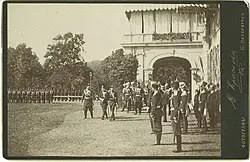
The Union of the Three Emperors, informally known as the Dreikaiserbund, was a loose agreement between Germany, Austria-Hungary, and Russia from 1873 until 1887 that sought to keep the peace in Europe and safeguard stability by keeping a possible anti-German alliance by Austria-Hungary, France, and Russia at bay.
Key Points:
- Formation:
This loose agreement was initiated by German Chancellor Otto von Bismarck in 1873 - Intent:
Bismarck sought to neutralize the conflict of interests between the Austro-Hungarian and Russian empires over the Balkans and to isolate France. - Initial Success:
The agreement helped to maintain peace and stability in Europe. - Increased Tensions and Dissolution:
Dissatisfaction over the agreement grew, especially concerning issues regarding the Balkans and the results of the Russo-Turkish War of 1877-78 and Berlin Congress which only worsened tensions between the empires. - Reinsurance Treaty:
In 1887, Bismarck attempted to save the agreement by signing a secret Reinsurance Treaty with Russia, which was never renewed after his dismissal in 1890 by Kaiser Wilhelm II. - Legacy:
The decline of the Dreikaiserbund provided the possibility for the creation of the Triple Alliance and the Dual Alliance redefining the complexity of the European power structure.
Key Stages:
- First Arrangement (1873) – An informal agreement commonly referred to as “the League of the Three Emperors” (Dreikaiserabkommen), which established mutual cooperation and non-interference in each other’s affairs.
- Second Arrangement (1881) – In a formal treaty:
o Powers agreed to remain neutral towards each other in the event of a conflict with a fourth power (not in the case of war with the Ottoman Empire).
o Special provisions were devised to address the Balkans, a continual area of contention between Austria-Hungary and Russia. - Dissolution (1887) – The arrangement broke down as:
o Tensions started to escalate between Austria-Hungary and Russia over control in the Balkans with the advent of the Bulgarian Crisis.
o Mutual distrust blossomed into animosity between Russia and Austria-Hungary, where Germany was unable to mediate.